DP leader vows to break factions
By Jun Ji-hye
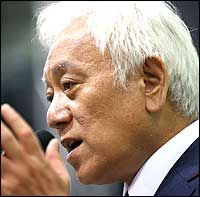
Rep. Kim Han-gil, the new chairman of the Democratic Party, speaks at a press conference after his victory was confirmed in the party’s national convention at KINTEX in Goyang, Gyeonggi Province, Saturday. Yonhap
Rep. Kim Han-gil was elected the new leader of the Democratic Party, previously known as the Democratic United Party, at its national convention, Saturday. Kim gained support of 61.72 percent against his opponent Rep. Lee Yong-sups 38.28 percent.
Along with Kim, Reps. Shin Kyoung-min, Cho Kyoung-tae, Yang Seoung-jo and Woo Won-shik were selected as supreme council members.
The convention also approved changing the partys name back to the Democratic Party, its original title before putting United in its name in December 2011.
"From now on, we have to proceed toward changes and innovation to survive in the political landscape. We face the difficult task of overcoming internal conflict and antagonism," Kim said in his acceptance speech.
Above all, the forth-term lawmaker pledged to clean up the factional politics that have caused a party feud between followers of the late President Roh Moo-hyun and others.
"I will also refrain from populism and ideologism to create the new and bigger Democratic Party. To ensure this end, I will carry out personnel appointments regardless of their background and actively discover new talents," he said, adding that he will devote himself to achieving party democracy.
Kim is now faced with the significant challenge of rebuilding the main opposition party that has lost its influence since last years presidential election.
Even after his victory, Kim is expected to have a bumpy road ahead after factional conflicts reached a boiling point during the election campaign.
Lee and Rep. Kang Gi-jung, who appeared as pro-Roh figures, formed a united candidate on April 25 in a bid to beat Kim, who was regarded as the leader of non-Roh followers.
A few days before the convention, Lee and pro-Roh members criticized Kim saying he had committed illegal campaigning, which Kim dismissed as "groundless maligning."
Moon Sung-geun, a noted Roh follower who previously served as acting leader, declared Friday he was leaving the party after complaints that pro-Roh factions were to blame for the partys presidential poll defeat.
Given that no pro-Roh figures or anyone from the Honam region, which refers to Gwangju and both South and North Jeolla provinces, the partys typical home turf, were elected as party chairman or supreme council members, Kims further personnel appointments will likely be a key factor in achieving party harmony.
How he establishes a relationship with independent lawmaker Ahn Cheol-soo is another key task as Ahn has been a lingering threat to the party since his entry into the National Assembly last month.
In a recent survey conducted on April 28 by the Korea Society Opinion Institute, a hypothetical new party led by Ahn earned a higher approval rating of 30.9 percent than the actual leading opposition party, which only scored 15.4 percent.
Regarding this, Kim said: "If the opposition side needs to be realigned, I will put the Democratic Party in the center of it."
The new leader also proposed President Park Geun-hye form a consultative group in which she would meet heads of the ruling and opposition parties regularly to discuss pending issues related to peoples livelihood.
Park delivered a congratulatory message to Kim via phone, Sunday, according to the DP.