Is diversity ignored in multiethnic education?
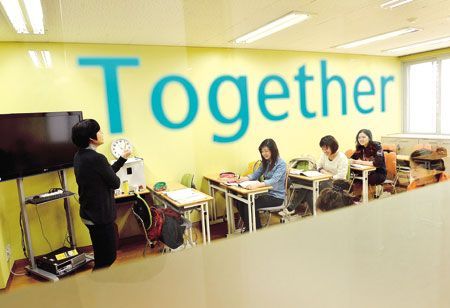
Kim Jung-hee, left, a Korean language instructor, teaches foreigners at Hana Multicultural Center Darin in Samseon, northern Seoul. / Korea Times photo by Shim Hyun-chul
Support centers need to focus more on cultural exchanges
By Chung Ah-young
On a bleak grey street in the Guro industrial district in western Seoul, home to the second-largest population of foreigners in the capital after Yeongdeungpo, a multicultural family support center is nestled on the third floor of a small residential building.
Sukyoung Yep, 32, from Qingdao, China, enrolled in the center in 2010 and now works as a Chinese interpreter for newcomers.
“Before I came to Korea, I had a little knowledge about the country. So I naively felt that I could successfully adjust to Korean society. But the reality was different. I confronted a lot of cultural differences,” she said.
When she learned about the center, she attended Korean language and cultural classes there and now helps other foreign wives. “The center’s cultural and language programs were really helpful to me. We not only learned Korean culture but also shared our native cultures with each other. So now I am working here,” she said.
However, many foreign wives from low-income families cannot afford to go to the centers as they are busy taking care of their children or working. Although the centers provide home education services, there are no special programs for poor multiethnic families.
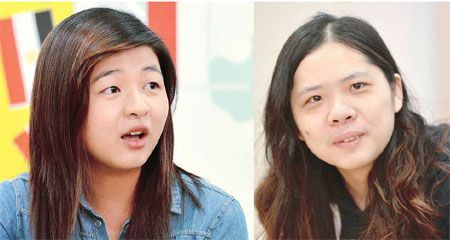
Nguyen Thi Linh Kieu, left, a Vietnamese bride, learns the Korean language at Hana Multicultural Center Darin. Li Wan Chiung, a Taiwanese student, learns Korean at the center to become a chef of Korean cuisine. / Korea Times photo by Shim Hyun-chul
“We don’t have special programs tailored for low-income multicultural families yet. But we are considering supporting multicultural families in accordance with their incomes in the near future,” Kang Sun-hye, a official at the Ministry of Gender Equality and Family, said.
Many foreign students and workers complain the centers focus too much on multicultural families instead of them.
Li Wan Chiung, 28, is a Taiwanese student who came to Korea last October to learn Korean cooking. Hana Multicultural Center Darin is one of the few options for her to learn the Korean language.
“I am here to study the Korean language before starting cooking courses. But there are not many centers open to foreign students,” she said.
Shin Hye-young, the team leader of Darin, said that unlike the government-led centers devoted exclusively to multicultural families, Darin is open to everyone, with foreigners from China, Vietnam, Mongolia, Uzbekistan and Taiwan attending the center.
“We are accepting anybody who is interested in cultural exchanges,” she said. While the government centers focus on helping foreigners adjust to Korean society, Darin focuses on encouraging them to mingle with others to promote cultural exchange. “I don’t think separating foreign wives from other kinds of foreigners in multicultural centers is a good idea because it can block them from sharing cultural diversity with others,” she said.
The Seoul Metropolitan Government operates Global Village Centers in seven districts, including Yeonnam, Yeoksam, Seorae, Ichon, Itaewon, Seongbuk and Yeongdeungpo, where a large number of foreign residents live. They have similar education programs to the ministry-run centers, but provide more administrative services.
Park Lae-chan, manager of the Global Village Center in Yeongdeungpo, said it is planning to integrate services for foreign wives and workers in the district, which are now separated in different centers.
“We are first attempting to combine the overlapped functions and provide one-stop services,” he said. The new center will be launched around the turn of the year and save 300 million won a year in expenses.
NGOs’ role still crucial
Lee Joo-young, an official at the Purun Citizen Community in Imun in northeastern Seoul, started helping migrant workers in 1998 and foreign wives in 2003, when government programs for foreigners were still rare.
“The civic groups supported foreign wives and migrant workers long before the government paid attention to them. Now the government seems to take over some of our activities. But our role is different from what the government does. They focus on helping foreigners settle in when they arrive, while we now concentrate on making foreigners fully integrated and active citizens, not dependent on social welfare,” she said.
Foreign wives are encouraged to engage in community activities focusing on cultural exchanges. “We approach them on equal terms. So our program focuses on exchanges. We regard them as members of the organization, not just students. We are helping them learn through cultural exchanges,” she said.
The organization opened a multicultural library in 2008 for community support activities. An annual multicultural festival is also organized to introduce the spouses’ own cultures to Koreans.
Currently 300 foreign wives are enrolled in the organization and some 50 regularly attend its language and cultural programs.
Heo Young-sook, chief director of the Women Migrants’ Human Rights Center, said the quality and quantity of the government-led programs have dramatically improved due to increased spending. “The difference between the government programs and civic groups is not that big. The one thing that the civic groups provide is filling the gaps that the government misses, such as human rights issues,” she said.
Minority languages
Although some newspapers and broadcasters offer foreign language services, they are mostly targeted at “Korean wave” fans abroad rather than foreign minorities living in Korea.
Major newspapers such as Chosun Ilbo, Dong-A Ilbo and JoongAng Ilbo provide Chinese, English and Japanese language services.
KBS, the state-run broadcaster, offers programs in Arabic, Chinese, English, French, German, Russian, Indonesian, Vietnamese, Japanese and Spanish, while SBS and MBC have Japanese, Chinese and English-language services.
For newcomers who are not fluent in Korean, the Ministry of Gender Equality and Family provides Tagalog, Vietnamese, Cambodian, Russian, Mongolian, Chinese and English at its Danuri website (www.liveinkorea.kr) which provides information on Korean culture and support services.