Migrant wives struggle to survive violence

Activists for marriage migrants are in a rally advocating the rights of female migrants who are often the subject of domestic violence, which sometimes lead to death, in Seoul last year. / Korea Times file
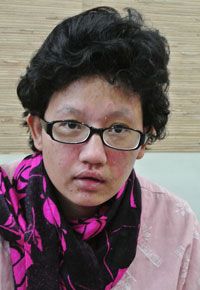
Laxmi Tamang
By Kim Se-jeong
The life of Laxmi Tamang, 29, has gone through two dramatic changes in less than a year.
Tamang came to Korea last August from Nepal to join her 61-old Korean husband. Driven by economic pressures, she agreed to marry a man about twice her age.
She planned to remit money to her family in Nepal after settling in Korea.
As expected, she got a job at a meat factory in Incheon, where the couple settled. She received her first month’s pay, which she happily wired to her family.
However, Tamang’s husband was allegedly beating her, culminating in a life-altering assault in December.
She had returned from work tired and drunk one evening to the fury of her husband, who ruthlessly beat her.
According to Tamang’s account, she could not move when she woke in the morning. Her husband had already departed for work.
She managed to ring a Nepalese friend for help and the police were called. She had been taken to hospital by the time the police arrived and her husband was taken for questioning.
“I couldn’t really see or move,” Tamang told The Korea Times from the hospital in Incheon where she is being treated.
Her doctor said she suffered a stroke as a result of the assault, leaving her permanently paralyzed on the left side of her body.
She has not seen her husband since she was admitted to hospital.
“I don’t want him here. I don’t want to see him again,” she said looking down at her paralyzed left arm. She now walks with crutches.
Tamang’s hospital bills are being covered by health insurance and she is getting assistance from Shelter for Migrant Women, a local civic group. She is seeking compensation from her husband so she can return to her native country.
Tamang’s story is one of many domestic violence cases involving foreign brides.
The worse case was the murder of a Vietnamese bride in 2010, less than a month after her arrival in Korea. She had been unaware that husband suffered mental illness.
Experts and advocates say domestic violence is commonplace, but hard to track.
According to the Women Migrants’ Human Rights Center which also runs an assistance program, the official figure for women seeking counseling for domestic violence was only 8 percent of the total inquiries it received in March.
They say 30 percent of callers sought help to divorce. Telephone calls were the main means of communication, accounting for almost 80 percent.
Some countries are already aware of the ugly reputation of Korean husbands of foreign spouses. In 2010, the government of Cambodia placed a temporary ban on its citizens marrying Korean men for that reason.
The trend of marriage related migration is on the rise here, in what was once considered a homogenous society.
Korean society, however, lacks adequate support systems for foreign wives, such as simple language lessons and social integration training.
The International Organization for Migration cited marriage migrants as the latest migration trend in Korea. According to IOM statistics, females accounted for more than 52 percent of immigrants to Korea in 2010, and remittances to their home countries hovered around $9 billion in 2011 alone.
Tamang is one of 1,500 Nepalese marriage migrants in South Korea. According to the Korea Immigration Service, almost 145,000 marriage migrants entered Korea in 2012, of which almost 20,000 were male.
About 65,000 of those are Chinese, leading the nationality of marriage migrants, followed by 37,000 Vietnamese, 11,000 Japanese and 8,300 Filipinos.
In the case of Tamang, this was not her first experience of battering.
“This is the sixth time he has hit her,” one of her Nepalese friends told The Korea Times.
Declining to give her name, the friend said she took pictures of Tamang’s injuries the last time it happened, and presented them to the police.
Tamang is unhappy with the service provided by Shelter for Migrant Women.
The organization offers basic help by providing her with such things as toiletries she needs for her hospital stay, but does little to help defend her rights.
A consul at the Nepalese Embassy in Seoul familiar with the case doubts the capacity of Shelter for Migrant Women to provide legal support.
Almost four months after the incident, Tamang still doesn’t have a lawyer.
The group declined to comment about the specifics of the case, arguing that sharing Tamang’s story with the media would only do her further damage.
Self-help
Kim Joon-sik, chairman of Asian Friends, a civic organization that helps migrants in Korea, said women are increasingly forming self-help groups to address their concerns.
“Women themselves get together to educate themselves and share information,” Kim said. By his organization’s estimate, almost 500 groups have sprung up across the country. Asian Friends assists them with training sessions.
“It is encouraging that the women themselves are trying to protect themselves.”