What's next NK step for Gaeseong complex?
By Kim Tae-gyu
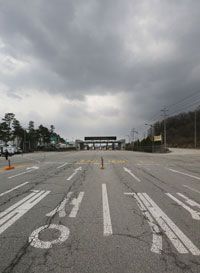
Dark clouds cover the skyline at the transit office in Paju, Gyeonggi Province, Wednesday — the second day of suspended operations at the inter-Korean Gaeseong Industrial Complex in the border city. / Yonhap
As the inter-Korean joint industrial park in Gaeseong stopped operations this week after North Korea pulled all its workers from there, concerns are rising the belligerent regime might freeze or confiscate South Korean assets.
When announcing the tentative closure Monday, Pyongyang said it plans to decide later whether to shutter the zone for good. Watchers do not think the threats are just hyperbole in consideration of its track record.
The isolated regime seized assets of South Korean firms at the Mt. Geumgang tourist zone in 2011. Southern outfits had channeled more than 750 billion won ($658.1 million) to the project.
“Many come up with optimistic expectations that the North would not shut down the Gaeseong park forever since it is a dollar earner for the cash-stripped North,” said a Seoul analyst who asked not to be named.
“Yet, worries prevail that the isolated regime may opt for the extreme measure of closing it permanently. In that case, it is feared it will freeze or seize assets of the South Korean firms, as it did years ago at Mt. Geumgang.”
The Gaeseong zone accommodates 123 South Korean corporations, mostly home appliance manufacturers, which combine to hire about 53,000 North Korean workers. Pyongyang earns around $90 million there a year.
Hyundai Asan in Seoul spent up to 600 billion won to get the license to develop the industrial complex and construct infrastructure including roads and buildings in the border town just north of the heavily-fortified Demilitarized Zone (DMZ).
Permanent closure would be a second large setback for Hyundai Asan, which also took the lead on Mt. Geumgang tourism programs. It began cruise ship services for South Koreans to the scenic area in 1998 when the progressive Kim Dae-jung administration came to power.
The land route to the enclave was opened in 2003 to carry tourists en masse on coaches. A total of 1.95 million South Koreans visited Mt. Geumgang in a decade.
The tours stopped in 2008 after a female South Korean tourist was shot dead at the resort by a North Korean guard.
As the programs continue to hit a snag after talks between the two Koreas kept faltering, the North made a special law in 2011 to confiscate the assets owned by South Korean companies, including Hyundai Asan.
The damage estimates vary. Net investments were around 350 billion won but some claim the losses caused by the North’s step amounted to 2 trillion won if lost opportunities were included.
Thereafter, Pyongyang made efforts to entice tourists from other countries, such as China, one of its few benefactors.