Two Asiatic black bears give birth
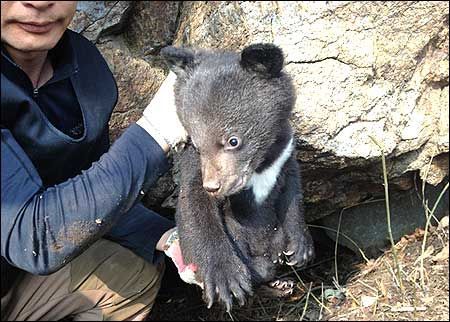
A 10-week-old male cub is shown at Mt. Jiri, Sunday. The Korea National Park Service said that two Asiatic black bears gave birth to one cub, respectively, in January, showing that they can reproduce stably in the wild. Courtesy of KNPS
By Kim Jae-won
Two Asiatic black bears gave birth in January, showing that they are reproducing stably on Mt. Jiri, the national park agency said Sunday.
The Korea National Park Service (KNPS) said it found out earlier this month that a six-year-old Asiatic black bear tagged RF-25 gave birth to a healthy five-kilogram male cub. Another bear with the I.D. RF-27 also gave birth to a cub, but its sex has not yet been confirmed due to difficulty in accessing the birth den, according to the agency.
The environment ministry, which supervises the KNPS, welcomed the news and said it means Korea has come one step closer to having bears’ naturally reproducing.
“If the number of bears reach 50, we assume that they can reproduce by themselves. With the two little cubs, we have come closer to that goal,” said Baek Gyu-seok, a director general of the Ministry of Environment.
One female bear, RF-18, died recently due to respiratory problems, the park agency said. It added an official found the bear dead during hibernation while replacing her identification card.
With the two births and one death, the number of bears is now 27. All of them live on Mt. Jiri, in the southern part of the country.
Baek said that the ministry will also make efforts to reproduce other rare species, including foxes.