Lee says Korea's future hinges on reunification
By Kim Tae-gyu
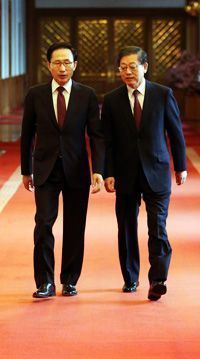
Outgoing President Lee Myung-bak, left, walks with Prime Minister Kim Hwang-sik to preside over the last Cabinet meeting of the current administration in Cheong Wa Dae, Tuesday. / Yonhap
President Lee Myung-bak, set to hand over the presidency to Park Geun-hye, said Monday that South Korea's future “hinges ultimately on unification.”
In his farewell speech, Lee said the South should be prepared for this. “The era of unification is not far away. We must prepare for unification. Of course it should be based on firmer national security.”
However, Lee called on the Stalinist state to realize that neither nuclear power nor missiles can protect it.
With regard to policies pertaining to North Korea, Lee said that his administration made significant changes, contrary to a broad consensus that Inter-Korean relations entered their worst stalemate over the past half decade.
“I did not use the issue of inter-Korea relations as leverage in domestic politics, nor did I provide one-way support unless actual change was observed. I made it clear that provocations would unquestionably be met with proportional responsive measures,” he said.
“I am confident that the continued and consistent pursuit of principle-based North Korea policies rooted in a solid alliance with the United States and cooperation with key nations such as China will secure a new turning point in inter-Korean relations.”
Lee said he wants to leave judgment on the successes and shortcomings of his administration over the past five years to history.
Lee expressed regret that "various matters around me caused the Korean people such concern," apparently referring to a series of corruption scandals involving close aides and confidants, though he said he tried to make his government "free of moral fault."
Despite outright criticism, Lee is still proud of much of what he did including the controversial four-river refurbishment project that cost tens of billions of taxpayers’ money.
Lee said that many expert groups overseas are praising the venture that included the nation’s four major rivers, the Han, Geum, Nakdong and Yeongsan.
“The OECD singled out the project as a successful example of comprehensive water resources management. The UNEP (United Nations Environment Programme) gave it a high evaluation, noting that it was a realization of green economy through the restoration of river routes,” he said.
“The project’s success also paved the way for Korean companies to take part in a water management project in Thailand.”
He added that it is necessary to continue efforts to carry on the purpose of the scheme, which he said was launched to deal with water shortages as well as large-scale floods and drought caused by climate change.
His remarks are in stark contrast to those of critics, who made vocal objections from the very beginning. Even the Board of Audit and Inspection concluded last month that the program was full of problems due to inefficient refurbishment plans, which it expected will lead to extra maintenance expenses down the road.
Lee also wished Park the best.
"I send warm blessings to President-elect Park Geun-hye and the new administration. I am confident that they will lead the way toward realizing a greater Korea and a happier Korean people," he said.