Kim Jong-un shows off image of strong leader
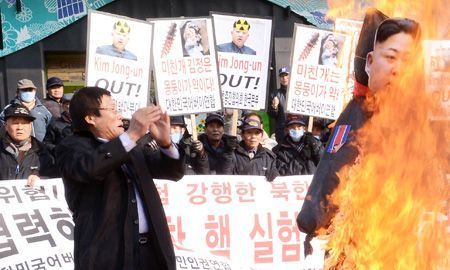
Members of conservative activist groups protest in downtown Seoul, Wednesday, burning a picture of North Korean leader Kim Jong-un. The North conducted its third nuclear test Tuesday, drawing condemnation from the South and the international community. / Korea Times photo by Cho Young-ho
By Jun Ji-hye
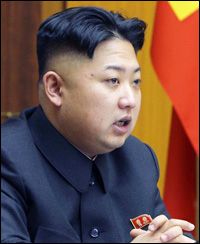
Kim Jong-un North Korean leader
Young North Korean leader Kim Jong-un gave the go ahead for his country’s long-threatened third nuclear test, in the usual show of brinkmanship intended to give the image of a strong state, experts said Wednesday. In addition, they noted the test was intended to cement a leadership succession over three generations
Achieving “greatness of the state” by launching a rocket and conducting a nuclear test was supposedly late leader Kim Jong-il’s dying injunction.
The latest test, conducted four days ahead the former leader’s birthday, was to pressure the United States as well as showing off its independence to China, according to the experts.
“The biggest aim was to elevate the level of its technology to develop nuclear weapons by miniaturizing and reducing the weight of the device. For Kim, it is a measure to preserve the North’s system and his leadership,” said Park Young-ho, an analyst at the Korea Institute for National Unification.
Park explained that this test was related to the Dec. 12 long-range rocket launch in line with its long-term goal to have the capacity of shrinking nuclear weapons to fit inside missile warheads.
“Kim might have wanted to show North Korean citizens and its military that he is a qualified leader, although he is young, who is able to push forward the nuclear development in pursuance of his father’s will,” Park said.
He added, under the North’s “military first” policy, fourth and fifth tests would follow to be used to raise peoples’ self-esteem.
The analyst said this test was also to pressure Washington into bilateral negotiations.
“Talks would be about replacing the cease-fire agreement that concluded the 1950-1953 Korean War with a peace treaty, dissolving the United Nations Command (UNC) and withdrawing U.S. forces in Korea,” Park said.
As for China, Kim was determined to display his country’s independence in develop a military strategy of its own, although the Stalinist state is reliant on Beijing for food and oil, Park said.
“Pyongyang is well aware that China cannot give up the North card in foreign affairs dealings with the U.S. or South Korea. That is why Kim pushed ahead with the test despite his economic dependence on China.”
In addition, Kim might have intended to cause a stir in Seoul ahead of President-elect Park Geun-hye’s inauguration as a tactic to strengthen its bargaining power in possible negotiations over various aid programs with the South, Park said.