`Seoul should stick to Washington'
By Jane Han
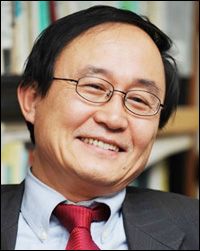
NEW YORK — With China growing in strength, some say that it is time for Korea to shift away from the United States, and get closer to the Middle Kingdom.
Their argument is gaining traction with Park Geun-hye taking over as president. Park may more than ever before come under pressure to pick one over the other in foreign policy challenges.
Not so fast, says a renowned expert of Korea-U.S. relations.
Korea should be cautious in making a distinction between being independent and autonomous in its relationship with the United States, according to Ha Yong-chool, a professor of political science at the University of Washington.
“Independent refers to a lack of dependence in both structural (security alliance) and policy terms. Autonomous refers to increasing leverage and room for active policy-making,” he said in an interview with The Korea Times.
Based on this distinction, he said Seoul is still dependent on Washington in security areas although it is getting more autonomy and eventually will become independent.
“South Korea is undergoing a sort of transition from past dependency to independence in the future,” said Ha, stressing either reckless or premature independent behavior will cause unnecessary friction and misunderstanding as witnessed in the past.
This delicate stage of Korea-U.S. relations requires prudent strategic thinking, he said, pointing out that the U.S. is an important security ally for South Korea, but they may not share the same perspectives on international and regional issues.
“Especially with the rise of China, South Korea should not be hasty in taking sides too prematurely,” Ha said. “All the countries involved are going through a learning process in terms of how to cope with the rise of China. South Korea should do the same thing without taking a premature strategic position.”
Ha, who spent 21 years teaching international relations at Seoul National University before heading to the U.S., says it is understandable that many of the younger generation in Korea believe the country should take a step away from the U.S. and take more charge in foreign policy, particularly in addressing North Korea.
“However, they should understand the complex interplays between international and domestic factors in setting up a peace process on the peninsula,” he said.
As much as South Korea wants to “Koreanize” Korean problems, Ha added, losing balance between the two forces would only complicate the situation.
“Being overly nationalistic or ambitious is not a panacea in solving complex international and regional problems,” he said. “A true sense of confidence lies in cool-headed thinking about complex history and problems related to the peninsula.”
Inter-Korean relations and North Korean nuclear issues are the two most important tasks that President-elect Park must tackle in the next five years, according to Ha, who urged that the incoming administration to stay away from “showy diplomacy.”
He took former president Roh Tae-woo’s Northern Policy and Kim Young-sam’s Globalization Policy dubbed “segyehwa” as examples of showy diplomacy pushed by past governments.
“Roh’s policy was historic in opening up relations with socialist countries,” said Ha, “but the problem is that it had too high an expectation from the Soviet Union’s influence on North Korea, which led it take a more or less pressuring policy upon Pyeongyang.”
He said all these are understandable in that they are the expressions which demand fresh recognition of South Korea. But if foreign policies are formulated based on sheer domestic needs and overconfidence, they are bound to fail and bring about some negative consequences.
When it comes to Northeast Asian relations, Ha says now is a good time for new thinking as all the major countries in the region have new leaders.
“In general, there exists a pervasive pessimism about the future of the region, what I called academic pessimism in the academic community,” he explained, “but it is only good leadership that can prove the pessimism is wrong.”
South Korea, Ha believes, should play as a hub of intellectual discussion by going beyond being a country which has mainly been focused on short-term economic interests.
Furthermore, the country’s economic and defense policies should be parallel in the future.
“In this day and age, security is not simply about hardware and military issues,” he said, adding that economic security has become an important pillar of national security.
This is particularly important for Korea given its high level of vulnerability to outside fluctuations.
“Attention to day-to-day survival tends to generate short-term based perspectives without considering long-term consequences for security,” Ha said. “Of course, this is not unique to South Korea, but given the dynamic nature of the region, there is an extra reason for the country to be concerned with interactive aspects between the economy and security.”