Repatriation of Chinese test Seoul-Tokyo ties
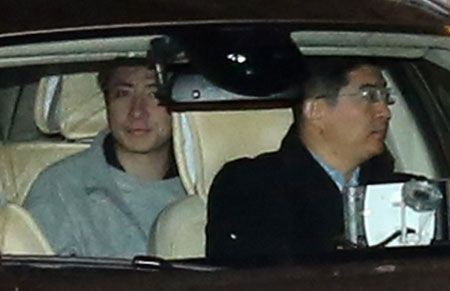
Liu Qiang, a Chinese man accused of setting a fire at the Yasukuni Shrine in Tokyo in 2011, sits in a car taking him to an airport for repatriation after the Seoul High Court rejected Japan’s extradition request, Thursday. / Yonhap
By Chung Min-uck
Liu Qiang, a 39-year-old Chinese, who has been accused of setting fire to the Yasukuni Shrine in Tokyo in 2011, was sent back to China, Friday, despite a Japanese request for extradition.
The move followed a court ruling a day earlier, which said the crime was of a “political” nature, not an ordinary crime.
Analysts say Seoul-Tokyo ties will be put to the test at a sensitive time when both nations are seeking to overcome historical animosity in the wake of leadership changes.
A special envoy, sent by Japan’s newly-elected Prime Minister Shinzo Abe to President-elect Park Geun-hye, expressed regrets over Seoul’s rejection to hand over Liu, during a meeting with Foreign Minister Kim Sung-hwan.
Abe also said the decision was “unfortunate” and that he wishes to “express a strong objection.”
“Abe said he would strongly condemn the repatriation of Liu and thus the bilateral relationship is likely to be affected by the incident,” said Yuji Hosaka, a professor at Sejong University in Seoul. “However, from a legal basis, Japan can neither protest nor push for extradition. There is nothing wrong with the Seoul court’s ruling.”
Japan had been requesting Korea to hand over Liu based on the two countries’ treaty on the extradition of criminal offenders. China, in contrast, urged the return of Liu deeming his act a political crime.
The bilateral treaty excludes political crimes.
Seoul High Court rejected Tokyo’s request concluding that Liu’s attack on the shrine was for a “political” cause, reasoning his crime “appears to have stemmed from his rage at the Japanese government’s stance and policies on comfort women and other historical issues.”
Liu served 10 months in jail here, prior to the ruling, for setting a fire at Japan’s embassy in January last year. The incident followed the arson attack on the Yasukuni Shrine in December 2011.
The shrine honors Japanese war dead including top war criminals and many see it as having the status of a political symbol of Japan’s wartime aggression.
He said he had committed the crimes because he was “angry against the Japanese government’s attitude of neither taking responsibility nor offering apologies” for its wartime atrocities inflicted on other nations.
Liu’s maternal grandmother was a Korean comfort woman during World War II, and his grandfather was an activist who took part in the anti-Japanese movement during the time.
Experts speculate Japan will, at least for now, avoid facing a conflict over its history with surrounding nations due to domestic concerns.
“Practically, the Abe administration would not want the issue to escalate into diplomatic disputes as it seeks to mend ties with both Korea and China for economic gains,” Hosaka said. “I believe Japan will be the one trying to scale down the problem.”
Abe’s Liberal Democratic Party (LDP) is bracing for an upper house elections in July and wants to revive Japan’s plunging economy before the elections take place.
The LDP won the majority of seats in the recent lower house election.
“Abe’s plan is to keep diplomatic issues at a low-key and focus on domestic issues especially the economy until the July upper house elections,” the professor said.
“Then it becomes easier for the conservative LDP to push its right-wing agenda. Japan’s gesture for conciliation right now with Korea is a strategic one. Historic issues can be a source of conflict anytime.”