Tailor-made pledges to woo religious voters
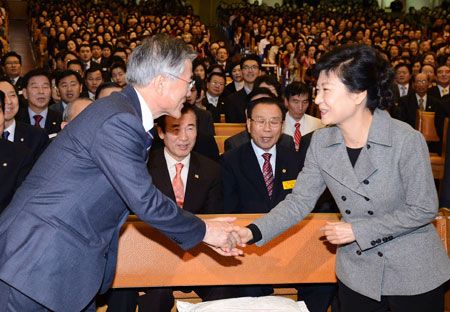
Moon Jae-in, left, of the main opposition Democratic United Party (DUP) shakes hands with Park Geun-hye of the ruling Saenuri Party during the Korea National Prayer Breakfast on Nov. 14 at Yoido Full Gospel Church in Yeouido, Seoul. / Korea Times photo by Son Yong-seok
By Yi Whan-woo
Conservative party contender Park Geun-hye and her liberal rival Moon Jae-in have come up with tailor-made pledges to woo votes from the faithful, especially Christians and Buddhists.
Park of the ruling Saenuri Party is seeking an endorsement from Christians who tend to be more conservative. For Buddhists, she tries to embrace them with pledges that focus on expanding their influence in the government’s policies and increasing financial support.
Moon of the main opposition Democratic United Party (DUP) is following a similar path in an attempt to win votes from Christians. He has not mapped out a plan to gain support from Buddhists. He is trying to narrow the gap with Park in a number of public opinion polls.
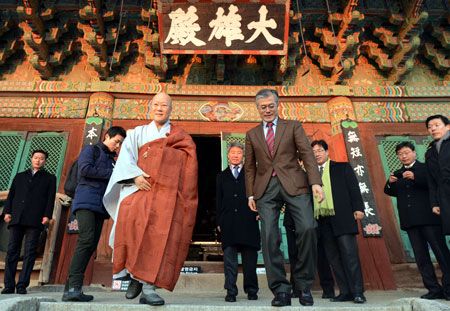
Moon Jae-in, right in the top photo, leaves Beomosa Temple with Ven. Soo-bul during his election campaign in Busan, Saturday./ Yonhap
The moves came after organizations for each religion have been relatively inactive in offering support for specific candidates this year, compared to the 2007 presidential election.
The Saenuri Party candidate is an atheist. Moon is a Catholic but is courting by reaching out to Buddhists and faithful of other beliefs by participating in their events.
The key contenders have so far shied away from publicly displaying their religious affiliations. Some minor sects have made endorsements, although big organizations refrain from doing so.
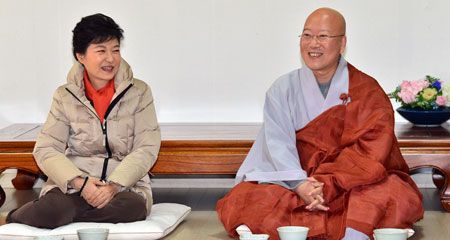
Park Geun-hye, left, of the conservative Saenuri Party talks with Ven. Soo-bul during a visit to Beomosa Temple in Busan on Dec. 1. / Yonhap
Back in 2007, the frontrunner and self-professed “devout” Christian Lee Myung-bak received endorsement from the Christian Council of Korea (CCK), one of the country’s largest umbrella organizations of Christian denominations. Lee also reportedly received the backing of the Jogye Order, the representative sect of Korean Buddhism.
The fact that neither of Park and Moon are strongly affiliated with a religion adds to lukewarm stance by Christians and Buddhists, who are more outspoken than other religious believers.
Both candidates adhere to Bible
Park and Moon have made their own pledges following a request from the Public Policy Committee for Korean Christianity in late November for their thoughts on 10 social issues, including controversial ones such as same-sex marriage.
Lee Kyung-jae, the head of the Saenuri Party’s Christianity Committee and also an elder at a church, said on behalf of Park that the party agrees in general with all of the issues and will carry out the suggestions made by the committee.
Regarding moves toward legalizing same-sex marriage, a controversial issue in the U.S., Europe and other developed countries, Park said she will not allow it regardless of any reason.
“We absolutely agree with the committee’s request not to allow any marriages between gays or lesbians by the word of God,” Lee Kyung-jae said.
He, however, added that “any discrimination against homosexuals” is unacceptable, saying “All people should be treated fairly and equally.”
Kim Jin-pyo, the chief of the religious committee at Moon’s election campaign, said “the DUP is extremely concerned about the circumstance.” He did not say the DUP is against the marriage between homosexuals but instead mentioned that the DUP will reflect the matter in government policies if Moon is elected the president.
Another issue centered on religious education at religious schools that has drawn divided public opinion over imposing a specific belief on non-believers. The Saenuri Party candidate said in her pledge that such education should be allowed in schools established with a religious focus.
“We should acknowledge the rights to teach such academic discipline in those special schools and the party will either reform or establish a law to serve the purpose.”
She also stressed the idea of democracy at the same time.
“Every student has the right to choose one’s religion and those who are against a religious education taught by a school should be given an opportunity to study something else as a replacement,” Lee Kyung-jae said. He also said that he agrees with the committee’s suggestion for equal financial support by the government for each religion.
The DUP also echoed the rival party’s view, as Kim said, “Such schools should provide replacement classes for those who do not want to be forced to believe in a specific religion.”
The liberal party, on the other hand, did not fully consent with the Christian group’s demand for equal financial support between religious and ordinary schools.
“Such matter should be decided by education offices under the local governments after conducting the possible number of students who want to study there,” Kim said.
Both parties were also on the same track on banning the state-run exams from running on Sunday, as they said Saturday as the replacement date.
Park active to woo Buddhists
Park made a more aggressive move over Moon by attracting the votes of Buddhists by announcing her 21 pledges for the group on Dec. 5. The DUP candidate said he is still under scrutiny for mapping the pledges for followers of Buddha.
The conservative proposes to expand chances for Buddhists to speak out in making government policies. It also said it will allow a greater number of Buddhists to take a part in government or its affiliated organizations.
The pledge came after complaints among Buddhists during President Lee’s five-year term since 2008 that he has discriminated against them while favoring Christians in government policies.
“Reconciliation, cooperation, and harmony is essential for development of our country and we look forward to achieving it through non-discrimination against Buddhists,” said Kim Moo-sung, the chief publicist of Park’s election campaign. “We also make sure to punish those civil servants including high-ranking officials who are religiously biased and show such behaviors in their work.”
A number of Buddhist temples were built a long time ago and they receive little financial support from the government in terms of maintenance, according to Buddhists.
Stressing that temples are “cultural assets,” the Saenuri Party said it will help preserve them with an increase of the fund used for preserving cultural properties from the current 200 billion won ($185 million) to 500 billion won ($464 million).
It also added it will seek ways to attract more international visitors to the temples for Korean Buddhism to prosper, such as the establishment of a Buddhism museum.