Can beleaguered prosecution reform itself?
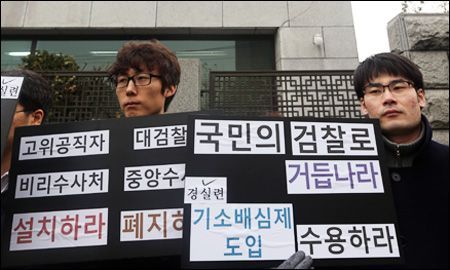
Members of the Citizens’ Coalition for Economic Justice call for prosecution reform during a media briefing in front of the Supreme Prosecutors’ Office in southern Seoul, Wednesday. / Yonhap
Prosecutors face uphill battle to regain trust
By Na Jeong-ju
Prosecutor General Han Sang-dae’s planned resignation is expected to spur talks on how to reform the prosecution, which has been reeling from the recent corruption and sex scandals involving incumbent prosecutors.
The Supreme Prosecutors’ Office said it will announce a set of reform measures, which may include the abolishment of its Central Investigation Department, which has often been criticized for conducting biased probes into politically sensitive cases.
Prosecution reform could become a major campaign issue in the lead-up to the Dec. 19 presidential vote as the main opposition Democratic United Party (DUP) has demanded various measures to weaken the prosecution’s power.
One of its key proposals is that the country set up an independent investigative body that only deals with crimes committed by high-ranking government officials, their relatives and prosecutors.
The prosecution is also facing calls to share its investigation rights with the police. Police officers have claimed they should be given the right to conduct probes independently and bring charges against criminals on limited cases without being supervised by prosecutors.
It seems very unlikely that the prosecution will accept such demands. That’s why its version of reform measures, which may be made public as early as Friday, could become a fresh bone of contention.
The measures are expected to focus on how to deal with the recent corruption and sex scandals that have demonstrated the poor work ethic of prosecutors.
Han had been under mounting pressure to take responsibility for what junior prosecutors described as “the biggest crisis that has ever hit the prosecution” and resign immediately. He finally said that he would tender his resignation Friday.
Han’s successor will be tasked to overcome the crisis, but it will be much more challenging because President Lee Myung-bak’s grip on state affairs is weakening fast. Lee’s single five-year term will end in February. The top prosecutor is appointed by the president.
That means how to reform the prosecution could become a headache for the next president as well regardless of who will be elected between Park Geun-hye and Moon Jae-in.
The most challenging part for the prosecution at the moment is that most people are skeptical about its reform pledges. The prosecution has often been criticized for being soft on prosecutors involved in corruption cases.
“Certain measures should be taken to reform the prosecution, not by the prosecution itself, but through the National Assembly. That’s the only way the prosecution can regain public trust,” the DUP said in a statement.