Majority of multiracial kids speak only Korean at home
By Lee Tae-hoon
Few would deny that multilingual skills are the keys to success in the increasingly globalized and competitive world.
Given that Korea’s dependence on exports in Asian countries, such as Vietnam and Indonesia, continue to grow, children of international and interracial marriages who have a parent from those countries will be valuable assets in bridging Korea with the emerging economies.
Experts point out that the country should be more proactive about encouraging such children to acquire proficiency in both languages spoken by their parents.
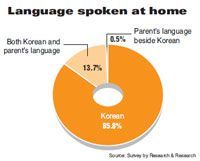
Still, a survey of 200 international and interracial children conducted in September 2011 by the pollster Research & Research shows that only 13.7 percent of the surveyed answered that they use both Korean and another language spoken by a foreign parent.
Of the respondents, 85.8 percent answered that they only speak Korean at home, suggesting that many parents in international and interracial marriages do not actively seek to teach their children another language beside Korean.
When asked which language the respondents speak with siblings, only 0.5 percent answered that they use a foreign parent’s language, whereas 74.1 percent answered Korean and 25.4 percent replied they are the only child.
Some may argue that the poll results indicate a lack of willingness among the children to learn their non-Korean ethnic parent or parents’ languages, but they have been proven to be wrong.
When the pollster asked the children whether they wish to learn a language of their foreign parent or parents, 63.5 percent answered that they would want to learn it.
Only 7.1 percent of them were negative about the idea of acquiring a language from their non-Korean ethnic parent, whereas 25.4 percent showed a lukewarm response, neither supporting nor disapproving of the idea of adding a new language to their skill list.
In contrast, the pollster found that the majority of international and interracial children have a good command of the Korean language.
When asked how well they believe Korean classmates understand their speaking of the Korean language, 91.9 percent replied that they consider their Korean to be proficient enough to have free-flowing conversation with them.
Only 0.5 percent answered that they fear their Korean language is poor and that their friends will have difficulties in understanding what they say, whereas the remaining 7.6 percent said they were not sure about their proficiency in the Korean language.
As for the degree of understanding classes being taught, 77.2 percent answered that they find it comfortable to follow lessons, whereas only 1.5 percent replied that they are having difficulties.
Rep. Jasmine Lee of the ruling Saenuri Party says that it is wrong to jump to the conclusion that the majority of international and interracial children encounter great difficulties in understanding the class and have a much greater school dropout rate than other Koreans.
She argues that such children adjust to school life as comfortably as other Korean children and that the dropout rate of them is almost the same as the national average.
“A lawmaker recently argued that the enrollment rate of interracial children is 36 percent during a parliamentary inspection, but the fact is that the enrollment rate of interracial children born in Korea is the same as the national average,” Lee said.
She argued that the lawmaker quoted inaccurate figures and mixed the statistics with figures of those born to a divorced foreign parent before he or she remarries a Korean.