Korea aims to be leader in green growth

A demonstration of solar-powered vehicles is held at the Korea Road Traffic Authority’s research center in Hwaseong, Gyeonggi Province, on Oct. 21. Korea is seeking to become one of the world’s top five clean energy powers by 2015. / Yonhap
By Na Jeong-ju
South Korea is on the fast track toward becoming a “green” economic power.
It has recently won the right to host the Green Climate Fund (GCF), a multi-billion-dollar UN-operated fund envisioned to fight climate change, and officially launched the Global Green Growth Institute (GGGI), the first international organization initiated by Korea.
Such achievements represent Korea’s vision of “eco-friendly growth,” which was considered an oxymoron in the era of industrialization. The organizations will invite renowned scholars, scientists and civil society leaders from around the world to find viable solutions to global warming and provide a technological roadmap on green growth.
That will also embolden Korea’s international status as a “fast mover” in the emerging sector.
.jpg?w=728)
Officials say the solar energy, wind power and water industries can become the backbone of the country’s future economy like today’s semiconductor and shipbuilding industries.
In that sense, it is important to continue efforts to reduce carbon emissions, while developing new green growth models that will ensure sustainable development and more jobs.
“The GCF and GGGI will enable us to achieve harmony between the economy and the environment _ tackling climate change and environmental challenges by enhancing resource efficiency and securing innovative new growth engines,” said Kim Sang-hyup, presidential secretary for green growth who is the chief architect of Korea’s green growth policies.
“Developing alternative, clean energy sources has become an urgent task for many countries as climate change is one of the greatest challenges the world faces today.”
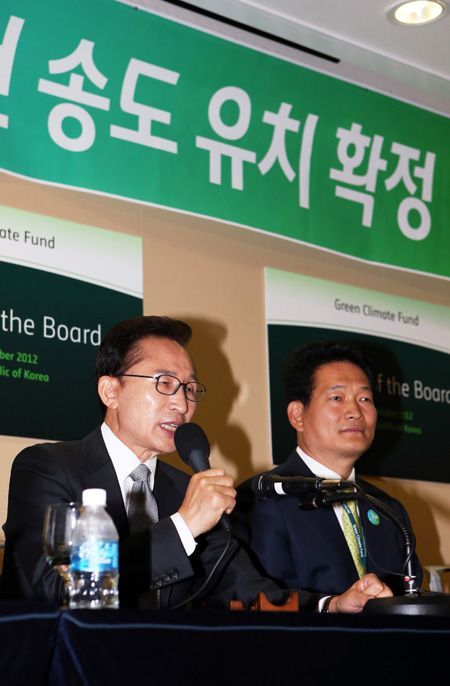
President Lee Myung-bak, left, speaks at a press conference at Songdo Conventia in Incheon on Oct. 20 after the western port city was selected to host the Green Climate Fund. Next to Lee is Incheon Mayor Song Young-gil. / Yonhap
The strategy calls for a smooth transition to a greener and more energy-efficient economy making use of a greater share of renewable and clean energy with a lesser dependence on fossil fuels.
Following the oil crisis in the 1970s, several European countries such as Denmark were “early movers” effectively decoupling economic growth and energy consumption.
“Korea is now rapidly emerging as a green growth power with comprehensive national and international initiatives,” Kim said.
Incheon City, which will host the GCF, vowed to play a central role in supporting projects, programs, policies and other activities in developing countries to fight global warming. It plans to bridge between emerging and developing countries in their efforts to create and implement national and local-level strategies, policies and institutional mechanisms for green growth.
Incheon expects green finance to be a core enabler of sustainability in the era of green growth. If companies want to be committed to sustainability or green growth, they should have the necessary expertise, practical tools and financial solutions to achieve the strategies.
The transition to low-carbon growth will also bring many opportunities for businesses.
An increasing number of companies are expected to place “sustainable finance” at the core of their business strategies by managing sustainability risks while seeking new opportunities. In taking this path, they will seek opportunities to advance into the low carbon, energy financing markets.
“Both developed and emerging economies should work under a shared goal to address global warming. Incheon will lead such efforts,” the city’s Mayor Song Young-gil said after it was selected to host the GCF.
Clean energy power
In 2009, Korea announced a bold plan to invest 40 trillion won ($37 billion) over the next five years in developing renewable energy sources and nurture them into a new economic growth engine.
The government forecast the country’s exports of clean energy will top $36 billion in 2015, if the plan is implemented successfully, creating some 110,000 jobs.
“We are seeking to become one of the world’s top five clean energy powers by 2015,” Kim said. “Our energy plan sets an example for other countries that are preparing for similar measures to embrace the era of green growth. Korea has taken important steps toward becoming a green economic power.”
Under the strategy, Seoul aims to increase its portion of renewable energy compared to the entire energy consumption of the country from 2.4 percent last year to over 11 percent by 2030.
It is also seeking to build 1 million “green homes,” which will be entirely dependent on renewable energy, and become the world’s fourth-largest producer of eco-friendly cars by 2020.
The government will further reinforce research and exploration of natural resources in the Arctic Ocean and Antarctica, as part of a drive to secure offshore energy sources, according to the Ministry of Knowledge Economy.
Global demand for renewable energy stood at $162 billion in 2009, but has grown at an average rate of 28.2 percent a year for the past five years, which means the market will be worth $400 billion in 2015 if it continues to grow at the same rate.
The government is now working closely with academia and private firms to promote the use of renewable energy.
It has obliged all electric power companies that generate more than 500 megawatts of electricity per hour to diversify their portfolio of energy sources and increase the supply of electricity generated from renewable energy sources to 10 percent in 2022.
All public buildings with an office space of 1,000 square meters or more should replace 10 percent of their energy needs with power generated from renewable energy, and 20 percent by 2020.
“The development of green technologies and the establishment of a green infrastructure across a wide range of industries are creating a virtuous cycle in which both environmental protection and economic growth are pursued together,” Kim said.
Indeed, the global race to develop core green technologies has begun.
The supply of fossil fuel resources rapidly declines, but global energy demand is forecast to increase approximately by one third over the next 25 years.
Economy-wide initiatives have been introduced to transform the country’s system of securing resources, its practice of utilizing energy and power generation. Green initiatives are also at work in industries, agriculture, forestry, land use, buildings and transportation.
Carbon trade system
One of the ideas the government has been pushing for is to introduce a carbon trade system to make it obligatory for companies to reduce greenhouse gas emissions.
Under the so-called cap-and-trade system on the emission of greenhouse gases, such as carbon dioxide, firms will have to trade the allowance on emissions, by ton measurements, among themselves in a market place like the stock exchange.
In the initial stage, the government will hand out most of the allowance free of charge. The size of the cap will vary by company and by industry. Then from 2013, the firms will have to keep their gas emissions below the cap, or they will have to buy quotas from other firms who have an allowance excess. The price will be naturally decided by supply and demand in the market.
Local business associations have opposed the scheme, citing a financial burden. However, officials assert that the carbon trade system is crucial in reducing the heavy dependence on oil and gas imports and developing alternative energy sources that are friendly to the environment.
“There have been numerous policy proposals to make Korea a global frontrunner in creating a greener future for the whole world,” Kim said. “We will play a pivotal role in coordinating green growth policies among countries and developing related technologies based on a firm public-private partnership.”