What AI overtaking jobs looks like

Kim Hyun-ju, a customer service consultant at KB Kookmin Bank, reenacts a call center consultation at the Hankook Ilbo office in Jung District, Seoul, March 5. The 20-year veteran said, “It was a foreseeable tragedy that neither customers nor consultants would be satisfied with AI customer service.” Korea Times photo by Kang Ye-jin
“Are you actually a human?”
The voice of a middle-aged man, thick with anger, roars through the phone.
For Lee Eun-young — a pseudonym for a woman in her 40s who works at the customer service desk of a major credit card company — the moment is nothing new. She pauses for a second before replying.
“Yes, sir. I’m a human.”
This time, the caller does not calm down easily.
“Since when did I say I wanted to talk to artificial intelligence (AI)?” he snaps. “You people let machines do all the work while you sit back and collect easy money?”
The words sting. But they are not entirely surprising.
Roughly one in four calls Lee receives each day now begins with complaints about the company’s AI customer service system. No one at the company has shared the numbers with her. Still, she has a sense of how things are going from the pile of frustrations customers unload the moment they reach a real person.
Customer service desk jobs like Lee's are experiencing the future arrive faster than other industries — and it is not a comforting one.
For years, the job was widely seen as one of the firsts that AI would replace. Around 2024, banks, credit card companies and insurance firms, along with public institutions such as the National Tax Service (NTS), began rolling out AI systems to handle customer inquiries. For workers on the phones, the shift quickly became impossible to ignore.
The problem is that neither customers nor workers are satisfied with the AI customer service — aside from companies that get to reduce costs. Kim Hyun-ju, 48, a customer service worker at KB Kookmin Bank with two decades of experience, let out a quiet sigh before saying that the outcome had been easy to predict from the start.
“If the company had sufficiently consulted human consultants who know the exact patterns of customers before adopting an autonomous customer service system, the results would have been different. This foolish AI consultant wouldn’t have appeared,” she said.
In her words, companies ended up creating the most useless AI because they tried to hide that they were adopting AI to replace human workers.
The Hankook Ilbo interviewed 15 people, including six call center workers, four scholars who study the profession, three officials at companies that introduced AI customer service systems and two customers, and analyzed related materials to examine what kind of disaster AI, introduced without consulting experienced workers, could create.
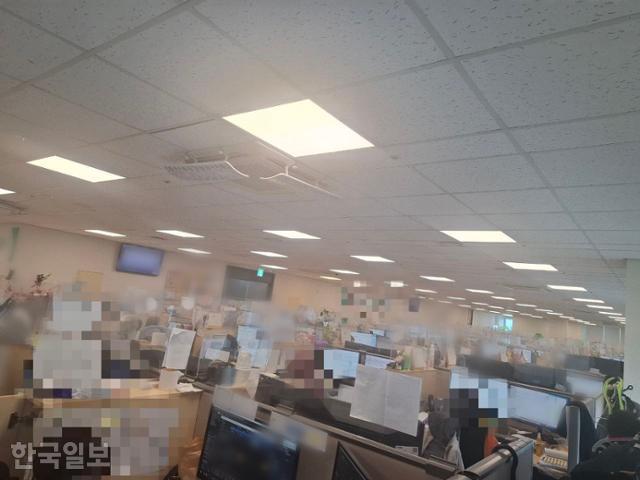
Consultants work at a call center office. Courtesy of the Call Center Workers’ Union
The stealth arrival of AI consultants
AI consultants quietly became colleagues to human customer service (CS) workers around 2023. The company never explained the change to employees, and Kim only realized something was off when customers kept asking whether she was an AI or a real human. Curious, Kim decided to call the CS center herself.
“I was connected to an AI consultant,” she said.
She was unaware of the system for nearly a year and in the meantime, customers were asking how they could speak directly to a human instead of going through AI once connected to human consultants.
Kim could not understand it. Why had the company introduced AI consultants without informing its employees?
Kim Kwan-uk, a professor of cultural anthropology at Duksung Women’s University who has studied call centers for a decade, said the reason is simple: there was no law requiring companies to notify workers when they adopt AI systems.
In other words, while AI could push human workers out of the office, companies had no obligation to explain the change in advance.
“Companies don’t need to be more moral than the law,” Kim bluntly explained.
Then there is the issue of perception. Call center work is widely seen as “unskilled, simple labor,” something that anyone can do without specialized knowledge or know-how, particularly in the eyes of companies.
“The fact that most workers are women without higher education and returning from career breaks makes them seem easily replaceable,” he said.
But the consequence of building AI consultants without having experienced workers review the system proved high. The AI could only imitate the job, not actually do it properly. Situations that could have been avoided with a single question to a call center worker ended up happening. Kim voiced her frustration.
“On Mondays, calls rush in — we call it a ‘peak day’ and the company doesn’t even allow us to take the day off. But then the AI consultants decide to send various messages to customers about minor issues like notices on closing dormant accounts, prompting people to call and creating a bottleneck, ironically leading to even longer waiting times.”
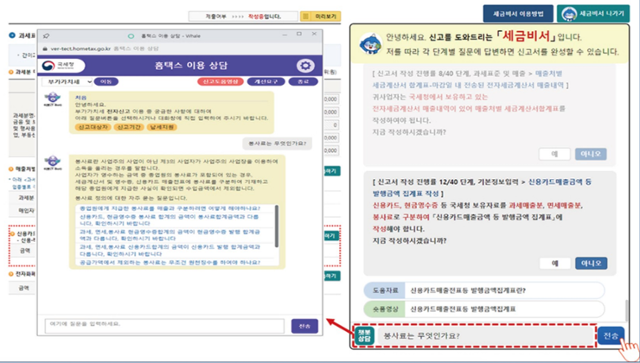
An AI chatbot service is introduced on the guidance screen for the National Tax Service’s Hometax tax filing system. Captured from National Tax Service promotional material
Nam Mi-kyung, 35, who works at the NTS, gave a similar account. The agency adopted an AI system for its tax filing service, only to provoke anger from taxpayers when it failed to understand complex and sensitive tax matters.
“We asked the agency to first talk with the labor union if it plans to adopt AI,” she said. “We were notified on the day the system was adopted — no training or anything whatsoever, just a piece of paper and told to learn on our own.”
AI trained on consultants’ know-how
CS consultants are more disturbed that without even knowing, they may have taught the AI that could one day replace them.
The beginning was around 2022, when several financial institutions started to implement some systems that sounded foreign to CS workers. They were called STT (Speech to Text) and TA (Text Analytics). Workers could see their conversation with customers live on their monitors.
Companies instructed workers to manually save AI-generated transcripts. Some even offered incentives based on how many were saved. Workers, who were told this was for their own benefit, were also tasked with finding spelling and grammatical errors.
The data compiling customers’ questions and know-how of consultants were then used by AI as a textbook. Hyun Jin-ah, who spent 12 years as a Hana Bank consultant, felt troubled seeing it.
“I just trained AI to take my place with my own mouth,” she said.
Consultants actually came close to losing their jobs. At the end of 2023, one bank decided it would leave customer service to AI, prompting two subcontracting companies to announce they were letting go of a total of 240 consultants.
Stark backlash from labor groups and politicians forced the bank to reverse its decision, but the uneasy coexistence with machines continues.

A layoff notice sent to call center consultants by a subcontractor handling customer service operations for a commercial bank in late 2023 / Courtesy of a labor union
AI leaves the hard work to humans
Initially consultants had their own hopes regarding AI. Kim, who suffers from cystitis after taking 200 calls a day, hoped AI might alleviate some of the workload and improve working conditions.
Hopes turned out to be misplaced, because AI actually increased the workload for the consultants. After taking over all incoming calls, it was only capable of handling simple tasks written in manuals — leaving difficult and complex work to human consultants.
Lee Young-sun, 50, who worked for eight years as a consultant and now handles loan consultations at Hana Bank, explained how the work became even more difficult after AI was introduced.
“Before, we used to handle about 200 calls a day. Now we take between 120 and 130 calls, but they are all much more difficult consultations, so the average call length has stretched two- to three-fold,” she said.
“Older customers need explanations for even very minor things — how to download the app, what to press and so on. Sometimes it can take up to an hour, which reduces the number of calls each consultant can handle. But when the company looks at the statistics, it only sees that the number of calls per consultant has gone down — so they decide to reduce the workforce.”
A survey last year by the Federation of Korean Trade Unions’ research institute of 168 call center workers found that while the number of calls handled each day fell after AI was introduced, the average call length actually grew. The optimism that “AI would rescue overworked human workers” has yet to materialize on the ground.

The Dasan 120 Call Center Foundation presents its plans for introducing and utilizing AI technologies in public call centers at the 2024 KCCM Conference. Yonhap
The not-so-smart AI also left customers exhausted. First of all, it often failed to understand complex requests consisting of multiple questions.
Choi Yoon-rak, a 68-year-old convenience store owner, called customer service last month when he ran into problems opening a new securities account, at a time when Korean stocks were soaring.
He was connected to an AI consultant with a voice strikingly similar to a human’s.
“I’m stuck trying to open an account — why am I stuck and what do I need to do?” he asked, only to be repeatedly told he needed to clearly define his request.
AI also failed to understand new services it had not yet learned. Whenever the government announces a new policy, such as consumer relief payments or retirement pension reforms, consulting calls flood in, but the AI is left largely useless.
A bigger problem is that AI cannot share emotions with customers. That can be fatal.
For example, customer service consultants at auto insurance companies sometimes receive calls from drivers saying their car has stopped in the middle of a highway and asking for emergency roadside assistance. In those moments, the consultant’s most important role is to calm the customer down.
Due to the risk of a secondary accident, callers are often extremely anxious. Consultants must reassure them, saying something like: “Sir, we’ll do our best to dispatch help as quickly as possible. Could you move your car to a safer location if you can?”
It is also the role of human consultants to calm the flaring tempers of customers who have already gone through AI. Nam, who works at the NTS, has experienced such situations several times.
“Looking at the conversation history, it is difficult to figure out what they were talking about. So I have to ask from the beginning why they called,” she said.
“And that makes them angry. ‘Again? I have to explain everything again?’ they say.”
Customers left angry or giving up
Unfriendly AI is tormenting customers as well. Hyun, a consultant with 12 years of experience, gave her account.
“AI demanded answer should be ‘Ne’ (honorifics for yes) or ‘Aniyo’ (honorifics for no). When a customer reached a human consultant, he expressed anger, saying ‘why do I need to say honorifics to a machine,’” she said.
How smart is AI, really? This reporter decided to test it by calling a securities firm.
When this reporter pressed “0” to connect to a consultant, a message said that call volumes were high due to increased market volatility and suggested using a visual ARS service instead, sending a link by text message.
When this reporter ignored the link and continued to wait, the call was routed to an AI call-bot consultation.
After hearing a voice say, “Please tell me the service you need,” the reporter replied, “A balance certificate.”
The response came back off target: “I’ll help you check your balance. Please enter your 10-digit account number and password.”
The system returned to the beginning. This time, the reporter spoke clearly: “Connect me to a human consultant.”
But the voice only repeated, “Please tell me the service you need,” before the call was eventually disconnected. After eight minutes, there was nothing to show for it.
Customers trapped in the endless loop face a choice: keep holding the phone in hopes of reaching a human consultant or give up midway.
Yoon Ji-hyun, a 26-year-old art academy instructor, called a credit card company to compare credit loan products but ended the call before getting through.
“It can’t even manage a back-and-forth at a kindergarten level,” she said. “If a person had answered after that, I think I would have snapped at them, so I just hung up.”
In the end, she accepted a higher interest rate and took out a small emergency loan that required no screening to cover the urgent expense.

Participants chant slogans during a rally in front of KB Kookmin Bank’s headquarters in Yeouido, Seoul, in 2023, demanding the withdrawal of layoff notices issued to about 240 call center consultants employed by two subcontractors in Daejeon. Yonhap
By contrast, human consultants have an uncanny ability to understand what customers really mean. There are areas of tacit knowledge — the kind of know-how built through personal experience, intuition and embodied skills that are difficult to express in words — that AI struggles to learn.
Lee, a bank consultant, has become highly skilled at “translating” financial knowledge into language customers can understand.
“Many customers refer to a digital certificate by saying, ‘You know, that thing you need to claim tax deductions at the end of the year,’ or describe an OTP (one-time password generator) as ‘that machine that gives you a password,’” she said.
Kim Yoon-suk, 55, a consultant at the Korea Student Aid Foundation, shared a similar experience.
“Many older students call the student loan department and there are so many complicated terms like ‘status updates’ or ‘accrual dates,’” she said. “When they’re frustrated, they’ll just say, ‘Why isn’t this working?’ We figure out what they mean through experience.”
Customers line up, figuratively, to bypass AI and ask a human consultant instead. Workarounds have even emerged.
“Calls about lost cards are connected quickly,” Lee said. “So even when customers have other issues, they press the lost-card option to reach a consultant. Once they’re connected, they bring up their real request, like canceling a transaction.”
Lee said she has noticed a sharp increase in reports of lost cards since AI was introduced.

A blog post explaining how to connect to a human consultant instead of Shinhan Card’s AI system is shown on a personal blog. Captured from Naver Blog
Kim, who had helped stop several companies from using AI as a pretext to lay off large numbers of call center workers, said she now often receives words of thanks from corporate officials — something she finds awkward.
“Company officials told us, ‘Thanks to you stopping the layoffs, it turned out to be a blessing in disguise. If we had cut so many consultants back then, we might not have had enough people left to handle customer service.’”
It was a confession from those who hold the upper hand.
The unaccountable evaluating the accountable
When AI gives incorrect guidance, who should be held responsible? Banks and credit card companies rushed to introduce the technology after focusing only on cost savings, without sorting out that question.
What if a customer asked to transfer 150,000 won but the system mistakenly sent 1.5 million won? What if the money was withdrawn from account B instead of account A? What if a high-risk financial product was explained incorrectly?
Before call center unions were formed, it was common for consultants to personally compensate customers for financial losses caused by their own mistakes or by customer misunderstandings. However, that cannot be applied to AI.
Financial regulators, meanwhile, have largely stood by without issuing clear guidelines on who should be held responsible when errors occur in AI systems.
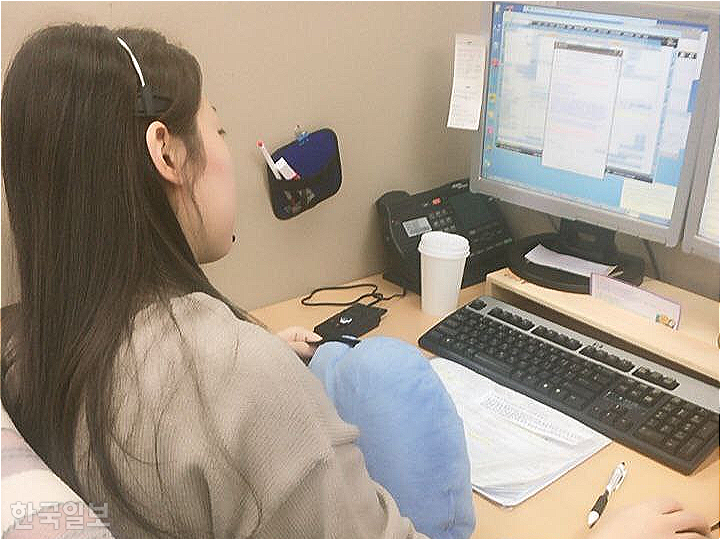
A call center consultant handles customer inquiries. Courtesy of the Call Center Workers’ Union
To make matters worse, consultants are now being evaluated by the very system that has caused so many problems. Some companies have begun assigning customer service quality assessments (QA) to AI.
Previously, a team leader at the outsourcing firm would randomly select two or three calls and listen to the recordings to evaluate performance. Now, AI has come to hold livelihoods of consultants in its hands, as QA results are used to rank consultants from best to worst and determine differences in pay and incentives.
Kim questioned whether AI is capable of overseeing human workers. There was even a case in which the system deducted points during a QA evaluation after mistaking the number “18” for a profanity.
“They even measure whether the ratio of the polite ‘yo’ style to the more formal ‘da’ style is about six to four, along with how often we use ‘cushion words’ — phrases like ‘I see’ or ‘That must have been inconvenient.’ They even evaluate whether the pitch of our voice sits around a ‘sol’ level. But can AI really recognize a tone of empathy like ‘Ah, yes, I understand’?”
AI has also become a convenient pretext for real-time surveillance of employees. Because calls are now transcribed and analyzed automatically, supervisors can monitor workers’ activities in minute detail.
“On the managers’ screens, they can see who is on a call, who is waiting and even who has gone to the restroom,” said Kim. “If a call runs long, they open the transcript to see what the conversation is about. Sometimes they even listen in on the call and send a message telling us not to say certain things. It makes you feel constantly watched.”

A mid-level manager at a call center sets a target for “calls per hour” on a workplace messenger. Obtained by Hankook Ilbo
If this is not to become the future
A look inside a call center in 2026 offers a glimpse of the future of work. In South Korea, companies and workers have embraced AI at breakneck speed, drawn by its promise of efficiency.
According to a 2025 report by the Bank of Korea, 51.8 percent of workers use AI for their jobs — roughly twice the rate in the United States. In the same survey, 48.1 percent of respondents said AI technology would have a positive impact on society, far outnumbering the 17.5 percent who gave negative responses.
But in August last year, the Massachusetts Institute of Technology’s (MIT) Media Lab said that 95 percent of companies investing in AI were seeing no meaningful returns.
In other words, the technology may not be as promising as the optimism suggests.
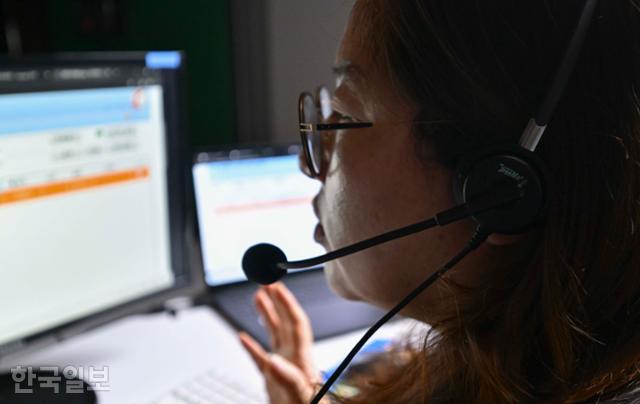
Kim Hyun-ju, a customer service consultant at KB Kookmin Bank, reenacts a call center consultation at the Hankook Ilbo office. Korea Times photo by Kang Ye-jin
Experts say the starting point should be recognizing that AI is not perfect. Kim Kwan-uk said many companies have fallen into what he called “technological optimism.”
“Companies advertise that new AI technologies can provide accurate, fast and personalized consultations without time constraints,” he said. “But they are hiding the fact that, in reality, there are very significant limitations.”
Creating truly intelligent AI that assists workers requires actively listening to human workers when developing the system, experts say.
“Adopting AI through a top-down approach makes it difficult to assess potential side effects,” said Kim Jung-hoon, 38, a doctoral student in industrial and labor relations at Cornell University who studies call center workers.
“A key finding of the MIT study is that AI often fails to function properly because it lacks the information necessary in the field.”
In late 2023, Microsoft reached an agreement with the American Federation of Labor and Congress of Industrial Organizations, the largest labor federation in the United States, to engage in dialogue with labor unions when developing and adopting AI technologies and to provide training for workers and union leaders on how AI works.
The agreement, which aims to prevent scenarios in which workers helplessly lose their jobs to AI, marked the first cooperation between a technology company and a labor union over artificial intelligence.
Kim stressed that the world must be wary of technology that leaves humans out.
“In the end, it is humans who create AI. There can be no AI without data. If workers disappear, there will be no economy, no state — and ultimately no future,” she said.
“We need AI to adapt to us.”
This article from the Hankook Ilbo, the sister publication of The Korea Times, is translated by a generative AI system and edited by The Korea Times.