Assassins in Seoul's streets in 1898: Kim Hong-nuik

Kim Hong-nuik circa 1896-98 / Robert Neff Collection
By Robert Neff
Arguably, one of the most hated men in Seoul in 1898 was Kim Hong-nuik, the interpreter at the Russian legation. Horace N. Allen, the American minister to Korea, described Kim as “a very common and uneducated man, unable to read or write the official Chinese characters used in Korea” ― but he had a skill that was needed: having been born near the Russian border, Kim was able to speak Russian. According to Allen, none of the Russians in the legation spoke Korean so Kim became “the mouthpiece, counselor, and general informant of the [Russian] Minister as to things Korean.”
The British representative, John N. Jordan, echoed Allen's sentiment. He described Kim as a simple “water coolie on the streets of Seoul” who managed to achieve “the most influential position in the country, [and] has earned a reputation for high-handed and unscrupulous action which has made his name a (byword) throughout Korea.”
He was a true Machiavellian ― unafraid to use “violent and threatening language” to the Korean monarch because he knew he was supported by his Russian employers. He was an almost permanent fixture in the palace ― meeting with the emperor almost daily ― but his abuse eventually reached a point where the emperor reportedly requested the Russians use a different interpreter. This was refused and caused increased hostility between Kim and the other members of the Korean court ― many of whom ascribed much of their bad fortune to Kim. He was also despised by the Independence Club.
Kim was more than willing to use his position for personal gain (including appointing members of his family to various high positions) and he was not afraid to remove obstacles. In the last week of January, a rumor circulated that Kim was planning to arrange the execution or banishment of at least 11 high-ranking officials ― his enemies. Apparently, his enemies decided to strike first.
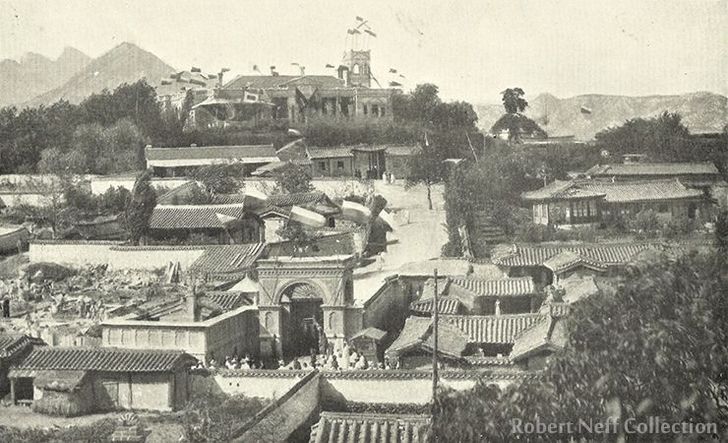
The Russian legation in the late 1890s / Robert Neff Collection
On the evening of Feb. 22 at about 8:30 p.m. Kim (followed at a short distance by two Korean policemen who acted as his security) was returning to the Russian legation when he was attacked by three men in the lane that ran from the British legation to the Russian legation. Two of the attackers pounced upon the policemen and knocked them down while the third attacker slashed at Kim with a sword.
Kim, defending himself with his cane, ran toward the little gate at the rear of the palace ― his policemen ran the other way. As Kim ran for the gate, his attacker continued to pursue and slash at him. Apparently, the gateman did not open the gate immediately but his screams did attract the attention of the British marines who were quartered nearby and the Korean soldiers within the palace. The would-be assassins disappeared into the night quickly.
Fortunately for Kim, the thick fur wrap around his neck prevented him from being seriously injured ― sustaining only scratches to his arm and ear. The Independent ― an English-language newspaper in Seoul ― denounced the act and declared, “The revival of the contemptible practice of assassination must be nipped in the bud.”
The Russian representative, Alexis de Speyer, promptly sent a letter of protest to the Korean government. He described Kim as the legation's “meritorious interpreter” who was attacked “by a band of scoundrels who intended to kill him.” Speyer was appalled at the unheard-of audacity of the gang and beseeched the Korean emperor to “search out the conspirators” and added that “it is necessary not only to punish the actual culprits but to find out the instigators of the crime. Even if the instigators be high in rank, their stations must not be considered in the proper administration of justice.”
Emperor Gojong responded: “How is it that police authorities permit the swords to appear in the darkness of night…if the police perform its duties in such a careless manner, what is the use of maintaining the so-called Police Department?” He warned that if the police were not able to find the assassins within three days, the chief of police would be “severely punished.”
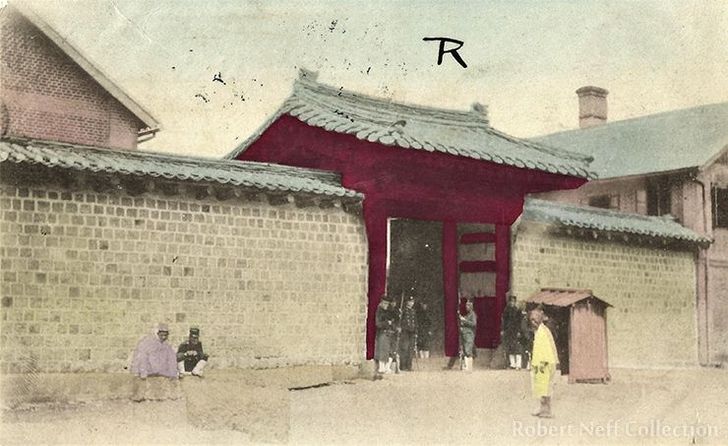
Deoksu Palace circa 1904 / Robert Neff Collection
With this threat as an incentive, four people were quickly apprehended. One of the men, Kim Sei-guk, a naturalized Russian who was from the same village as Kim Hong-nuik, was at first thought to have participated due to a personal grudge but was soon ruled out and released. The other three men (Yu Ku-whan, Yu Chin-kiu and Ye Pom-suk) confessed under questioning (and a liberal dose of torture) that they had been hired by a noble within the court ― a nephew of a former king. Apparently, it wasn't that surprising that this noble was involved and Speyer, in his missive to the Korean government, may have been referring to this noble. However, the story of this conspiracy and the subsequent trial will have to wait for another time.
Allen described the attempt upon Kim Hong-nuik's life as “simply a clumsy resort to ancient methods by these people, who saw their Government irrevocably slipping out of their hands and despaired of any other kind of help.” Jordan seemingly agreed and added: “[The] only feeling which the incident has produced amongst Coreans, with whom political assassination is a familiar expedient is one of the most universal regret that it did not succeed.”
As if supporting Jordan's claim, Yun Chi-ho noted in his diary: “What is the use of killing [Kim]? However, his escape seems to be a matter of universal regret. All 'cuss' the would-be assassins not because they attempted to murder the unimportant 'Regent' but because they failed.”
It was truly a dismal failure for within days of the attack, Kim was back at work, his injuries nearly healed. He was more than aware of the identities of the conspirators and he was already plotting his revenge. A revenge that was swift but would eventually contribute to his own fall from power. He, too, would eventually resort to assassination and would
.
While in his diplomatic communications to the Korean government, Speyer may have expressed outrage and horror at the attack upon his “meritorious interpreter,” his personal feelings were completely the opposite. He confided to Allen that “two very pleasant things occurred to me on the same night.” One was “the attempt on the life of my interpreter [which] places this Independence party right in my grasp. I will push this matter to the farthest limit.”
And the second? That is the subject for our next article.
Robert Neff has authored and co-authored several books, including Letters from Joseon, Korea Through Western Eyes and Brief Encounters.