Clare Hess: The dangerous spectator

A quiet street in Korea in the early 1900s Robert Neff Collection
By Robert Neff
In the first week of February 1903, Horace N. Allen, the American minister to Korea, reported to the State Department that the annual “seokjeon” (stone battles) had begun. He assured the State Department that these fights were common and the Korean government allowed, if not supported, them because they were “supposed to promote a courageous spirit” in Korean men. He went on to explain:
“In [these stone fights], rival villages assemble their best men in line and stone the opposing line of villagers. If damage is done by the stones the men rush at each other and fight with clubs. Severe injuries are always received on either side and there are usually several deaths each year. Thousands of spectators cover the adjoining hills and when a rush takes place the whole crowd surges back to avoid the flying stones.”
Allen stressed that “foreigners are usually careful to keep well out of reach of stones when visiting the scene of one of these fights.” However, late in the afternoon (approximately 5 p.m.) on Feb. 5, 1903, at a large stone fight outside the West Gate of Seoul (probably near modern Ahyeon-dong) ― there was an exception.
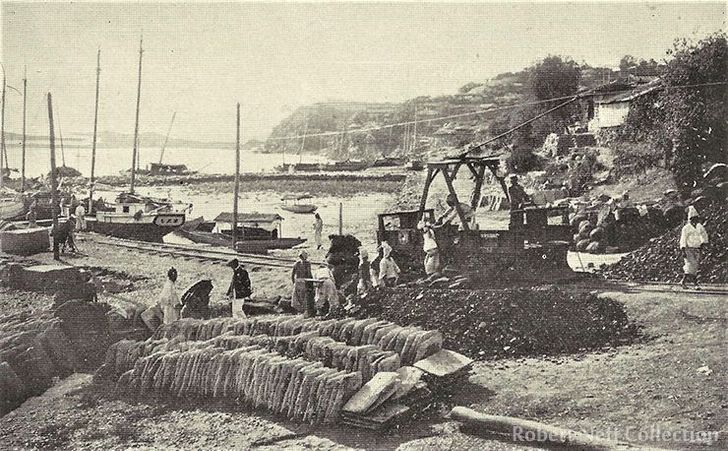
One of the small ports on the Han River circa 1900 Robert Neff Collection
Ahn Myung-soon recalled that he was on the field (it isn't clear if he was a participant or a spectator, but I am guessing the former) and noticed two foreigners on a low hill nearby. A gunshot rang out and Ahn felt something ― like a small stone ― strike his right leg. He thought nothing about it and watched as a wave of fighters and spectators surged toward the foreigners. The foreigners ran, but one man turned several times and fired his “small” gun. Ahn tried to follow the crowd but was overwhelmed by an intense pain in his leg and he was barely able to move it. He was surprised to discover that his leg was bleeding profusely.
Ahn's recollection of the event appears to be somewhat muddled. The two foreigners on the hill were actually Horace N. Allen and Carl von Waeber (the Russian representative) who had nothing to do with the shooting and were merely witnesses.
According to Allen, the two diplomats were out for an evening walk and as they reached the top of the hill near “the collection of houses at the fork of the roads leading respectively” to the river ports of Mapo and Yangwha, they “saw many Koreans in the valley beyond, apparently engaged in the annual stone fight.”
It was at this time they noticed a foreigner, at the edge of the crowd, fire his weapon and then turn and run towards the diplomats. Later, Allen insisted he “saw and heard but one shot.”
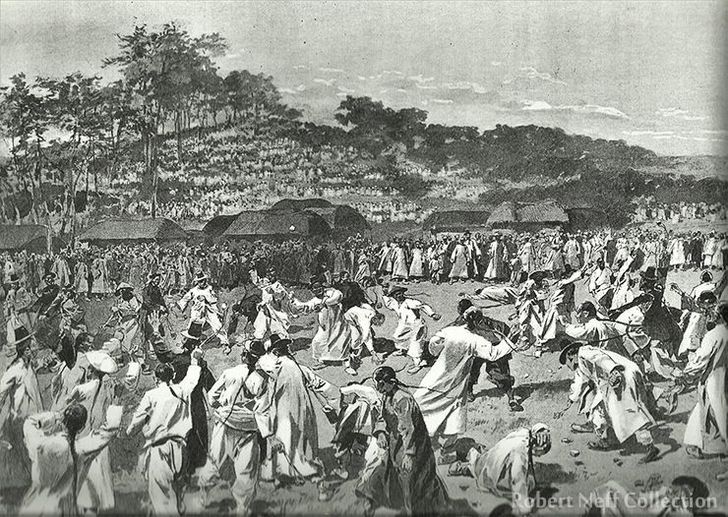
A stone battle in 1902 Robert Neff Collection
When the foreigner drew close to the diplomats, Allen recognized the shooter as Clare W. Hess, a young miner from Oriental Consolidated Mining Company (OCMC), the American gold mining concession in northern Korea. In his sworn testimony, Allen wrote:
“I rebuked him for firing in such a crowd, thinking he had simply fired into the air. He said he had been attacked by the crowd. I took his revolver away though it was a very large one, I struck in into my pocket. The man objected strongly to my taking his revolver and I had to use a little force. He asked me to protect him and I told him I could do nothing there but that he should go on to the legation. He then fled toward the city and we followed deliberately. Quite a crowd of Koreans followed the flying man, some of whom told me that a Korean had been shot and killed.”
Allen had a flair for description and his narrative often changed. He was definitely more diplomat than missionary.
In his sworn statement he said he arrived at the American legation where he found Hess safe, and had the legation's constable take charge of the young miner. However, to the State Department, Allen reported that 24-year-old Hess was one of the miners brought from Columbia City, Indiana, by the OCMC in 1901 and had recently been discharged (Hess would later explain that he quit because he wanted to go in to business for himself). Apparently he had gone to take some pictures of the fight but, Allen noted, “for some strange reason he took with him a very large and powerful revolver, loaded.”
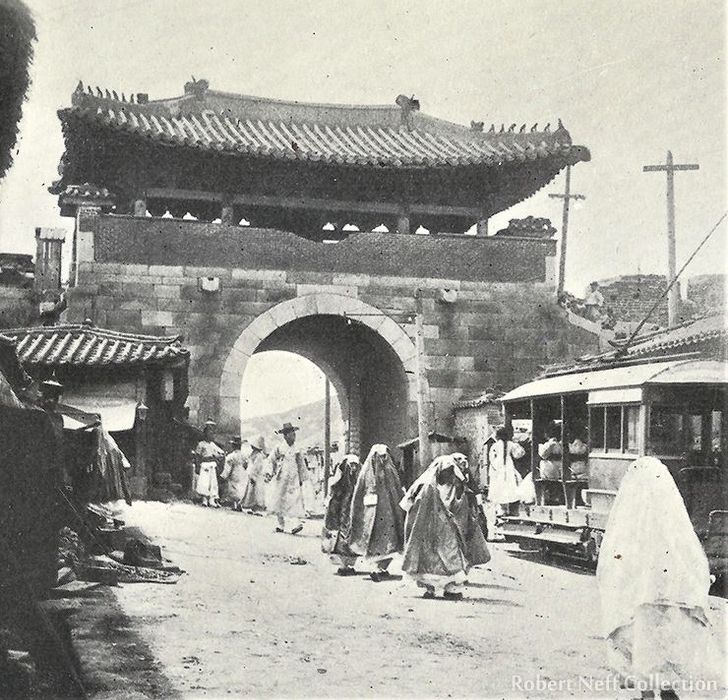
The city gate Hess likely passed through as he fled the enraged Korean mob, circa 1900 Robert Neff Collection
When the crowd surged, he became alarmed and “fired his revolver in the air to scare the people away. [This was a mistake as] these people on such an occasion are in no mood to be trifled with” and they rushed towards the American. Allen insisted that it was “inconceivable” that Hess was in any danger until he shot again ― this time hitting Ahn Myong-soon. Upon the realization that one of their number had been shot, they “became very ugly” and chased the young American.
In a private letter to the OCMC and in his State Department report, Allen played up his own role and claimed that he and Waeber “were in considerable danger from the angered people.”
Fortunately for Hess, Ahn did not die. He was carried on the back of one of his fellow participants to the American legation where he gave his statement to the consul general and was then hospitalized in one of the Western clinics. As his wound was rather nasty, it was decided he would remain in the hospital until it was determined whether or not he would make a full recovery. Once that could be determined, Hess would be put on trial for murder or manslaughter (if Ahn died) or for assault.
According to one of Allen's narratives, rather than return to his room at the Station Hotel, Hess elected to stay in the legation's jail until the trial ― perhaps fearing the mob would take matters into their own hands. Supporting this claim is his instructions to the consul general: “If Hess agrees to remain in jail pending your further communication with [the Seoul] governor it must be at his own expense.” However, in the same note, Allen clearly indicated that it wasn't really the young miner's choice. “[Hess is] to be imprisoned pending the trial which must be ordered to take place as soon as the wounded man is able to appear.”
Allen complained frequently about having prisoners but if the truth be told, I think he liked having prisoners ― especially paying ones ― after all, he built the jail with his own money. He also seemed to revel in taking part in consular courts.
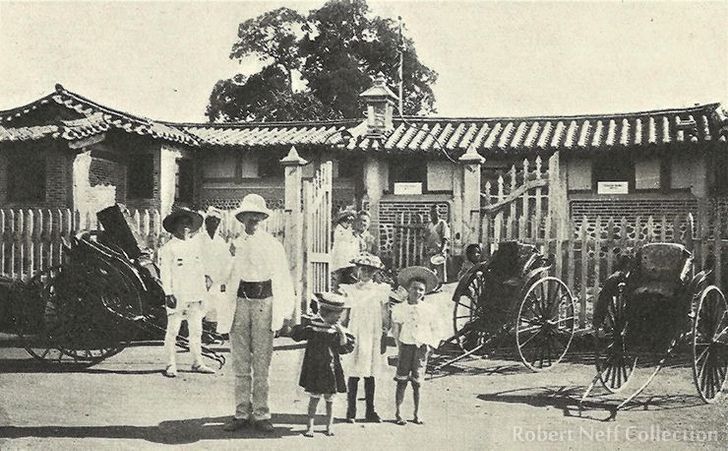
Station Hotel with the proprietor, his family and staff, circa 1900 Robert Neff Collection
These were his suggestions for the consul general to consider:
1. He had no business to go to a place where he knew there would probably be disorder.
2. In taking with him a loaded revolver he committed another indiscretion and showed intention.
3. The crowd there were not armed; when they came toward him he was in no danger of his life and should have retreated.
4. He was guilty of a crime in discharging a firearm in a crowd if only to scare them.
5. Having discharged his revolver he would be guilty of manslaughter had he, however unintentionally, killed a man.
6. He seems guilty of mayhem as it now stands.
7. When he saw the crowd was angry and coming at him, knowing they had no weapons, he should have fled. He did not fly until he had shot twice again.
8. Even if self-defense were required, he went very much too far in his method of applying it.
In his report, however, Allen wrote: “Hess [was] not intoxicated, nor is he insane, which makes the shooting seem all the more incredible. It is a disgraceful thing for Americans.” To his sons he wrote: “[Hess] is just a plain fool, nothing in his favor.”
Others in the foreign community had different opinions. At least one of the missionaries was willing to lend Hess 200 yen ($100) to help pay for his legal defense and settlement with Ahn. Lillias Underwood certainly had an opinion when it came to restitution for Ahn's injuries:
“I suppose this is far more than [Ahn] would dream of getting in a matter where it is most questionable if he ought to have anything, considering he was engaged in a murderous pastime and had a mere flesh wound. One of my friends saw the wound before it was dressed.”
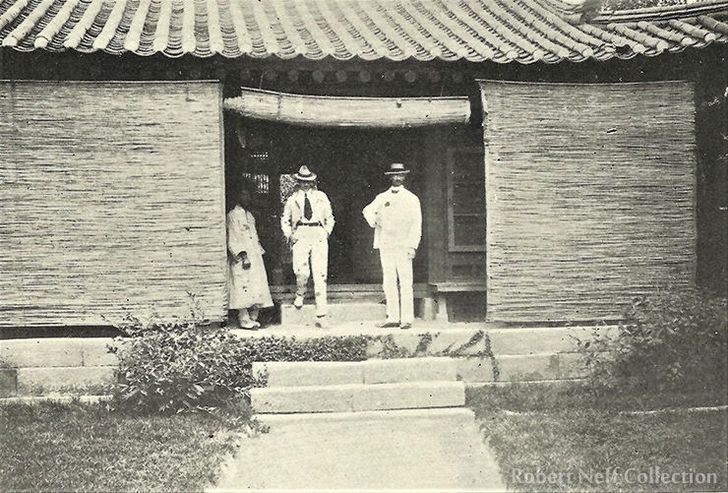
Part of the American legation in Seoul in 1900 Robert Neff Collection
By mid-March Ahn had recovered sufficiently enough that he, along with the consul general, the governor of Seoul and Hess reached an agreement to settle out of court before the trial could take place. Hess agreed to pay Ahn 100 yen in restitution for his leg wound, 40 yen to the hospital for Ahn's treatment; 43 yen for room and board in the legation's jail (1 yen per day) and 119.95 yen to the Station Hotel (this was for 2 dinners, 1 bottle of beer, lodging and other expenses). In addition, Hess agreed to leave Korea by the first steamship departing Jemulpo (modern Incheon).
On April 4, Hess was safely aboard the steamship Shinano Maru as it sailed from Kobe, Japan, to Seattle, Washington. He had departed the Land of the Morning Calm a lot richer with experience and with a good deal less money but he had dreams. He was determined to come back and make his fortune ― not at a gold mining camp but in the Korean wilderness.
I would like to express my appreciation to Diane Nars for her invaluable assistance.
Robert Neff has authored and co-authored several books including, Letters from Joseon, Korea Through Western Eyes and Brief Encounters.