The Argonaut's arrival in Korea in 1791

Japanese fishing vessels in the late 19th century / Robert Neff Collection
By Robert Neff
One of the earliest Western attempts to establish trade with Korea took place in the summer of 1791 by the English-flagged Argonaut, commanded by Captain James Colnett. The 400-ton ship had a crew of 19 men (excluding the captain) as well as Thomas Beal, a Prussian and the younger brother of one of the ship's owners, and a Chinese man, “smuggled on board who pretended to be a Japanese interpreter.”
The Argonaut departed Macau on July 27 with a cargo of furs. On Aug. 9, Jeju Island was sighted but no contact was made with any of the islanders. They then sailed along the western coast of Japan and had several encounters with Japanese boats. Apparently, the Japanese thought that the Argonaut was a Dutch vessel that had lost its way, and thoughtfully pointed in the direction of Nagasaki, while stressing the importance for the Westerners to leave their vicinity.
Nonetheless, the Argonaut continued to explore the coastline, and on Aug. 16, encountered a “small squadron of junks,” which it endeavored to follow but was unsuccessful, as the Japanese ships were too quick for the European ship. The following morning, near a large village, the Argonaut again encountered a great number of Japanese junks not too far from a village. Seeking information, Colnett dispatched one of his small whaling boats with a boarding party to one of the Japanese vessels in the hopes that that they could communicate.
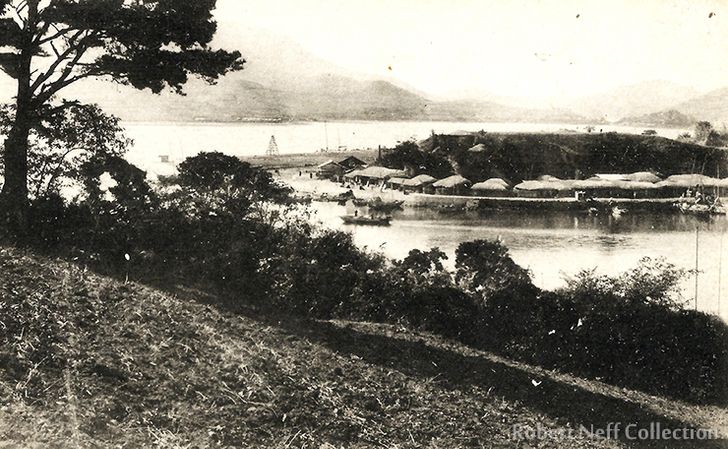
The Tongyeong area in the early 1900s / Robert Neff Collection
While waiting for the boat to return, some of the men aboard the Argonaut spotted and retrieved a model of a Japanese junk floating on the water. There was a piece of paper attached to the model's mast that, according to one of the Argonaut's Chinese crewmembers, was an offering of thanks for a safe return by a Japanese crew that had traveled to a rich country in the east. The English crewmember, who had retrieved the model, was warned by his Chinese shipmate not to keep it as there were a couple of Japanese boats nearby and their crews were carefully watching to see what the foreigners would do with their offering. Colnett added some “small articles” and stamped it with the ship's identification ― in English and Chinese ― and then released the model boat.
It was soon made clear to the foreign interlopers that they were not welcomed ― as was their experience in previous places in Japan ― and they sailed to Tsushima Island. But the islanders were no friendlier. When the Argonaut sailed into the harbor at Tsushima, it was greeted by armed boats, whose crews made it clear by closing their eyes and ears that their orders were “to be both deaf and blind” to any entreaties the English captain might make. In an effort to win them over, Colnett presented them with a couple of pieces of otter skin. He was rewarded with a small amount of water but the islanders were adamant with their refusal to allow him and his crew to land.
Undaunted, Colnett decided to wait them out. It was towards evening when a large group of men sailed towards the Argonaut; their intentions evidently were unfriendly. Colnett ordered first a musket, and then a three-pounder, to be fired near the approaching hostile islanders. These shots temporarily discouraged their approach, but it was clear that the Argonaut's presence would be tolerated no longer.
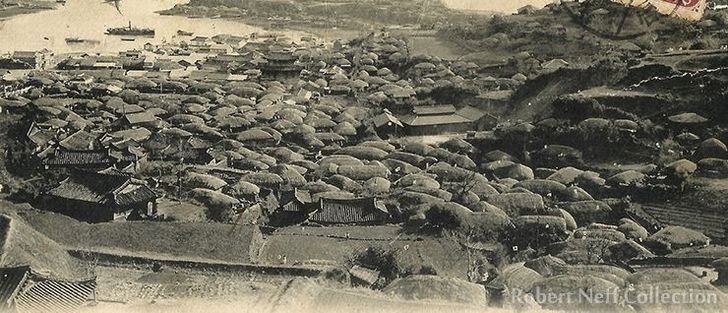
The old port of Tongyeong in the 1910s / Robert Neff Collection
Convinced that he might have better luck in Korea, Colnett set sail for the unexplored coast. On Aug. 25, the English vessel “made the land of Corea” (probably somewhere near Tongyeong in South Gyeongsang Province), and was received “with open arms, without the smallest dread or apprehension.” Several Korean sailors boarded the English ship and tried to communicate, but the interpreter could not understand a word. The “over officious behavior” of the Koreans and their constant signaling to the shore, where ever-increasing numbers were gathering, made Colnett somewhat apprehensive. This apprehension was further strengthened when the crew noticed that many of the Koreans “seemed to be barricading their houses with bushes.”
A crewman from the English ship ― equipped with a lead line ― boarded one of the Korean boats and began taking soundings of the bay. The boat slowly moved farther and farther from the safety of the English ship.
Much to Colnett's displeasure and suspicion, one of the Koreans ― perhaps in a tit-for-tat fashion ― tried to take control of the English ship's helm. This act was too much. The English crew armed themselves and made it clear that their man aboard the Korean boat was to be brought back immediately, to which, grudgingly, the Koreans complied.
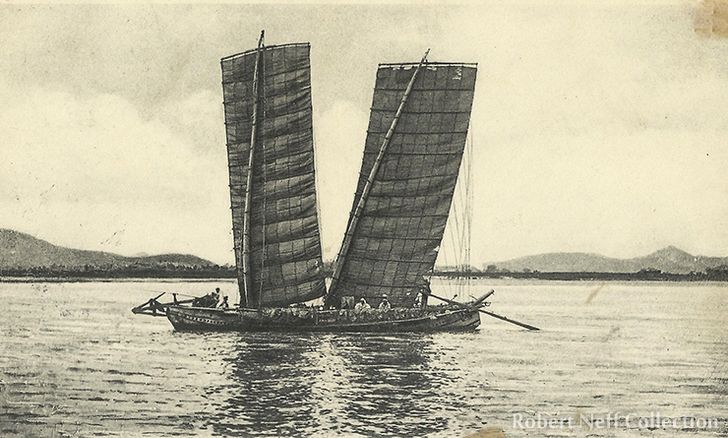
A Korean boat in the late 19th century / Robert Neff Collection
The Korean boats then retreated a short distance, and their crews appeared to be deliberating whether or not to attack. But the weather changed, and the brisk wind and the subsequent choppiness of the sea discouraged most of the Koreans, except for one boat, which drew closer and, according to Colnett, pantomimed their intentions to, “beat our brains out with a club.”
Following his normal protocol, Colnett ordered one of his crewmen to fire a musket over the heads of the Korean sailors, but his orders “were exceeded,” and the shot went into the boat and wounded one of the Korean sailors.
Startled and justly outraged, the Koreans returned to their village and the Argonaut abandoned the questionable safety of the bay ― safe from the elements but not from their Korean hosts' rage ― and weathered the night in the rough sea.
The following morning, the Argonaut sailed for China and arrived on Sept. 6. Colnett later reported that the denizens of the southern coast of the Korean Peninsula, as well as of Tsushima, were nothing more than pirates and were not under the subjection of the Chinese. He advised that any trade attempts in the region should “always be under arms.”
Nearly a century later, gunboat diplomacy opened Korea to trade.
Robert Neff has authored and co-authored several books including, Letters from Joseon, Korea Through Western Eyes and Brief Encounters.