Korean kites: aerial battles as cornerstone of childhood
By Robert Neff
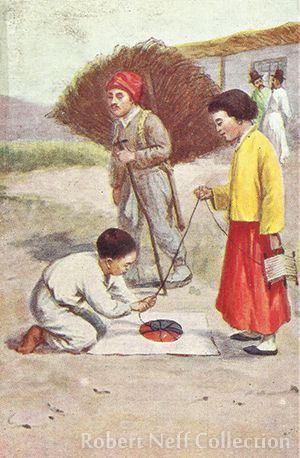
A postcard of a Korean boy preparing his kite for a day of flying circa 1920s. Robert Neff Collection
In early February 1903, the sky over every village and city in Korea was filled with kites. In Pyongyang, nine-year-old Il-han described the kites as resembling “a vast flock of gulls” dashing and whirling about, but they were not flying about aimlessly, for they all had “a real purpose” ― they were the weapons in the annual kite fights. These kite fights ― as well as the kite-flying season, took place during only the first two weeks of the Lunar New Year.
These kite fights were, declared Il-han, “the [greatest] sport events of the year and every Korean boy at some time in his life has hoped for the championship of his village.” However, it wasn't just boys who took a keen interest in kites. Korean men of all ages ― including the king ― were either active participants or enthusiastic spectators.
In the late 1880s, George Gilmore, an American teacher in Seoul, noted that it was “not at all unusual to see a boy flying a kite while the baby on his back gazes at the bright thing in the air or sleeps with its little head thrown back to a position in which dislocation of the neck seems imminent.”
The baby may have been fascinated with the idle flight of its older sibling's kite, but others weren't ― they wanted to see kite fights.
Gilmore claimed that shopkeepers and merchants would often cease business transactions and crowds of up to 1,000 people would gather in the streets to witness these aerial battles.
Not all Americans were pleased with the inconvenience this caused to travel. Percival Lowell, an American residing in Seoul during the winter of 1883/84, frequently encountered “groups of men and boys standing gazing up into the sky. Oftener than not, they stand right in the middle of the highway; and other people as they pass the spot, turn aside for the gazers, as a matter of course.”
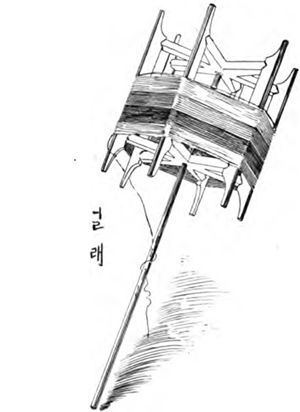
A Korean kite reel in the 1890s Stewart Culin, Korean Games with notes on the corresponding games of China and Japan, 1895
Although Lowell was only 29 years old, his description of the kite fights evokes an image of him as being an elderly man screaming at his neighbor's children to get off his lawn:
“I saw far up a rectangle of paper sailing across the blue. And then, as my glance wandered, I discovered another and then another, and away off in the distance still others, hovering over the roofs of the city like great white birds. As they are not wholly white, but in part colored, there was at intervals a momentary flash of red or blue or brown to the distant sheen as the kites turned in the air. Sometimes they soared alone in solitary grandeur; sometimes they flew in pairs, and the two hovered about each other like a couple of angry birds. This betokened a kite-fight. Two kites are flown near each other, and then each so handled that the strings shall be brought to intersect. Then, by adroit [maneuvering], each tries by rubbing against it to cut the other's string, until one succeeds. The severed kite falls fluttering to ear, while the victor relieved from the strain, rises with a mocking toss of triumph yet higher into the air. There is so much skill involved in the manner in which one string may be made to cut the adversary's without being parted itself, that it demands the appreciate sympathy of a large concourse of do-nothings, who completely surround the kite-flier and gaze, open-mouthed, up into the sky, utterly oblivious of aught else.”
Gilmore and some of the other American teachers were at first rather pedantic in regards to Korean kite-flying and battles. They considered themselves quite the experts ― “having flown kites at home” ― and decided to educate their Korean hosts:
“They had noticed the antics and gestures used by natives in manipulating the string, but supposed this to be the effect of the Koreans' natural demonstrativeness. But another opinion gained ground, as the only success achieved on that occasion was the loss of several kites, which by their plunging were cast down into neighboring grounds and became the prey of the ubiquitous small boy.”
The teachers complained “the absence of a tail makes these playthings unsteady, and in letting out the line the kite generally makes a series of plunges, which must be controlled by the promptest action, guided by a remarkably quick eye.” They apparently were not the experts they thought they were and should have confined their teachings to math, English and science.
The Americans were not the only ones who could not fly kites ― at least according to the Korean men:
“Women sometimes fly kites from their yards, but it is said that anyone can tell when a kite is flown by a woman. The owner of a kite is often considered unable to fly it, and when he does away, another who understands kite-flying will take the reel and play it.”
The Koreans also denounced the Chinese as being poor kite-fliers. Hindered by their heavy kite strings, the Chinese grew tired quickly and would tie their kite “to a tree and lie down and watch it.”
These kite battles were not spontaneous and participants ― especially young boys ― prepared several months in advance. According to our young kite expert, Il-han, the first part to be made was the wooden reel constructed from “five carefully rounded sticks.” It seems to have been the most important part of the kite as it was crucial to controlling it in flight. The kite itself was made from bamboo and paper. Il-han recalled that “colored paper [was] expensive, and, since each boy must furnish all his material without cost to the family, the kites [were] usually unadorned.”
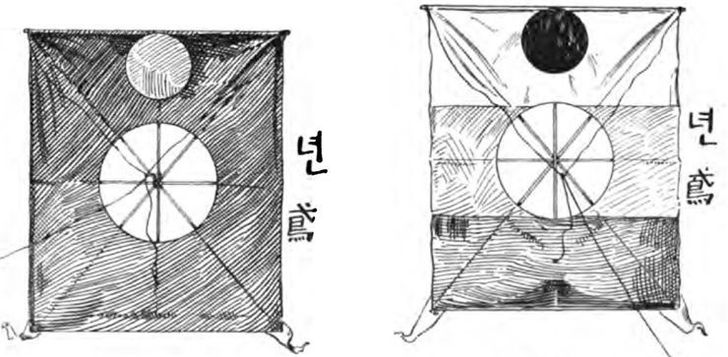
Korean kites in the Smithsonian in the 1890s Stewart Culin, Korean Games with notes on the corresponding games of China and Japan, 1895
The next part was the kite string. It was usually a stout cord, but if the boy had some funds at his disposal he could purchase fine silk string, and it was coated with an abrasive substance. According to Il-han:
“For many weeks previous, bits of broken bowls, crocks, and the like have been gathered and put away carefully. When the reel and kite are finished, these bits are pulverized. A small pot of glue is heated and the line is passed quickly through the hot glue, then through the pulverized mixture. The line must, of course, be dried thoroughly before it can be wound on the reel.”
Not everyone made their own kites. Some children received kites as gifts during the Lunar New Year celebrations from doting relatives while others (presumably adults) purchased their aerial weapons from professional kite makers. According to an American observer in the 1890s:
Many kites are “made by professional kite-makers and cost about ten cents of our money for the best kinds. The kite string is made of pure silk, sometimes colored, [and the kites flown in the] royal palace [use] sky-blue [silk]. The string is the most expensive part and many men save money during the year to buy kites and string at the appropriate season.”
However, a little over a decade later, the price of kites fell, so many children stopped making their own kites and instead purchased them. According to Foster Beck, a young American kite enthusiast living in Korea, “The boys do not make their own kites but buy them at the stores for about a half cent to five cents in American money.”
It was an expensive sport and required ― as mentioned earlier ― a great deal of skill. It was, proclaimed Il-han, an “art.” One had to be mentally alert at all times and when danger to one's kite was sensed, the flier had to immediately unreel great lengths of line from his reel to confuse and bewilder his opponent.
According to Gilmore, sometimes the kites became entangled by their strings as they dashed and dived about and then plunging after one another “in such a way as easily to suggest to the imagination that they are alive.” In this entangled state, the owner would attempt to pull down his kite so that he could retrieve it, and, if lucky enough, to capture his opponent's kite and as much of its precious line as possible. Usually the combatants sought to saw through the string of their opponent's kite to remove it from the battle. This, however, required a great deal of skill and strategy as Il-han explained “the sawing motion of the assailant's line must fall on only one spot” to be effective and often the strings of both kites' were severed thus removing the two competitors from the battle.
Il-han added, “As the kite strings are severed so quickly and amid such confusion, an adult wonders how the boys can distinguish anything.”
In the early 1900s, Horace N. Allen, the American representative to Korea, wrote: “When the kite falls there is such excitement in the chase to get it, that even old men catch the contagion and hobble off in search of the unlucky kite ― finders being keepers.”
The kites battled throughout the afternoon and eventually only one kite was left in the sky. Il-han somewhat romantically recalled: “[The] victor of the day is carried off the hill, bearing the first prize, an event that is the great corner-stone of his childhood.”
It isn't clear if he ever experienced the joy of being carried off the hill as a victor by his peers ― I am guessing he didn't because we know the following year his father sent him to the United States to study. I can imagine him teaching his American peers at school how to truly fly kites ― of course, the difference in culture might have made kite flying somewhat difficult as American boys tended to fly kites whenever the wind was right and Il-han would have only flown kites during the first two weeks of the Lunar New Year ― any other time would have been viewed through his eyes as madness.
However, Il-han probably had better things to do than fly kites. As an adult, he became a very successful businessman and established La Choy Food Products in the United States and Yuhan Company in South Korea. His legacy lives on.
While kite battles took place for only the first two weeks of the Lunar New Year, there was one other time that kites were flown ― which is the subject for tomorrow's article.
My appreciation to Jeon Dong-hun for his invaluable assistance.
Robert Neff has authored and co-authored several books, including Letters from Joseon, Korea Through Western Eyes and Brief Encounters.