Knowledge consumerism
By William R. Jones
Be admonished: of making many computers there is no end; and much reading of websites is a weariness of the flesh. Computers are everywhere and are used for everything. Websites number in the millions and blogs as well. I limit myself to one Korean anatomist's blog.
One must be quite choosy, as our life span will not permit us to access so much free-floating knowledge, information and opinions. And, who would want to? The sea of knowledge is so immense that to know anything well we must specialize.
Personally, I dabble in everything. I fancy myself in F. Scott Fitzgerald's words: that most limited of all specialists, the “well-rounded man.” Perhaps, you are one as well. Well-roundedness can serve as a valuable protection against imposters and charlatans, as well as frauds and scammers.
People who are well-rounded are ideal guests and do well at party gatherings. They can comment sufficiently on almost any topic and carry on a conversation with nearly everyone. On the other hand, people who have a narrow educational background are well-versed in that and can talk on-and-on about their specialty as though they own the subject in question. You shall find that most Ph.D. dissertations fall into this specialty category, as well as doctors who devote their lives to specialization. Nevertheless, surely, there may be yet another connoisseur that you could listen to without end.
Now, early on in public school we are molded to conform to engage and accept life by the “fractionalization of knowledge” into isolated categories through different subjects. This fractionalization continues with university academic courses. It often produces ordinary people because so often students languish under teachers who cannot not teach.
The remedy has always been available, and you could find a million citations, but I'll give you this one: “All schools, both here [in England] and in America, ought to teach far fewer subjects and teach them better” (1958, Quality of Education ― C.S. Lewis). Of course, economic gains might be affected in adopting that philosophy.
There is another remedy which I was forced to apply because invariably nearly every university course textbook was never dealt with from cover to cover. For example, it was the final chapters ― concerning nuclear energy ― of my universal physics textbook, which I waited patiently for the forthcoming lectures of that never came. The professor's reasoning was, “There is no time.” Finding the cure for that was autodidactic (self-taught) learning.
Not to stray too far, I find “Capron and Johnson's Pocket Internet 4001 Sites” quite enough for me. It guides me to maintain my status as a well-rounded man.
I am not seized with guilt about this social position. I don't require self-affirmation through great claims for myself either. I know where I stand and I know my real position. As a matter of fact, I don't mind at all being a nobody. “When everyone is somebody then no one's anybody,” stated W.S. Gilbert. At the same time, social hierarchy does not impress me; I quit the “rat race” in grade school.
Finally, I have no propensity to seek entrance into social circles beyond my background and social competence. Yet, I think it would be nice to have a Ph.D.
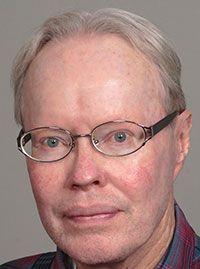
The author (wrjones@vsu.edu) published the novella, “Beyond Harvard,” and presently teaches English as a second language.