Episode behind 'Heaven, Wind and Stars'
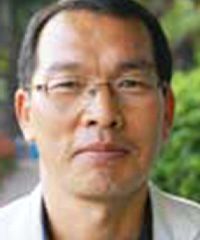
By Kim Jin-heon
Last weekend I visited Jeong Byeong-uk's house near the Mangdeuk Estuary in Gwangyang County, South Jeolla Province, which is situated at the mouth of the Seomjin River. At the house was a preserved collection of poems by Yoon Dong-ju, which was printed three years after he passed away in 1945.
In 1941, when the poet was graduating from Yonhi College (today's Yonsei University), he planned to print the poetry collection. At first, he asked his professor whether he should do it. The professor responded, “If you print it, you will go to jail because some of the poems criticize Japan's colonization.” Thus, the pupil gave up his attempts, but made three handwritten copies of the collection; one he gave to his teacher, another to his friend Jeong Byeong-uk and the last he kept for himself. However, in the end, only his friend's collection survived.
While at Yonhi in Seoul, Jeong resided in the same dormitory as Yoon, who was then in his third year of college. During that time, he learned how to survive and thrive as a freshman from Yoon, his senior who was known for his literary sensibility and national spirit. One year later, both of them moved to the same boarding house near the school.
While living together, the poet showed him his new works and often inquired as to their literary value.
After graduation in 1942, Yoon went to Japan for further studies. One year later, he was arrested at Doshisha University in July 1943 on charges of involvement in the Korea independence movement. His life ended abruptly when he was killed for unknown reasons in a Fukuoka prison in February 1945 at the age of 27.
Meanwhile, Jeong was drafted as a student soldier and sent to Southeast Asia in 1944. Before leaving home, he gave his mother his last request, “If the poet and I don't come back home alive, you should keep his collection of poems well, return it to Yonhi College after the country becomes independent from Japan, and help to get it printed.”
Fortunately, Byeong-uk returned alive. His mother had hidden the collection, packing it into a pot with silk cloth, which she kept in a hole she dug under the floorboards.
Keeping his promise, he faithfully ensured it was printed in 1948, thus revealing some of the poet's greatest works. Soon after, he received a doctoral degree in Korean literature from Seoul National University and became a professor there.
Later, Jeong's house was sold to his uncle, Park Yeong-ju. Since then, his son Chun-sik has lived there. In the late 2000s, his daughter attended high school in Gwangyang. The daughter wrote an article relating to how Jeong's collection of poems was kept.
After some teachers read the article and visited her house, the story became known to the public. The Gwangyang mayor visited the house and declared it to be “Jeong Byeong-uk's house,” thus preserving Yoon's posthumously published work by appointing it as registered cultural property No. 341, to be managed by the city.
The news that Yoon's poems were stored at Byeong-uk's house and printed spread to Longjing in China's Yanbian Korean Autonomous Prefecture, where the poet was born. In 2008, 20 ethnic Korean students who had received Yoon's literary award from three provinces in Northeast China visited the house and showed an instant connection relating to his life.
The process of Yoon's collection of poems being printed, Jeong's willing to evaluate his friend's poetic excellence and preserve it and his mother's efforts to hide his works in her house with devotion during the period of Japanese colonialism tells a dramatic story worthy of the history books.
Kim Jin-heon is an English teacher at Chung-mu High School in South Jeolla Province.