K-pop, K-quarantine and now 'K-fire service'
By Shin Yeol-woo
In July, the United Nations Conference on Trade and Development (UNCTAD) made a unanimous decision to raise Korea's status from a developing economy to a developed one. This was the first such upgrade ever made since the establishment of UNCTAD 57 years ago. Praising Korea for being a model case of growth in all domains from economy to culture, UNCTAD expressed its hopes for Korea to play a bridging role between developed economies and developing ones.
While we all have our own interpretations, this moment surely counts as one of the key milestones in the nation's history, because the global community formally acknowledged Korea's status as a developed economy. So 2021 may well be remembered as the first year of the Republic of Korea as a developed economy. As such, the first Firefighting Day (Nov. 9) we celebrate as a developed economy offers an opportune occasion to reflect on the present and the future of the nation's fire service.
One of the top duties of a government is to protect the life and property of its citizens, and firefighting is one of the most essential means of doing so. But most countries in their early stages of growth struggle to make an adequate investment in firefighting capacity. Korea was no exception, but thanks to its rapid economic growth and in response to a series of severe disasters, Korea's fire service has witnessed remarkable development.
As of now, Korea has over 60,000 personnel engaged in the fire service, with a goal to increase the number to 70,000. It also has over 7,000 fire engines and 31 fire helicopters positioned all around the country. Such mission-ready capacity allows us to reach any scene of disaster within just seven minutes on average.
Korea's fire service is also responsible for leading the nation's emergency response to disasters, forming one of the most effective fire service-led systems in the world. For all types of disasters, from receiving emergency calls to timely communication with related organizations such as the police and conducting rescue operations on the scene, fire authorities command, coordinate, and control disaster response efforts. The situation management system for supporting its operations is also world-class, thanks to Korea's cutting-edge information and communication technologies.
The Korean fire service is also an active member of the global community. Classified by the U.N.'s International Rescue Advisory Group (INSARAG) as “heavy” grade in its capability, a Korea Disaster Relief Team has been dispatched overseas 17 times since 1997 to support disaster response efforts in foreign nations. In addition to providing education and training to emergency rescue workers from developing nations since 2005, we're also sending used fire trucks and ambulances to such nations.
For Korean citizens abroad, there's an emergency medical service helpline. If our citizens, while travelling, working, studying, or living abroad, sustain an injury or illness, they can reach us via telephone, e-mail or social network services. The fire service's emergency medical specialists are available for support 24/7.
The fire service has also played an important role in Korea's successful fight to control the spread of COVID-19 and facilitate the rapid vaccination of the population. We have been responsible for transporting patients safely and our paramedics have supported vaccination centers all over the country, even providing disaster relief vehicles for the comfort of medical staff.
So it would be no exaggeration to say that, just like K-pop, K-culture and K-quarantine, the level of Korea's fire service too is that of a developed economy. And yet, we have so much more work to do, especially to prepare ourselves against future risks such as the climate crisis and other pandemics. In particular, we ought to accelerate the application of future technologies such as big data, robotics, drones, IoT and AI in firefighting.
And through such innovations, on this 59th Firefighting Day, we hope “K-fire service” will have an even stronger footing with its disaster response system empowered by the latest technologies, to serve the world at large.
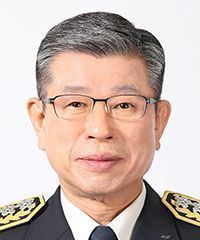
Shin Yeol-woo is commissioner of the National Fire Agency.