The difficult choice

A group of children looking at the photographer, circa 1900s / Robert Neff Collection
By Robert Neff
Photographs of Korea in the late 19th and early 20th centuries often are graced with the images of children. They captivate the viewer. In many pictures, the children are more like accessories ― used as a scale to indicate the size of an object or to breathe life into a rather dull image of a building or artifact.
In other pictures, children are the main subject. They gaze curiously out at the viewer ― the interloper ― who has accosted them in the street while they are playing with their friends or are busy with chores.
Many photographs were staged, with the children placed to capitalize on their beauty and innocence ― in hopes of appealing to a greater market.
These images of Korean children in photographs are flattering but the images portrayed in contemporary books, newspapers, magazines and letters home were not.
One of the most frequent comments about Korean children was their lack of clothing. In the late summer of 1888, an American correspondent blushingly described small Korean children as rarely wearing anything “more than a little jacket coming down two inches below the arm pits.” A little over a decade later, an American gold miner told his parents that Korean children ran around “dressed only in a smile.” Perhaps this is why a missionary in 1891 declared Korea to be “a land of naked children.”
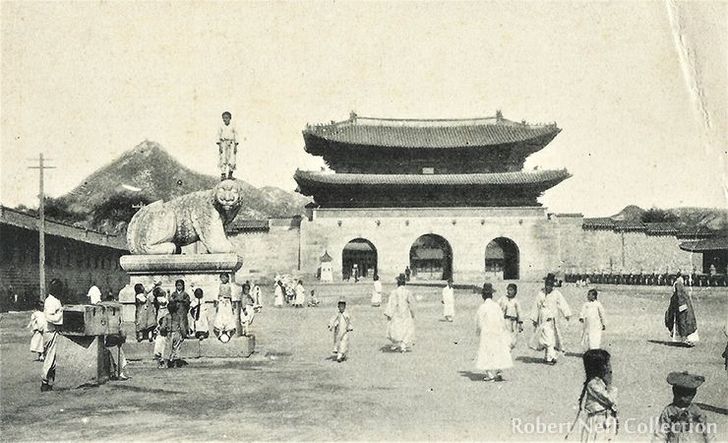
A view of Gwanghwamun in the early 1900s / Robert Neff Collection
Their observations were rather amusing and benign but others, like Isabella Bird Bishop, may have been overly harsh. Describing her first impression of Fusan (part of modern Busan), she disparagingly wrote that “mangy dogs and blear-eyed children, half or wholly naked, and scaly with dirt, roll in the deep dust or slime, or pant and blink in the sun, apparently unaffected by the stenches which abound.”
Westerners also wrote about the high mortality rate of Korean children ― especially from smallpox. Horace Allen, a missionary doctor, claimed that about 50 percent of Korean children died before the age of five due primarily to smallpox. Many parents did not even name their children until after they contracted and survived the disease. (It might be interesting to note that the mortality rate among missionary children was also quite high, which they stoically ― if not a little coldly ― accepted as the will of God).
Foreign visitors often described seeing mothers and elderly grandmothers wandering the streets with sick babies and small children upon their backs. The women spoke softly, in honorific Korean, to their small ward in an attempt to quiet their cries of discomfort and misery, and not to excite the wrath of the demon they believed was responsible for the disease.
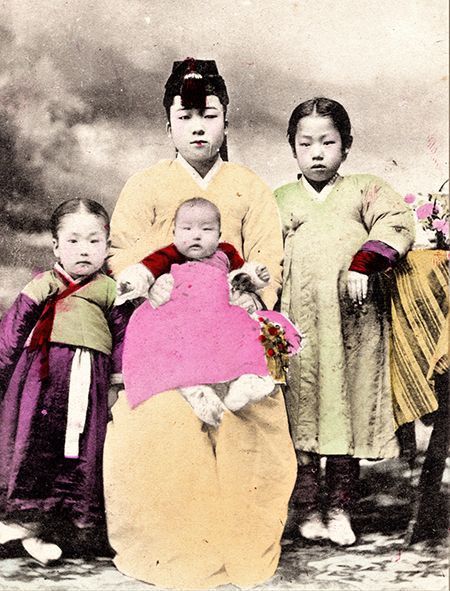
A mother and her children in the early 1900s / Courtesy of Diane Nars Collection
Sometimes their efforts were futile and the child died. The corpse was sometimes taken outside the city gates and displayed in the fields as a reminder to the demon that it had already claimed a life and that perhaps it should move on. Others were wrapped in straw and sometimes placed in trees.
Poor families were sometimes forced to make practical but horrendous decisions. Unwilling or unable to pay for treatment, they abandoned their children (those unlikely to survive) outside the city walls among the corpses or tied them to trees in the vicinity to prevent them from wandering back to their homes.
By the late 1880s, Western missionaries established many small hospitals and clinics. At first, they were viewed with suspicion but as time passed their popularity grew ― especially in cases where traditional medicine seemed inadequate.

A Korean mother and her young ward, circa 1900s / Robert Neff Collection

A young Korean porter and his rude feathered passenger, circa 1900s / Robert Neff Collection
In December 1888, a Korean couple and their 12-year-old son visited Chejungwon, the royal hospital in Seoul, now part of the Yonsei University Health System. The parents explained to the American physician, Charles W. Power, that their son “was contemplating matrimony” and wanted the doctor to make a choice.
Although Power was a fairly recent arrival to Korea, he was, undoubtedly, aware of the importance marriage played in Korean society. At the time, it was believed that for a woman to fulfill her destiny, she needed to marry and have children ― at least one son, if not more. Some of the superstitious believed that if death claimed a woman before she wed, her spirit ― filled with han (a feeling of regret, hatred or despair) ― would roam the mortal world until it was placated. Sometimes this placation was a shamanist ritual or a spiritual marriage with a young deceased bachelor.
Men, too, were completed with marriage. An unmarried man, no matter what his age, wore his hair in a long braid and was spoken to and treated as a mere child. If a young boy ― not even in his teens ― married, he was allowed to wear his hair in a top-knot and joined the ranks of men.
Power understood the importance of marriage in Korean society (his own religious beliefs echoed this sentiment) but he did not understand in what manner he could help his young patient. What choice could he make to enable his young patient to marry?
Power began by examining the boy and noted that the lad was good looking and as he talked with him his patient seemed to be intelligent and with a good male voice. However, when the patient undressed, Power was startled to discover both male and female genitalia. The parents wanted the doctor to decide which gender would best suit their child.
It isn't clear but this may have been the first intersex patient to have been treated by Western doctors in Korea. However, undoubtedly there were others in the Korean community. Historically, one of the best-known Korean intersex persons was Sa Bangji, a serf who was raised as a woman. Sa Bangji was apparently very attractive and during the reign of King Sejo (r. 1455-1468) was discovered having an affair with a widowed noblewoman. The Korean court was shocked.
Power was apparently not shocked but did feel the case was interesting enough to write about in a letter to his former medical school classmates. He noted that he consulted with one of his fellow Western doctors and they decided not to choose a gender until they could verify the location of the various parts of the genitalia and then they would proceed with an operation. Of this case, we know nothing further; Power apparently did not send another letter to his classmates possibly because he was distracted with his own personal affairs in Korea (he departed within the year under a cloud of morality shame).
So we are left with nothing but questions. Did they eventually operate and, if so, what was the outcome? What gender was chosen? Did the youth eventually marry and, if so, was it a happy marriage? Who knew about the operation? Surely the youth's peers were aware; as mentioned above, Korean children often ran around naked or near-naked ― and, although perhaps it is only wishful thinking on my part, accepted and supported their friend. Was the past more accepting and inclusive than the present?
Robert Neff has authored and co-authored several books including, Letters from Joseon, Korea Through Western Eyes and Brief Encounters.