America's first encounter with Joseon happened by chance

Busan in the early 20th century. Courtesy of Diane Nars Collection
By Robert Neff
On January 28, 1853, the residents of Busan were alarmed by the appearance of “a big foreign ship” ― nearly 40 meters long with two decks and three masts. Hanging from one of the masts was a strange red, white and blue flag ― it was one that had never been seen before by the Koreans.
This incident, when mentioned in history books, is often no more than a footnote and there seems to be a lot of confusion surrounding the ship and its importance. One source claims that the ship was an American gunboat from Hawaii and was the first official US-Joseon contact. Another source claims it was a merchant vessel and was the first attempt at trade between the United States and Korea. Both of these theories are incorrect. The ship was the American whaler South America and its visit was due to an act of nature rather than an economic or political ploy.
In late December 1851 or early January 1852, the whaler (commanded by 36-year-old Washington T. Walker) left New Bedford, Massachusetts, and sailed to Hawaii ― arriving there on May 25, 1852, but not without incident.
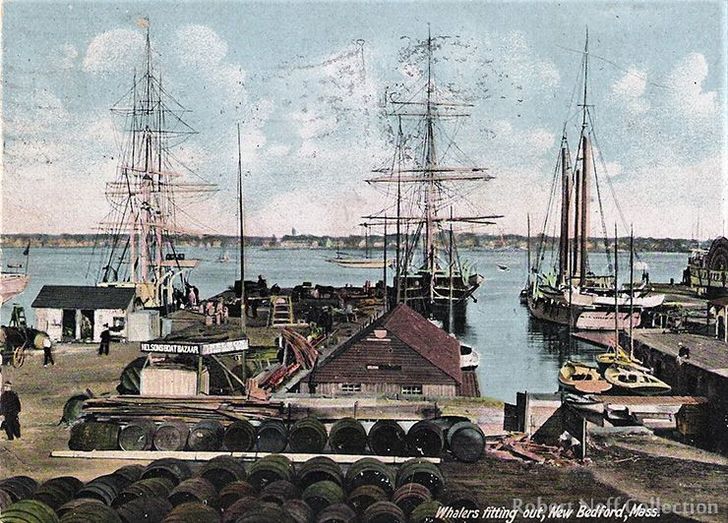
The whaling port of New Bedford in the early 20th century. Robert Neff Collection
According to the “Polynesian” ― an English-language newspaper printed in Hawaii ― the whaler “touched” a reef in Honolulu harbor. The paper caustically noted the whaler's “running on the reef was anticipated by persons ashore who had been watching her evolutions during the day.” Apparently Captain Walker was ashore at the time and had left the ship in charge of one of his crew who “most certainly exhibited a recklessness in approaching the reef perfectly unjustifiable” even though it was broad daylight and “the line of breakers as distinct as the nose on his face.”
Fortunately, after about an hour, the whaler managed to float itself off the reef “without sustaining much injury” and set sail to hunt whales in the northern Pacific Ocean and the Arctic regions. The newspaper editor seems to have considered Walker's quick departure as rather rash for he wrote, “[We] should not be surprised to see her [South America] back leaking, for she must have been considerably strained while on the reef.”
The editor was wrong.
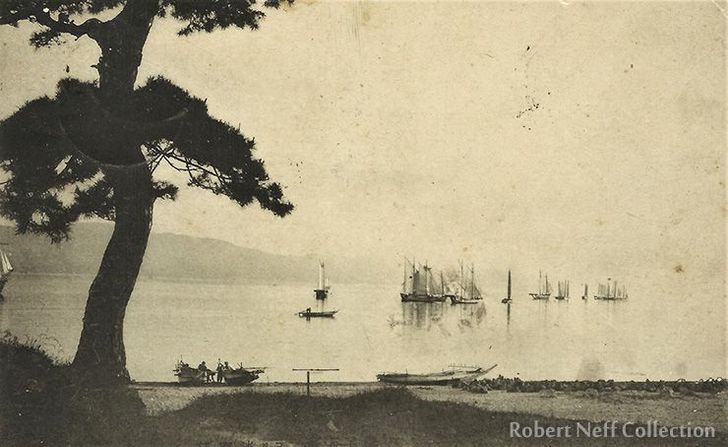
Japanese coastal scene in the early 20th century. Robert Neff Collection
On October 6, South America triumphantly sailed into Honolulu harbor with its holds filled with more than 1,300 barrels of whale oil and 2,600 whale bones. Captain Walker; his 23-year-old wife, Hattie; their 17-month-old daughter, Antoinette; and the crew of about 40 men, spent the next five weeks refitting the ship and preparing for their next voyage.
On November 17, South America ― accompanied by its tender, a brigantine named Wilhemine ― sailed from Honolulu bound for the East Sea. It was in the third week of December that they encountered a horrific gale near Japan and the two ships were separated. The Wilhemine's captain, “being without instructions to meet the case, and not knowing where to find the South America” sailed for Hong Kong. Captain Walker, still intent on hunting whales in the East Sea, proceeded along the coast of Japan and encountered a Japanese shipwreck. Two Japanese charcoal merchants ― Gankichi (about 60 years old) and Senkichi (35 years old) ― were rescued near a small island. They were the only ones to have survived when their ship sank on December 23.
It isn't clear why Captain Walker and his ship, South America, sailed into Busan. Perhaps the ship was damaged in the earlier storm or, perhaps, they were seeking refuge from another storm. Regardless of the reason, their appearance caused some excitement.
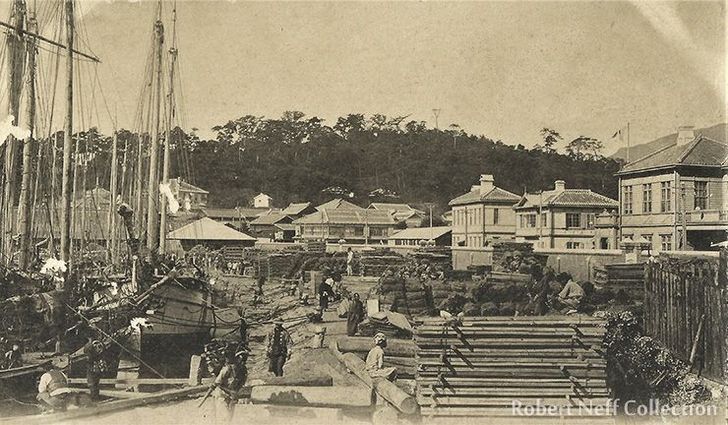
Busan in the early 20th century. Robert Neff Collection
When the local authorities approached the ship, the Western sailors identified themselves as “myorikye” ― at least that is what the Korean authorities heard but they were likely saying “America.” The Korean authorities tried to communicate with writing but the Westerner's writing was like the “shape of clouds or a picture not similar to the old seal script or any other known scripts.” Hong Yeol-mo, the governor of Gyeongsang Province, was understandably frustrated with the inability to communicate with these strangers ― even though he had interpreters who could speak in Japanese and Chinese, there was apparently no one in Captain Walker's crew who could speak either language. Obviously, the two shipwrecked Japanese merchants were unable to assist.
Despite the inability to communicate with one another, the relationship between the American crew and their Korean host seems to have been amicable. One source claims that Captain Walker and his family wined and dined the local Korean authorities and we know from Korean sources that a tour of the ship was given. According to a government report, the ship had a “large room of the width of roughly 12 kan, which was used as living quarters in the middle of the ship.” It also noted the ship had one cannon, 12 rifles, 50 fishing hooks, 2 crates of grain, 5 barrels of whale oil and, somewhat surprisingly, two saddles.
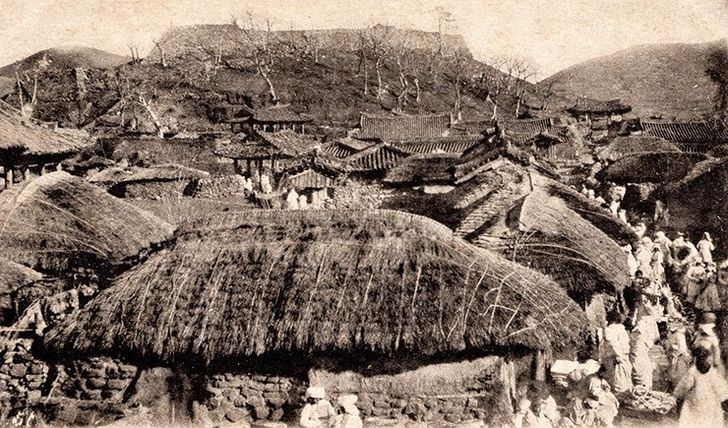
A fortification in the Busan area in the late 19th century. Courtesy of Diane Nars Collection
There were also a number of animals aboard including two calves, a small flock of chickens, a pig, a goose and two dogs.
The whaler remained in Busan until about February 7, 1853, when the winds were favorable for the ship to leave. The two Japanese merchants were left behind and subsequently repatriated to Japan. South America continued with its whale hunt and returned to Hawaii by November ― apparently, despite its poor start, it had a successful whaling season.
While the South America played no important role in early Korean-American relations, it does deserve more recognition than a mere footnote.
My appreciation to JiHoon Suk for providing the Korean source material and to Diane Nars for her invaluable assistance in tracing the whaler South America's history.
Robert Neff has authored and co-authored several books including, Letters from Joseon, Korea Through Western Eyes and Brief Encounters.