The misadventures of the HMS Grafton

The HMS Grafton in Japan ― notice the ship is decorated with evergreens for the Christmas season. December 1896. Courtesy of Dougal Watson
By Robert Neff
Following the Sino-Japanese War of 1894-95, the British government increased its naval strength in the Far East. In early summer of 1896, one of the British navy's newest ships, the HMS Grafton, departed England for the China Station.
Captain Edward Pitcairn Jones, a Tasmanian, commanded the ship but he was not the senior officer aboard ― that honor fell to Rear-Admiral Charles Lister Oxley, the second-in-command of the British China Station fleet. We know little about their relationship save Oxley was described as being “most eccentric altho' very friendly” and Jones ― who had been chastised for being drunk on duty when he was a young naval officer ― had a bad heart.
Almost from the beginning, the HMS Grafton's voyage was plagued with mishaps. On July 3, 1896, while steaming through the Indian Ocean to Sri Lanka, the ship encountered heavy seas and the main topmast ― equipped with semaphore equipment and top-heavy ― snapped and was carried away. Fortunately, it “was soon repaired by the artisans on board.”
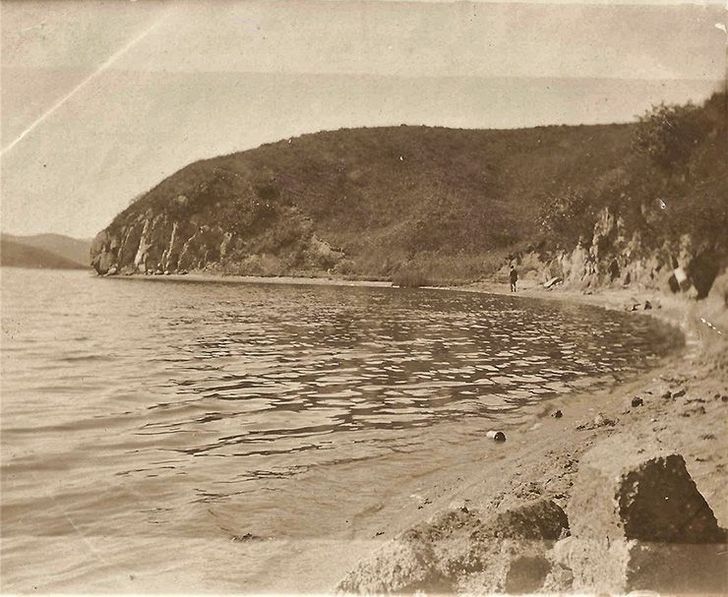
Sivoutch Bay or the nearby lake. September 1896. Courtesy of Dougal Watson
Two days later, in the early afternoon, the crew was startled to discover a huge whale impaled upon the ram of the ship. Fortunately, the ship suffered no damage but the whale, estimated to be about 18 meters long, had to be cleared from the ram before the ship could continue.
On August 11, the H.M.S. Grafton finally arrived at its destination, Yokohama, Japan. Apparently, after the long arduous voyage, the crew was allowed shore leave and took to exploring the Japanese port on bicycles ― for many of the sailors, this was their first time astride two-wheel ―and wreaked havoc on the population by crashing into pedestrians, rickshaws and walls.
Shortly after his arrival in Japan, Oxley decided to tour the region surrounding the East Sea in the Grafton. He first traveled to Vladivostok where he was treated quite civilly by the Russian authorities and then traveled along the eastern coast of the Korean peninsula. One of the first places they visited in Korea was a remote anchorage near the Russian border known as Sivoutch Bay.
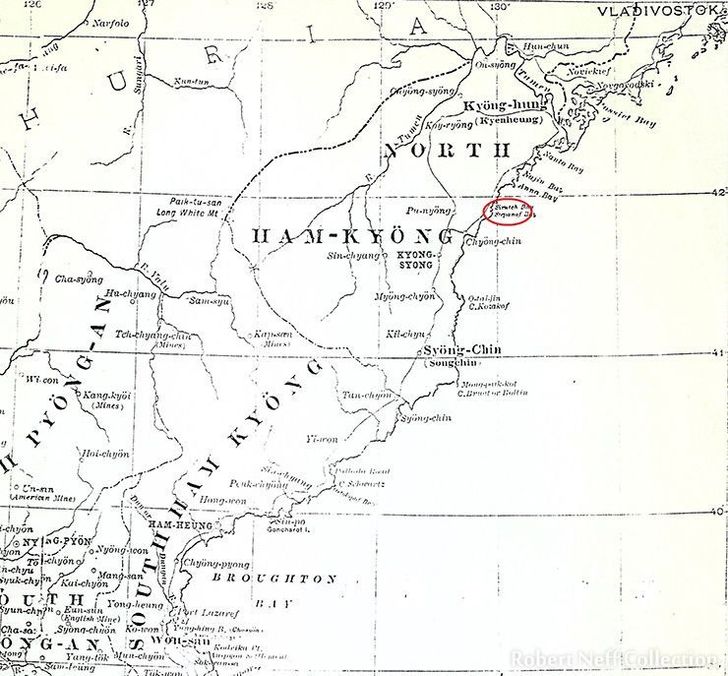
Sivoutch Bay on a map, circa 1904. Robert Neff Collection

Korean villagers inspecting a British naval officer near Wonsan in 1887. Robert Neff Collection
On the morning of September 28, Oxley decided to take advantage of the good weather and do some bird hunting with his secretary, Henry James Troughton, 27. Bird hunting was a popular sport for British naval officers along the north-eastern coast of the Korean peninsula. This region was still comparatively uninhabited with vast tracts of wilderness and wetlands.
Of course, there were dangers. Tigers and leopards roamed these desolate regions with relative impunity. but I have found no mention of any armed-Westerners being killed by these predators in Korea.
Inhabited areas were also dangerous. Villagers were often alarmed at the sudden appearance of armed foreigners and would sometimes flee their homes or grudgingly humor their uninvited guests making it clear the sooner the foreigners left, the better it would be for all involved.
Even when welcomed, the foreigners often found themselves the center of unwanted attention by the more curious members of the male community ― no part of their clothing or bodies were exempt from curious hands. Sometimes the victims of this curiosity feared they were going to be pick-pocketed, but generally the only thing taken was their personal space and dignity. There was, however, an even greater ― and more plausible ― danger of contracting smallpox, which often plagued the Korean peninsula.
Oxley, however, does not seem to have been concerned. He and Troughton tramped a couple of kilometers inland to a large lake where they spied a large flock of wild geese at the opposite end. It was here that they separated ― Troughton trudged along the shore towards the geese while Oxley waited.
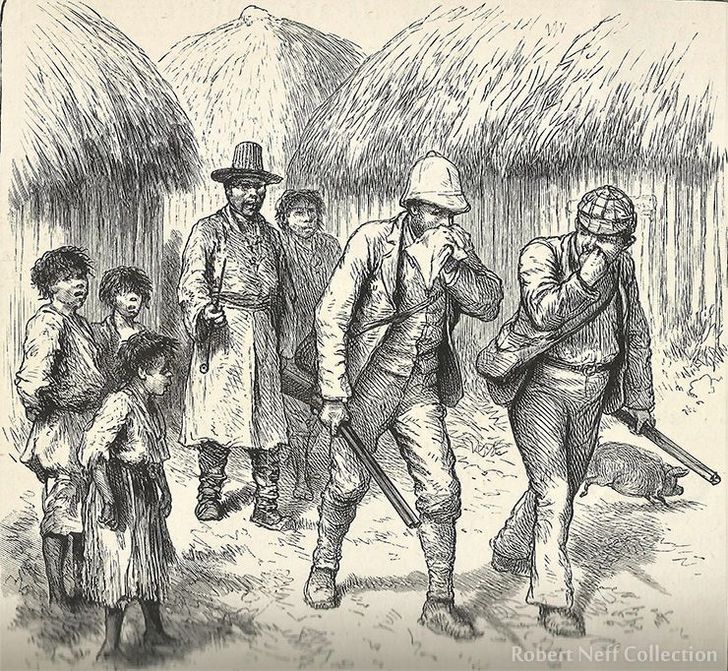
A British naval officer hunting party going through a Korean village. They are concerned about contracting smallpox from the Korean villagers. Circa 1894. Robert Neff Collection
After a short time, Oxley heard Troughton “fire both barrels of his gun, and, turning round, saw him throw off some of his clothes and wade into the lake to recover the birds he had hit.” Oxley thought nothing of it and “sat down and waited, expecting to see him emerge from the water again in a few minutes.” Troughton never reappeared.
Alarmed, Oxley raced to the spot where he had last observed his secretary and found “his gun, cartridge bag, and clothes, and observed footprints where [Troughton] entered the water.” Realizing his secretary was probably dead, Oxley returned to the ship “as quickly as possible, and procured men, drags &c., and had boats carried overland to the lake.”
The lake was dragged and it was not until the early morning of the 30 that the young man's body was discovered. “It was covered with the Union Jack, was reverently brought on board, and received by all the officers on the quarter-deck, while the ship's bells were tolled. He was buried at sea the same afternoon.”
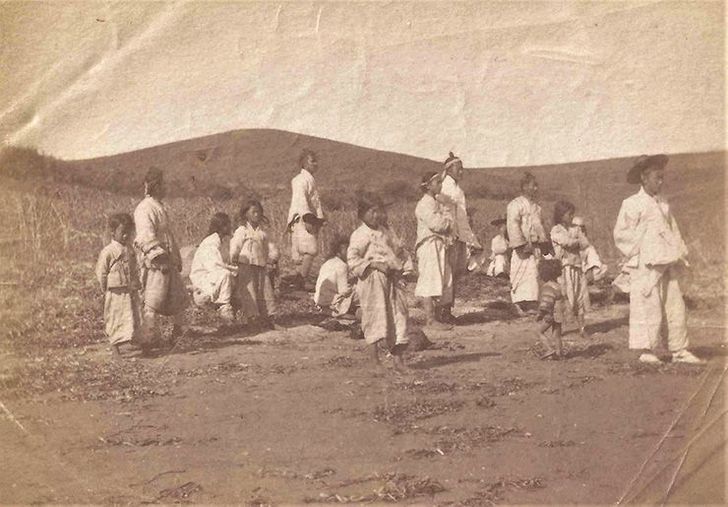
A curious group of Koreans near Sivoutch Bay. September 1896. Courtesy of Dougal Watson
Oxley ordered that a cross be cut into the stone near the spot where he had discovered his secretary's clothing and gear. A picture was taken as a final remembrance of the young officer who “was much esteemed by all who knew him.”
The HMS Grafton returned to Japan and the death of the young officer was reported to the Admiralty. It was speculated that Troughton, upon entering the water, had suffered severe cramps or possibly a fit of some sort. We will probably never know what killed the young man.
Oxley remained in the Far East as second-in-command for a little over a year before going on to other assignments. He eventually retired in 1906 as a full admiral. Captain Jones ended was sent back to England with “Morbus Cordis” ― heart disease ― but soon recovered and was given other commands. He retired as a rear-admiral at the end of 1905.
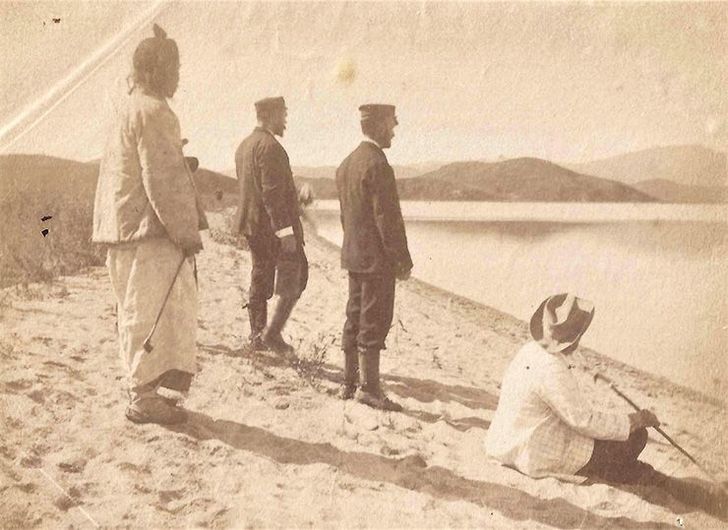
British naval officers and a Korean villager near Sivoutch Bay. September 1896. Courtesy of Dougal Watson
The Grafton finished its tour in September 1899 and two years later was assigned to the British Pacific Station Fleet. Surprisingly, once again, the Grafton had a strange encounter with a denizen of the deep. In early 1903, while sailing from Peru to Chile, an enormous blackfish which, according to one officer, was between 10 and 13 meters long and landed on the bow. The impact killed the fish immediately. The young officer remarked in a letter home that he had never heard of such an encounter ― perhaps he should have checked his own ship's history.
I would like to express my appreciation to Diane Nars for her assistance and to Dougal Watson whose great-great-uncle, Frank Seymour, served aboard the HMS Grafton and was kind enough to allow me to use his images for this article. If you would like to know more about the HMS Grafton's tour on the China Station see Mr. Watson's site
https://atlantic-cable.com/CableStories/Seymour/people_seymour_f.html
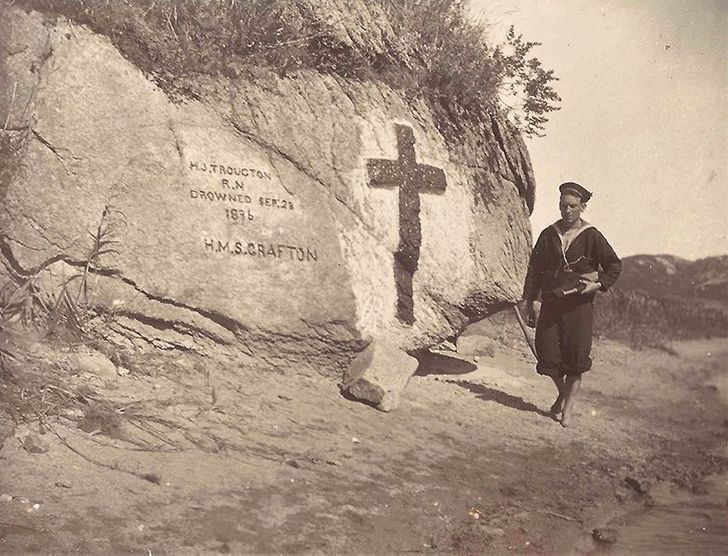
The location of Henry James Troughton's drowning. September 1896. Courtesy of Dougal Watson