Treasures along the Han River: Salgoji Bridge
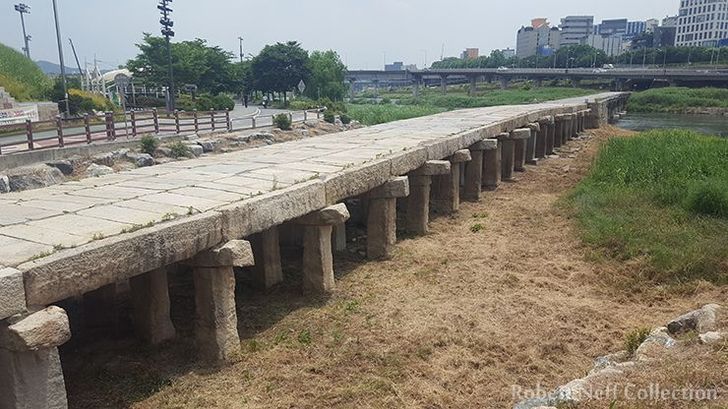
Salgoji Bridge, June 2020. Robert Neff Collection
By Robert Neff
Bicyclists who ride along the Han River on the eastern side of Seoul are probably quite familiar with the Salgoji area.
A couple of bike lanes converge here and it is not uncommon to find the Ipseokpo (Standing Stone) rest area filled with cyclists taking a break.
At one time, this was a popular fishing spot but now, for the most part, the fishermen are gone, and the large schools of carp and smaller fish provide visual entertainment and photo opportunities.
Many cyclists ― too intent on their ride time ― are probably unaware of the history associated with this area but the knowledge is there ― if you look for it. The Seoul government recently set up story sites ― signboards that describe the history and legends of the area.
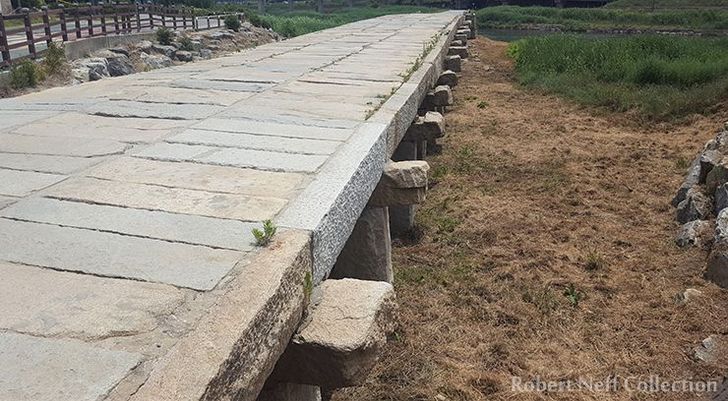
A close-up view of the surface of Salgoji Bridge, June 2020. Robert Neff Collection
Salgoji was once covered with fields that provided grazing for the government's horses and an ideal habitat for birds. It was also the domain of masculine activities. Gentry ― with their falcons ― hunted birds. Archers practiced their art in the archery ranges that also served as drill fields for soldiers
Often, modernization destroys the relics of the past but in this area one visage of Joseon remains and, remarkably, is still used. This relic from the past is Salgoji Bridge.
According to the signboard nearby, construction of the bridge began in 1420 but was not completed until 1483. It was the longest stone bridge built during the Joseon dynasty and had a vital role in transportation with the capital and the southeast region. It was also a popular place to stave off disease ― as we shall see tomorrow.
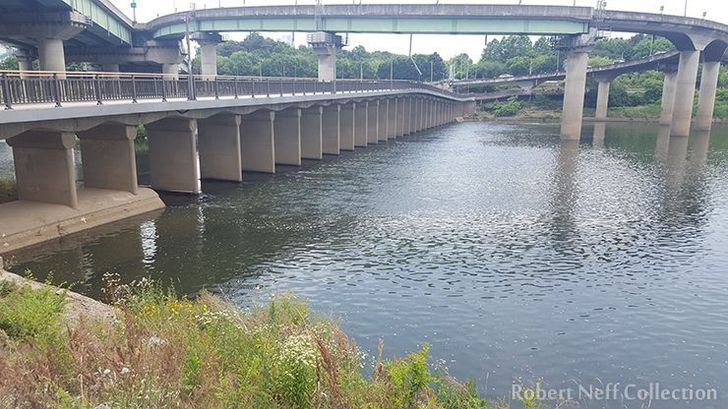
The Ipseokpo rest area can be seen just below the overpass, June 2020. Robert Neff Collection