Walking in the footsteps of the past: The memorial of national shame

Samjeondo Monument's protective enclosure, June 2020. Robert Neff Collection
By Robert Neff
In the fall of 1884, George C. Foulk, an ensign in the U.S. Navy temporarily assigned to the American legation in Seoul, traveled extensively around the Korean Peninsula.
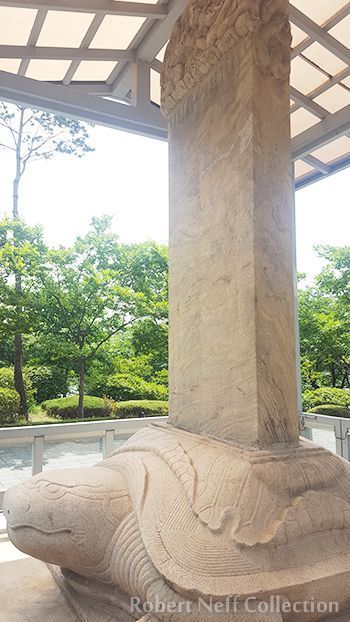
Samjeondo Monument, June 2020. Robert Neff Collection
His journals were filled with observations of Korean culture, architecture and the trials and tribulations of traveling in a country that had only recently opened to the West ― one of his chief complaints was the lack of privacy.
It is somewhat surprising that during his trip he was granted access to so many sensitive sites ― such as the North and South Mountain Fortresses. The authorities showed a remarkable willingness to show him the fortifications and ask his opinion but, just outside of Songpa (now in Seoul), the willingness to explain in detail ceased.
On October 7, on the edge of Songpa ― “a village of historic interest” ― he encountered a “tall building of graceful shape and indicated to be official by its decorations in red containing a great marble tablet fully twelve feet high and a foot thick mounted upon the back of a gigantic granite turtle.”
Foulk was intrigued. The front of the memorial was filled with Manchu and Mongolian characters while the back was covered with Chinese characters. Outside the building was another turtle ― surrounded by a rough railing ― but it did not have a tablet on its back. There were also several dressed stones, stone columns and sheep and drums that he usually found near Korean graves.
When asked the significance of the site, a Korean officer stationed in Songpa informed Foulk that “after the Chinese had begun the invasion of Korea in 1637, two large marble tablets covered with inscriptions were brought to Korea from China by sea; that the erection of these was violently resisted by Koreans, and one was destroyed; the other was brought to Songpa and there set us.” Ever since then, it was protected by the Joseon government.
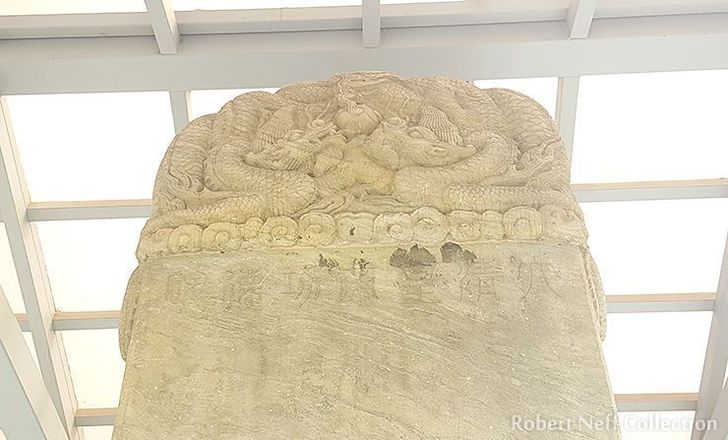
The top of the Samjeondo Monument, June 2020. Robert Neff Collection
When Foulk asked for a translation of the inscriptions, the official professed he did not know what they meant. Foulk then asked if he could make a rubbing of the inscriptions but this was forbidden ― only the governor could provide this special permission.
With daylight running out and the need to continue with his journey, Foulk left the village but noted in his journal: “Historically this monument presents much interest and a thorough examination may develop information on the status of Korea with regard to China of more directly practical use: this I shall endeavor to make.”
Foulk apparently never followed through with his investigation and thus was probably unaware of how accurate his observations were. The memorial is now known as Samjeondo Monument. According to the information board next to it:
“In early 1637, the Qing troops crossed the Amnokgang River. Six days later, King Injo (r. 1623-1649) and his ministers took refuge in Namhansanseong Fortress to defend themselves against the invaders. After withstanding 47 days of siege, King Injo went to surrender at the ferry dock of Samjeondo, where the Qing troops were staying, and was forced to accept vassal status to Qing. Later, the Qing Emperor Hong Taiji ordered a monument to be erected at Samjeondo, praising his excellent virtues.”
The board also notes that the memorial has suffered vandalism on several occasions “as it was regarded as a symbol of humiliating history.”
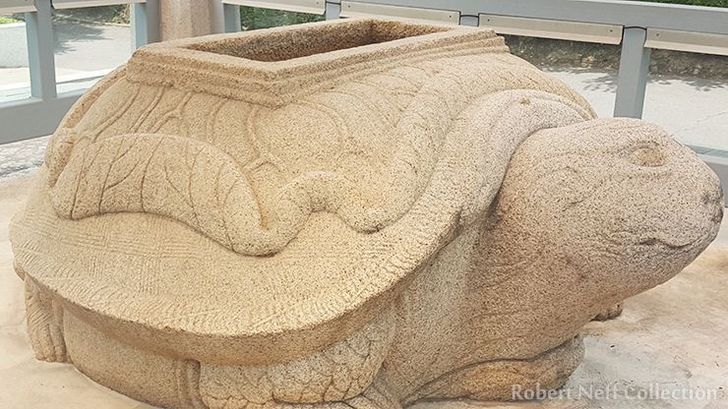
The empty turtle at Samjeondo Monument, June 2020. Robert Neff Collection
One of the earliest acts of vandalism took place in 1894-95 when the stone was toppled over and buried. Fortunately, before it was hidden away, another American, Homer Hulbert, was able to translate the inscriptions. According to Hulbert, “there were two stones, one of which was set up; the other, remaining on the bank of the river, was finally washed into the stream.”
The memorial was set up where the Joseon surrender had taken place and a sturdy building was built over it to protect it from the elements but it wasn't the elements it needed protection from.
The inscriptions were extremely humiliating. It denounced the Joseon monarch as being a “weak and insignificant king” while praising the Qing emperor for being extremely patient and “treated us [Koreans] with kindness and by his goodness calmed our agitated minds. When we beheld him our heart went out to him.”
According to the inscription, the invasion by the emperor and his more than 100,000 soldiers ― “many of them were like the tiger and the dragon” ― was because Joseon had failed to honor its treaty. The Korean people ― in fear ― “scattered like pheasants” while the king fled to the mountain fortress where he hid for 50 days before the threat of starvation caused him to surrender.
With the emperor's forgiveness, “all things became as they had been. Snow and frost were gone and spring smiled forth again. After the drought the showers fell. All that had been destroyed revived again … to the dead roots of the tree was brought back the springtime.”
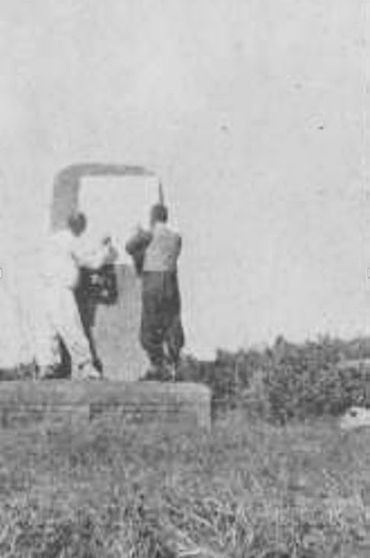
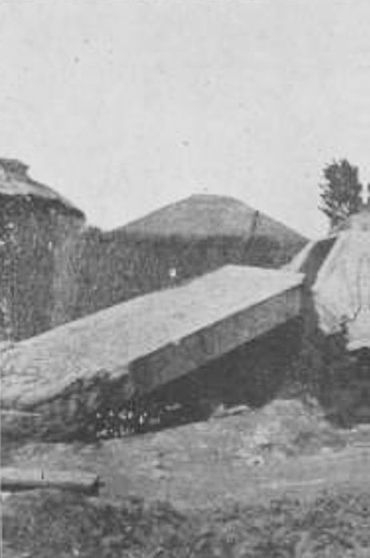
Koreans making rubbings of the stone in 1917. Korea Magazine, September 1917, courtesy of Brother Anthony
This lofty stone was erected to remind the Joseon people of the goodness of the Qing emperor. Hulbert summed it up as the narrative the emperor used to reinforce the claim that Korea was a vassal state of China.
In 1917 (Wikipedia states 1913), the stone was rediscovered and restored to its original site. Over the next couple of decades it was pretty much forgotten until Syngman Rhee ordered it to be destroyed. Fortunately, his orders were not carried out and the stone was once again buried. Rhee's own statues would not be so lucky. With his fall from grace, his statues were hauled down and dragged through the streets.
But the Samjeondo Monument would not stay hidden. A flood in 1963 revealed it and it was promptly declared a historical site and protected. The monument now stands in a protective enclosure near Lotte Tower. Time and the elements have nearly erased the inscriptions, leaving it nothing more than a forgotten curio from the past.
Around the world, statues and historical sites are being destroyed in an effort to forget the past but perhaps we should be protecting them (with a narrative) so we can remember the past and learn from it.
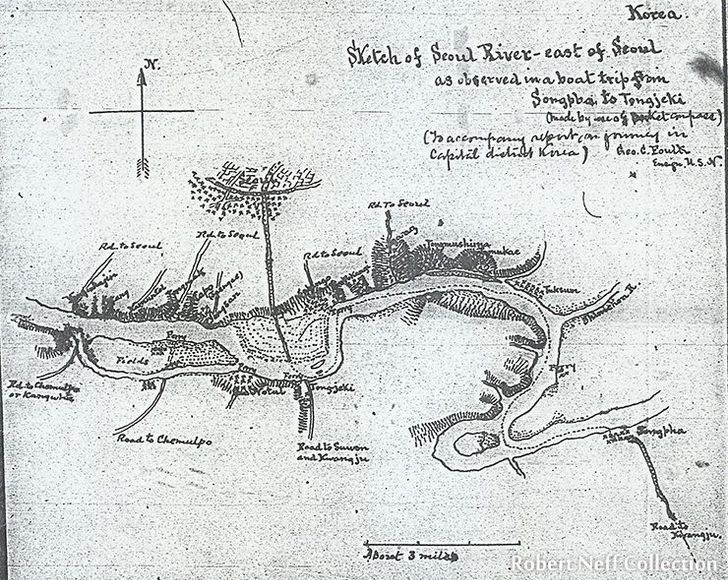
George C. Foulk's map of the Han River in 1884. Robert Neff Collection