The jumak: A sanctuary in a possibly deadly night

Isabella Bird Bishop's traveling party in the mid-1890s.
By Robert Neff
At the end of the 19th century, traveling at night in Korea was generally avoided. The darkness hid many dangers. Some were physical.
Bandits and rebels preyed on small parties, stripping them of their goods and, on occasions, their lives. Unwary travelers were also preyed on by tigers, the monarchs of the wilderness, or ― in later years ― by wolves.
There were also malevolent spirits that haunted the night ― goblins and ghosts that played pranks on travelers or led them to their doom.
Gumi-ho (a type of nine-tailed were-fox) seduced young men with their feminine charm and looks and then robbed them of their lives. Thus, as darkness began to fall, many travelers elected to stay in a jumak, or inn.
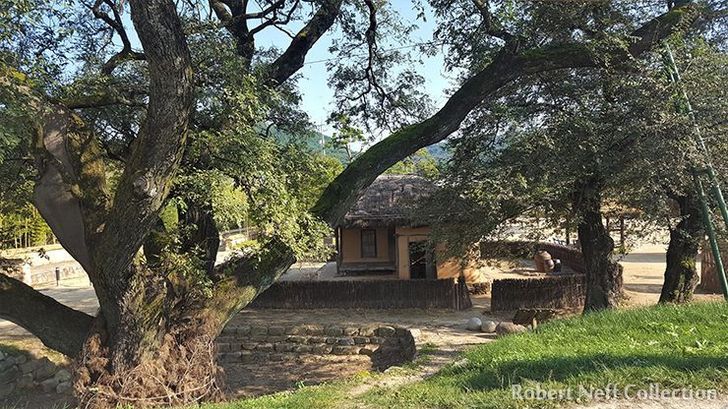
Samgang Jumak near Yechon in North Gyeongsang Province. Robert Neff Collection September 2017.
Isabella Bird Bishop, an intrepid English travel writer, traveled extensively through Korea and had a decidedly negative slant when she described the jumak in her writings.
“There are regular and irregular inns in Korea. The irregular inn differs in nothing from the ordinary hovel of the village roadway, unless it can boast of a yard with troughs, and can provide entertainment for beast as well as for man. The regular inn of the towns and large villages consists chiefly of a filthy courtyard full of holes and heaps, entered from the road by a tumble-down gateway. A gaunt black pig or two tethered by the ears, big yellow dogs routing in the garbage, and fowls, boys, bulls, ponies, mapu [horse handlers], hangers-on, and travelers' loads make up a busy scene.”
Usually decent food could be found in even the crudest of these establishments. Rice, eggs, vegetables and, depending on the season and location, chickens, pheasants, seaweed, fish, pork and dog.
She warned, however, that “the position of the well, which frequently receives the soakage of the courtyard, precludes a careful traveler from drinking aught but boiled water.” Room and board was relatively cheap ― she paid about 100 cash (Korean coin) a night, which was roughly about 18 cents in American currency.
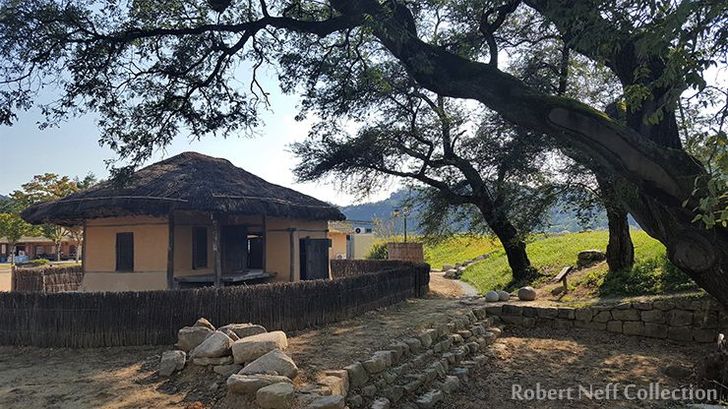
This jumak has been around since the early part of the 20th century and was a popular gathering place for travelers and ferry operators. Robert Neff Collection, September 2017.
The inn's large common room served not only as the dining room but also as the sleeping chamber. Guests stretched out on the floor and used wooden blocks as their pillows. Many Westerners found it difficult to sleep because they were never alone and not all of their companions were human.
According to Bishop: “On arriving at an inn, the master or servant rushes at the mud, or sometimes matted, floor with a whisk, raising a great dust, which he sweeps into a corner. The disgusted traveler soon perceives that the heap is animate as well as inanimate, and the groans, sighs, scratchings, and restlessness from the public room show the extent of the insect pest.”
She and her companions were relatively lucky; at about the same time, a Canadian missionary reported ― with great exaggeration ― that the bedbugs that infested the inns of Songdo (modern Gaeseong in North Korea) weighed 0.2 kilograms.
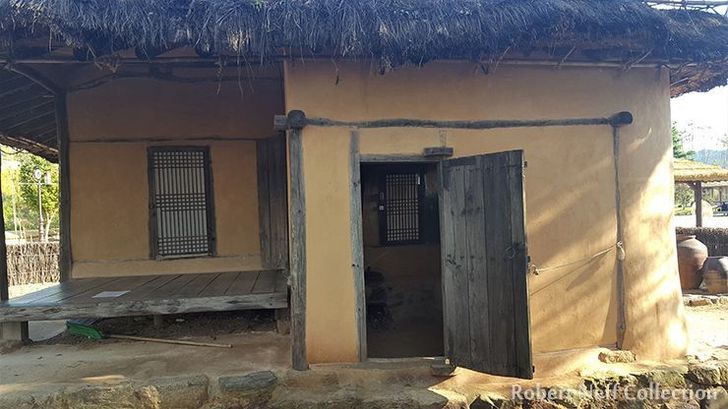
Yoo Yok-yeon was the proprietor from 1935 until her death in 2005. Robert Neff Collection, September 2017.
Bishop, however, generally did not sleep in the common room and usually arranged to sleep in the private room (if the inn had one) or in the owner's room. She always had her servant put down two large sheets of oiled paper and then slept on her folding cot. But there were discomforts.
The inns were notoriously hot. A fire was kept burning at all times, causing the floors to be uncomfortably hot. To escape the heat ― especially in the summer ― some Westerners tried to sleep out on the porch but were quickly convinced by the landlord or their guides that tigers were far more likely to kill them than the heat.
Perhaps more annoying to Bishop were the onlookers. The paper-covered doors and windows were soon devoid of their paper and crowds of curious villagers jockeyed about for a better view of her. When she hung up sheets to block their view, the spectators used long sticks to knock them down or move them away.
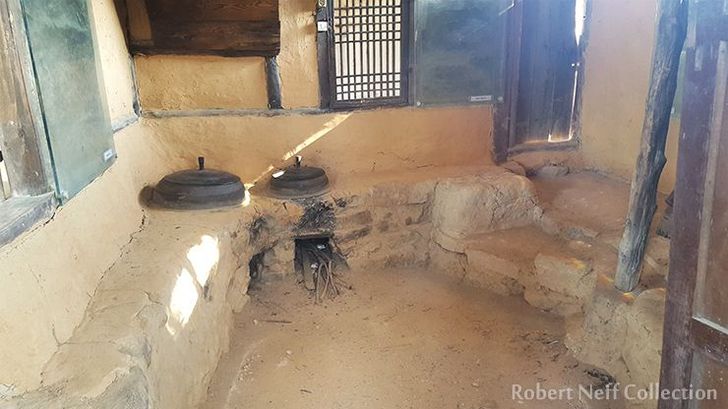
The kitchen area. Robert Neff Collection, September 2017
“[Then] the crowd broke in the doors, and filled the small space not occupied by myself and my gear. The women and children sat on my bed in heaps, examined my clothing, took out my hairpins and pulled down my hair, took off my slippers, drew my sleeves up to the elbow and pinched my arms to see if they were of the same flesh and blood as their own; they investigated my few possessions minutely, trying on my hat and gloves, and after being turned out by Wong [Bishop's servant] three times, returned in fuller force, accompanied by unmarried youths, the only good-looking 'girls' ever seen in Korea, with abundant hair divided in the middle, and hanging in long plaits down their backs.”
Wong managed to push the curious crowd back outside and then made a suggestion to Bishop that she promptly complied with. Later, when the crowd broke into her room again, they were confronted by her calmly sitting on her bed cleaning her revolver. “There was an immediate stampede,” Bishop recalled, “and for the remainder of the evening I was free from annoyance.”
Bishop concluded that although “the charges at Korean inns are ridiculously low,” traveling in the countryside “is entirely unsuited to the 'globe trotter,' and that even the specialist may do well to count the cost before embarking upon it.”
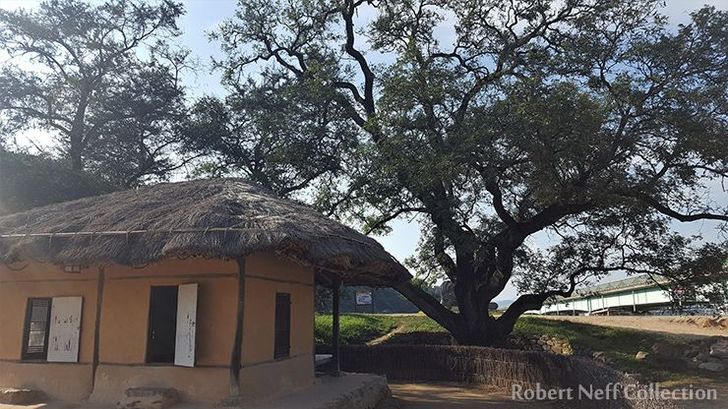
The tree is said to be about 200 years old. Robert Neff Collection, September 2017.