Viva Italia -- the power of 'family' in a time of crisis

A woman looks on from her window as radio stations across the country play the Italian national anthem for a flash mob to raise spirits while Italy remains under lockdown to prevent the spread of COVID-19 in Rome, Italy, March 20, 2020. Reuters
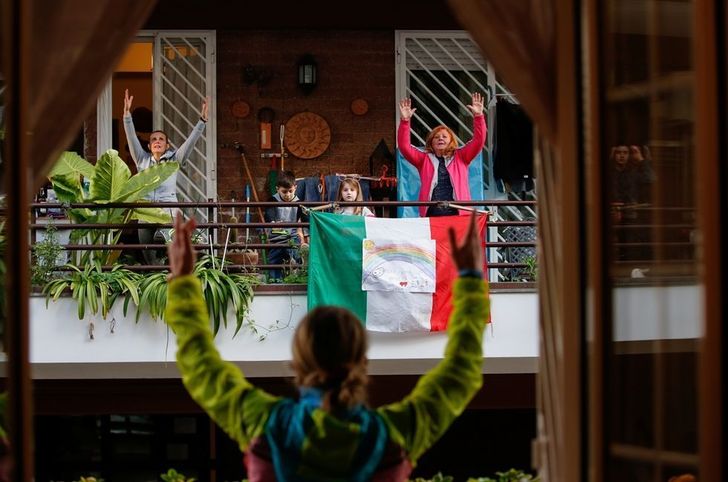
Personal trainer Antonietta Orsini carries out an exercise class for her neighbours from her balcony while Italians cannot leave their homes due to COVID-19 outbreak, in Rome, Italy, March 18, 2020. Reuters
By Amanda Price
On the streets of Italy there is singing.
The very few who cannot sing are playing instruments. Those without instruments are turning pots and pans into makeshift timpani orchestras. Those without improvised equipment are dancing.
In Milan, a gentleman plays “O mia Bela Madunina” on his trumpet ― a song considered to be an anthem of the northern Italian city, hit hardest by the virus
Florence woke to the exquisite sound of Puccini's impassioned aria “Nessun Dorma”, sung by quarantined tenor Maurrizio Marchini. The locked down audience cried, not because of the crisis, but out of deepest appreciation.
From a balcony in Turin, a concert violinist and a professional opera singer perform “Un Bel Di Vedremo” as if they were in Il Teatro dell'Opera di Roma.
Their audience is anyone of the hundreds of people within ear shot.
From balconies in Rome, the Italian national anthem “Inno di Mameli” is sung as if the Olympic Games had just opened in the City of Seven Hills.
In other cites “Volare” is sung as people dance with complete abandon.
In Agrigento, hundreds of residents, fitted out with accordions and drums, excitedly sing a favorite Sicilian song.
A sole violinist serenades his neighbors with a sublime performance of Paganini's “Cantabile”
On a cobblestone street in Treviso voices pour out windows in harmonies that rival the sounds of the Monteverdi Choir.
Musical flash mobs erupt spontaneously in all regions, at any time of night or day.
Italy is awash with music.
And the singing will not stop. Some will be spontaneous and organic, while others will be organized through social media.
As a friend from Italy wrote a few days ago, “I hope the world is listening, I hope our songs bring hope to the world.” He finished by writing “Please sing with us!” providing me with a list of songs and the times they will be sung.
A new festival of sorts has been created. It is not a harvest festival, or a traditional “celebrazione.” It is a festival of hearts, a celebration of solidarity that embraces grief and hope.
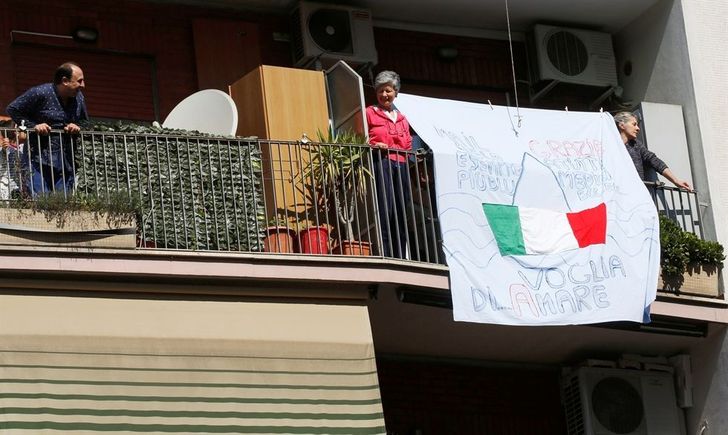
People stand on their balconies as radio stations across the country play the Italian national anthem for a flash mob to raise spirits while Italy remains under lockdown to prevent the spread of COVID-19 in Rome, Italy, March 20, 2020. Reuters
It is no longer a waiting game.
Fear is for yesterday. The unknown is now the known. No-one need be afraid of what might happen, because it already has.
Strength, resilience and determination are the new order of the day. Panic, brought on by fear of the intangible unknown, has been displaced to make room for resolve. Italians know what they must do, because there is no longer a choice to do otherwise.
With a spirit that is characteristically Italian, locked-down citizens have begun mobilizing hope ― not a passive hope, but an aggressive belief that bad things will come to an end, and good things will begin again ... perhaps better than before
Italy will grieve, and are already grieving their immense loss, a loss made more cutting because those they are losing are those they hold dearest: their mothers and fathers, their grandmothers and grandfathers, their uncles and aunts.
These men and women are the stories that are part of Italy's enduring legacy. They are living memories of times that should never be forgotten.
Italy's richest legacy to its children, the elderly, are everyone's family, and their loss is everyone's loss.
Though criticism has been leveled at the Italian government for its early handling of the crisis, in Italy this does not indicate a lack of respect for authority. It is the Italian way to speak out your frustration rather than bottle it inside where it turns into ulcers.
But all this stands in stark contrast to Italy's swelling number of those infected. With a population of 62 million, more than 35,000 citizens have been diagnosed with Covid-19. Almost 3,000 have died, which means that approximately five times that are in mourning.
Despite being one of the first countries to close its borders, experts believe that an asymptomatic person was actively spreading the virus weeks before it was detected.
Being a country with a healthy lifestyle and an equally healthy diet of fresh produce and oil-rich food, the average person will live well into this or her eighties. On the Bloomberg Health Index, Italy takes second place on the list of healthiest countries.
Italians rarely consign their elderly to old-age facilities. They are at home with their children and grandchildren, still helping, still socializing, still preparing meals as long as possible.
Considering all these factors, the value of the elderly, the solidarity of Italian citizens in crisis and the fact that the virus has spread extensively, the Italian Government has had the confidence that its citizen cannot only handle the truth, they can act upon as well
This transparency and collaboration between officials, healthcare workers and the public has been a hallmark of the Italian crisis.
Then why are so many infected?
This question has attracted both expert and ignorant opinions. Perhaps most regrettably, it has attracted judgment.
I call this “biological bigotry”; the belief that if a country has had a large number of infections it is because governments have failed, and people have not been diligent enough.
This bigotry is founded on nothing more than people's inherent desire to answer a question by laying blame.
The spread of the virus is not so simply explained. Astute answers take into account the complexity of people ― their lifestyles and culture, the environment in which they live, the variables that increase vulnerability and the movement patterns within society.
In the case of Italy, the same behavior that makes this nation the world's second healthiest, with one of the most profound senses of community and respect for the elderly, is what makes it so vulnerable.
It is an irony that is hard to process.
But another strange reality is that the very things that cause the virus to spread in Italy, are the things that will help Italy not only endure this crisis, but recover as well.
If the world is to judge Italy for having a stronger sense of togetherness and a generational-style family unit, then that judgment reveals a world that has become detached from its fellow man.
This is why Italians can sing, because the virus that is ravaging their homeland cannot destroy their culture of inseparability.
Italians are the embodiment of the proverb, “La famiglia e la patria del cuore ”… home is where the heart is.
American journalist Alice Speri wrote that she would rather be in Italy (where her family is) in the heart of the worst outbreak outside of China, than in the United States. She has been looking for flights to get back into Italy, and is probably there now.
“For a society as communal and physical in its affection as Italy, social distancing has been an extraordinary blow,” she said. “And yet even with people locked up in their homes away from family and neighbors, a strong sense of solidarity has emerged. Italians know they'll get through this because they have each other's back. I am not sure we Americans can say that.”
Roberto Buffagni from GeoPolitico, explains that those countries whose primary focus is their economy and warding off financial ruin, effectively sentence a certain proportion of their population to death. Both cannot be achieved, he argues ― either you take radical steps to contain and combat the disease, saving whoever can be saved, or you spend a good amount of time worrying about recession.
He argues that those countries spend time on management issues, rather than containment and testing, which are proactive rather than simply defensive.
This is why governments assuming the defensive-style, he asserts, are not garnering the trust of their citizens. They are also the countries who make predictions about how many people will die, as if it is inevitable. Countries like South Korea and Italy are too busy to have time to make predictions, especially those that add impetus to fear.
In a BBC interview, Luigi Di Maio, Italy's Foreign Minister, similarly believed that countries needed to be aggressively proactive. He referred to Italy's history of responding to war and the heartfelt respect for those fighting on the frontline.
“Our grandfathers were drafted to go to war, we're being asked to stay at home,” he said. “If a doctor and nurse can work for 24 hours non-stop, we can give up leaving our own home. The huge majority of citizens are respecting the rule. Those who aren't will face sanctions, either fines or criminal charges.”
The nurses and doctors are Italy's new freedom fighters. In a collective show of earnest appreciation, millions of Italians coordinated an even to honor those fighting on their behalf. On balconies and on roof tops, out of windows and even skylights, the country united to applaud its new heroes.
As authorities and citizens are voicing their appreciation, parents and children are standing against feeling of hopelessness and resignation.
Millions of Italian children are taking part in a project that expresses a sentiment that is quintessentially Italian. In the windows of homes, shops and walls are hand-drawn posters with the words, “Andra tutto bene,” meaning, “Everything will be all right” or “All will be fine.”
Luisella Romeo, a tour guide from Venice, has not been able to work since 29 February. She said, “When I look out of my window, I see this huge banner saying, Andra tutto bene. The message helps. Venice is quite a strong community, we all know each other. The slogan doesn't mean 'relax, stop being vigilant', it means 'Don't give up'.”
She added, “It's human to be scared, but I don't see panicking, nor acts of selfishness.”
As Chiara de Santo was given a positive result, she tweeted, “I'm okay everyone. I didn't think this would happen to me, but it did so what can you do? I can still fight and I can tell the person next to me it will be all right. Stay well my friends, but don't be scared and don't forget we are Italians.”
Almost bizarrely, even as Italians are hospitalized and some tragically die, the virus is reminding Italians they are stronger if they stand side by side, facing the inevitable suffering as a people united.
In certain ways, Italy, at war with the virus and staring into the face of the enemy, has already won a battle.
Spain may do the same, and perhaps other countries with the same intangible sense of national unity, and an essential belief that their governments will do what government should … prioritize people and not the economy.
There are stereotypes we create to make us think we understand countries we do not. Italy, with unquestionably the richest history of any nation, has been most starkly stereotyped.
This crisis has revealed to me much I did not know about my Italian friends. I knew them to be wonderful people, but I did not know the depth of their compassion, or the mettle of their fighting spirit.
My daughter is in Italy at this moment.
Many have wondered why we are not afraid for her. First, we trust her judgment, but of equal importance, we trust the people who are her Italian family. We trust the citizens of Italy, and we also trust those who govern them.
Because of these things, she is in the world's safest place.
In the midst of this crisis, Italians have disproved the stereotypes that more aloof societies have imposed on them.
If there are words to define Italians, they are “family”, “solidarity” and “generosity”.
Italy is “Il Bel Paese”, the beautiful country, but its people are its real beauty.
And that remark sums up much of this remarkable nation. You feel as if some of the stereotypes almost apply, until you realize that none of them do.
As Antonio Esposito explained in his book on Italy in the 21st Century, “Italy is the only enigma, that is also an open book. And there are more pages in that book than any one person could read in their lifetime. To be Italian is to be home.”