End-of-year crisis in Asia for Trump?
By Andrew Hammond

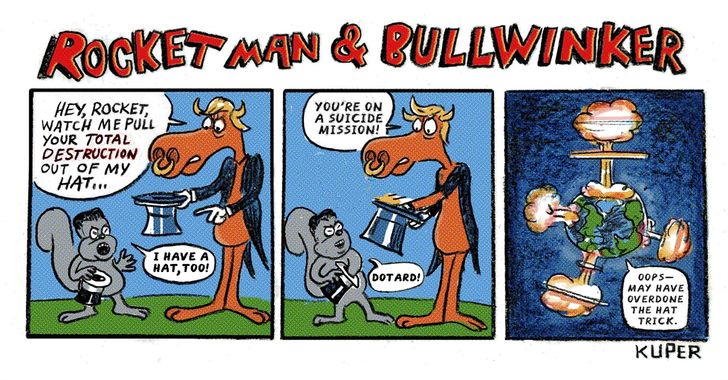
The United States remains on high alert after North Korea raised the specter of a major end-of-year provocation (a “Christmas gift”) for Donald Trump unless he soon makes concessions in the stalled nuclear talks.
The “new path” Pyongyang has threatened if Washington fails to deliver on this agenda could include resumption of intercontinental ballistic missile launches capable of reaching the U.S. mainland (suspended since 2017), and/or the possibility of new nuclear tests.
As Trump faces the coming election year, these scenarios would represent a serious setback to the U.S. leader who has cited the regime's moratorium on these activities as a key foreign policy success of his presidency.
A further reason why the peace process may be approaching a pivotal point is the fact that China and Russia are, this month, calling on the U.N. Security Council to terminate sanctions on key North Korean exports like coal, iron ore and textiles, with the nominal goal of enhancing the livelihood of the civilian population.
Moscow and Beijing, in a further proposed easing of the screws on Pyongyang, are also seeking to rescind a ban on the estimated 100,000 North Korean nationals working abroad and repatriating earnings which critics claim support the nation's nuclear and ballistic missile programs.
These diplomatic initiatives, which are opposed by Washington, highlight a fracturing in the previously more unified international containment of Pyongyang.
It is in this diplomatic cauldron, since the collapse of the Vietnam summit between Trump and Kim Jong-un earlier this year, that an array of other storm clouds have appeared to threaten the U.S.-North Korean dialogue.
For instance, there have been U.S. intelligence claims in recent months that Pyongyang has increased production of fuel for nuclear weapons even as it has engaged in continued diplomacy with Washington.
The revelations are a significant embarrassment for the White House. This is especially so since Pyongyang appears to have been trying to hide this increased fuel production at secret sites, while simultaneously seeking concessions from Washington, including ending U.S. military drills with South Korea, forcing even the ever-optimistic Trump to concede that it is “possible” the talks with Pyongyang may “not work out.”
At the heart of the logjam, right now, is not just the vagueness of the commitments in last year's Singapore summit between Kim and Trump. There is also a fundamental difference between Pyongyang and Washington over what next steps are needed to build confidence.
While Trump and much of the international community are expecting further concrete actions from Pyongyang, Kim and his allies argue that the North has already taken the major step of dismantling a nuclear test site in Punggye-ri, where nuclear tests “have been made impossible for good.”
And the North is therefore pushing hard for reciprocation measures, beyond the halting of joint Washington-Seoul military exercises, to “create situations [on the ground] on the peninsula] where [Pyongyang] would feel the decision to denuclearize was a right move.”
What this underlines, even if there is an unexpected breakthrough soon, is the significant expectations gap that emerged out of the Singapore summit which seemed to forget the failure of similar U.S. initiatives in the past including six-party talks which fell down in 2008, mainly because North Korea refused to allow inspectors to verify that it had shut down its nuclear programs.
At best, that Singapore session was no more than a start to a sustained strategic dialogue, despite the hype put on it by both sides.
Trump, for instance, declared the “nuclear threat from North Korea was over.” And one would have been forgiven for thinking that he had already completed the immensely complicated process of de-escalating tensions in the world's last Cold War-era frontier.
Even now, it is also still not clear that the Trump team has a comprehensive, clear or coherent strategy toward Korea which continues to contain much complexity for the president around U.S. alliances, and the nonproliferation regime.
Moreover, there does not even appear agreement on what Kim's purported “commitment to denuclearization” means in practice.
To Trump this appears to continue to mean unilateral disarmament. Yet, for Kim it is much more about potentially lengthy negotiations in which North Korea should be treated as an equal to the United States, giving him further propaganda victories.
In this context, Kim will probably remain wary about making concrete commitments on specific time frames, and want to win further economic and political concessions from Trump, before any reduction in nuclear capabilities, let alone committing to full denuclearization in its literal sense.
Taken overall, the historic potential opportunity offered by the Korea negotiations remains hanging in the balance as 2019 draws to an end.
A breakthrough cannot be ruled out, which could see Korea becoming a central part of Trump's foreign policy legacy, yet the president appears just as likely right now to emulate others who have failed to bring a sustained, peaceful diplomatic outcome to one of the key foreign challenges facing Washington.
Andrew Hammond (andrewkorea@outlook.com) is an associate at LSE IDEAS at the London School of Economics.