Fatal attacks: Rampaging boars strike fear into villagers' hearts
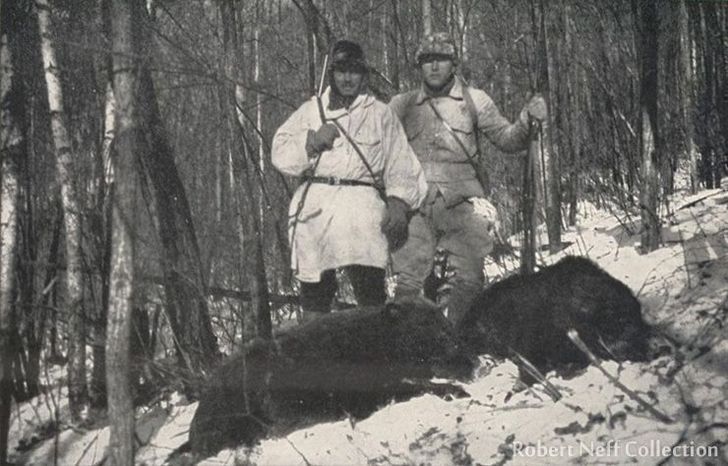
Sten Bergman and V. Jankovski hunting boars in northern Korea in December 1935
By Robert Neff
Up until a century ago, tigers prowled the mountains and forests of the Korean Peninsula but they were not the only nocturnal beasts that terrorized the countryside ― there were also great wild boars.
These boars were huge.
In 1902, James E. Adams, an American missionary, killed a boar that he estimated weighed between 135 and 180 kilograms (with very little fat), stood about a meter high at the shoulders and was armed with tusks nearly 20 centimeters long.
While this boar may have been huge, it was not the biggest out there. In 1915, Horace Underwood, another missionary, claimed a boar weighing nearly 225 kilograms had been killed. Many Korean hunters assured him there were even bigger boars ― some with tusks nearly 40 centimeters long.
These boars were extremely dangerous ― especially when wounded ― and would use their tusks to disembowel anything that got in their way. It was said that even tigers avoided the largest boars.
But tusks were not their only protection. They had thick hides, covered with long, stiff bristles ― sometimes as long as 20 centimeters on the back ― and thick layers of fat during the fall and winter. Their propensity to wallow in mud caused their hides to become caked, making them even more impenetrable to fang, claw and bullets.
It wasn't uncommon to kill a boar and discover bullets in various parts of its body from previous hunters.
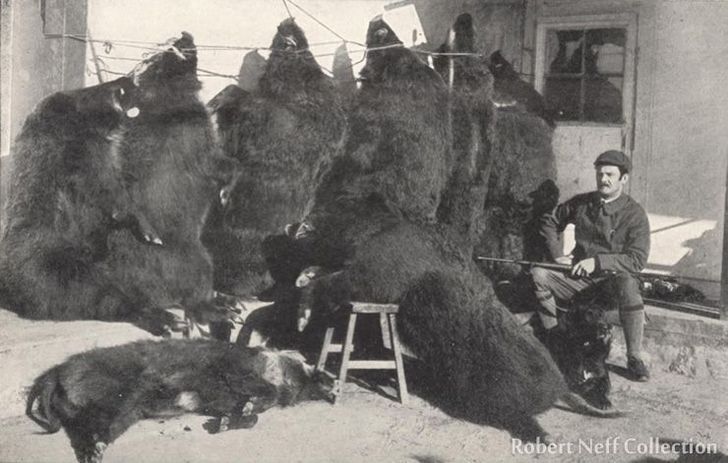
Some of the boars killed by the Jankovski family in northern Korea in 1935
Some Korean hunters even claimed the largest boars had small trees growing out of their mud-caked hides. A Korean hunter told Underwood that he had personally killed a boar with seedlings growing from its hide. When Underwood expressed a degree of disbelief, the angry hunter declared:
“If I'd been telling that story to anyone else I would have told them the trees were big enough for roof beams, but seeing that it was you, I made them only seedlings, and you don't believe even that [so] I wish I'd told you they were bigger.”
During summer and fall, herds of wild pigs would play havoc on farms throughout the peninsula. What they didn't eat, they destroyed with their rooting. Even the royal tombs were not safe from these destructive pigs.
In early 1518, a wild boar dug up the tomb of Queen Jangsun. Many saw this as an evil portent ― including King Jungjong. It was suggested to the king that he go to the tomb and preside over a ritual to help comfort the queen's spirit and to explain how her tomb came to be disturbed. The king, however, elected not to go and instead sent an official to act in his stead.
The living also suffered. According to Adams:
“In some countries it is said that the wild boar is a dangerous customer and will generally charge at sight; but that is not the case with Korean boars. They get away as fast as their legs will carry them, which is very near the gait of a deer.”
He reasoned that the attacks on humans were due to the boar being cornered or suddenly surprised and that a “man properly armed needs have little fear of trouble along this line.”
Others disagreed. They claimed boars would attack for little or no reason. Underwood recalled an incident that happened in 1915, near Seoul, when a Japanese man was seriously injured by an unprovoked boar.
On June 29, 1925, a woman and her daughter were badly gored by a boar that entered their village. Fortunately, they survived but the boar ― which was described as being “the size of a small cow” ― was eventually beaten to death by the enraged villagers.
In 1928, four Koreans and 33 cows were reportedly killed by boars ― in the same year, one person was killed by a tiger and three by leopards.
But humans also took their toll on the boars. In the Muju region of Jeolla Province, a boar was given as tribute to the central government every two years. This was quite a burden on the people as they had to pay the hunter 100 nyang and seven measures of rice. King Jeongjo (r. 1776-1800) took pity on the people and declared the tribute would be changed to 80 pheasants.
At first, the people were happy but bagging 80 pheasants in a short period was not easy and so the local magistrate was forced to purchase pheasants. This, however, led to the price of the birds shooting up to 3.5 nyang each.
The tribute, which had once only cost 100 nyang, now cost 280 nyang. Eventually the people petitioned the king to either go back to the old tribute of a single boar or to lower the price of the pheasants to 2 nyang each.
Boars were also valued for their gall bladders. According to Sten Bergman, a Swedish zoologist who visited Korea in the mid-1930s:
“Wild boar hunters in Korea attach a great importance to the gall bladder, which is dried afterwards and made into medicine. With its contents it is pulverized and the powder is mixed with sake or some spirit and the mixture is drunk by Korean women immediately after giving birth to a child. It is believed to hasten the woman's convalescence and to prevent complications. A boar's gall bladder will, as a rule, be worth five or six shillings in Korea.”
Thus, it is not surprising to see that in 1927, just in South Hamgyeong Province, 320 wild boars were killed.
The tigers, once regents of the night, are now gone from the peninsula. But their old rivals, the boars, continue to thrive ― even in the mountains surrounding Seoul ― and still cause consternation for farmers and fear in unwary hikers.
Robert Neff is a historian and columnist for The Korea Times. He can be reached at robertneff103@gmail.com.