Wild brawl: War fears over mistaken gesture
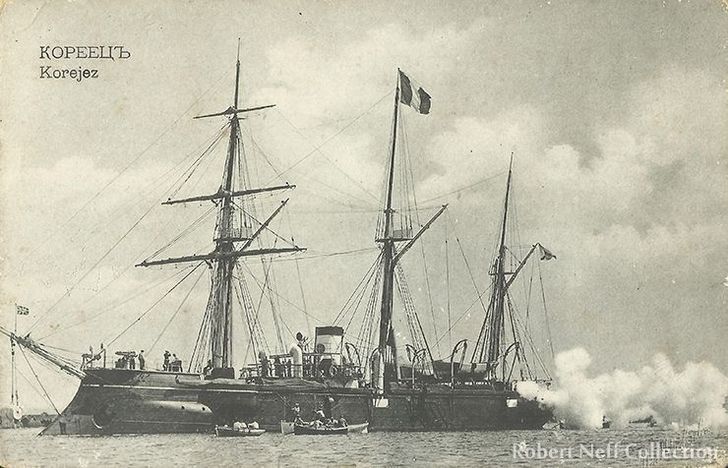
A Russian gunboat, circa 1904. Robert Neff Collection
By Robert Neff
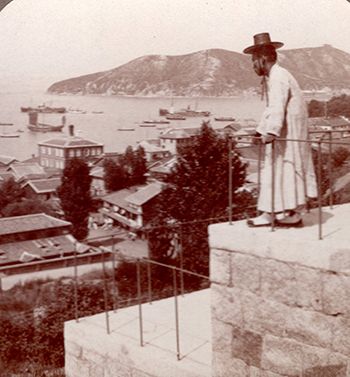
Jemulpo harbor, circa 1904. Courtesy of Diane Nars Collection
In the autumn of 1903, war seemed imminent between Russia and Japan over Korea, as both countries considered Korea under their sphere of political influence.
Many feared that one rash act or a misspoken word could be the catalyst for a devastating war on the Korean Peninsula, so great care was taken to alleviate tension before it could escalate. Unfortunately, sailors are not often aware of how simple acts ― such as asking for a cigarette ― can quickly snowball out of control.
On November 1, the port of Jemulpo (modern Incheon) was extremely busy. Steamships were arriving from Shanghai and Japan and there were several warships in the harbor. One was the Russian gunboat Bobr.
Thirty sailors from the Bobr on shore leave were seeking entertainment. According to one account, a Japanese establishment was celebrating its opening day and the owner, spying the Russian sailors, invited them “to partake of the cup that cheers and also inebriates.” The sailors readily agreed.
After some heavy drinking, one of the Russian sailors desired to buy some cigarettes from the establishment but due to his inability to speak Japanese and the shopkeeper's inability to speak Russian, he resorted to using gestures to convey his desire. Apparently, his gestures were mistaken for something else and, instead of receiving cigarettes, he received “a blow across the face with a bag said to contain stones.”
Another source, however, claims the incident began when one of the Russian sailors quarreled with a Chinese fruit merchant. A Japanese merchant (who could speak Russian), came upon the scene and thought he could mediate the problem ― his efforts were met with “maltreatment by the Russians.”
Both sources agree that a riot soon broke out as more and more Japanese came to the aid of their fellow countrymen. The fight was quite brutal and, judging from one source, was not confined to the Russians and Japanese:
“An Englishman is alleged to have pointed a loaded gun at the Russians while the row was going on. A Japanese officer seized the gun, but on the owner informing him that he wanted to shoot, not the Japanese, as the officer seemed to imagine, but their opponents, and this because his wife was, he said, a Japanese, the officer allowed him to do as he pleased. Some other Englishmen came along, however, and prevented him from firing.”
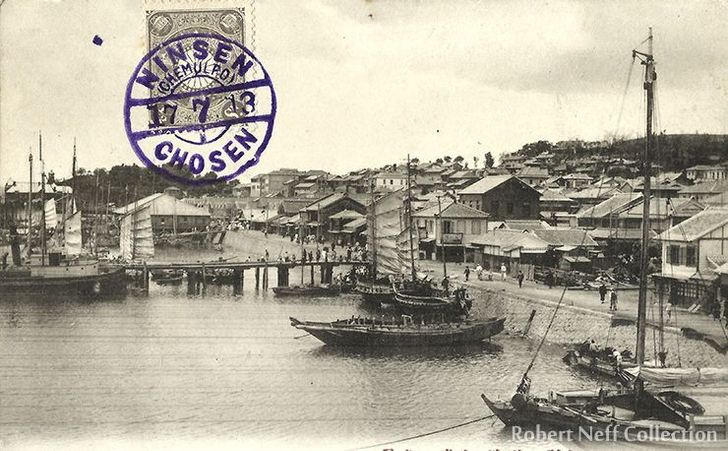
Jemulpo harbor, circa 1910. Robert Neff Collection
Eventually the Russian sailors, “who were very much inferior in number to their opponents,” were forced to flee to their steam launch. Allegedly, while they were making their way to the Bobr, a Japanese steamship tried to run them down. Luckily they managed to avoid the ship and safely reached their own warship.
Once aboard, however, they realized that they had inadvertently left two of their comrades behind. These two men sought safety in the general settlement ― presumably in a Russian house.
But the Japanese mob was not to be placated and began searching Russian homes.
“[The] manager of the local branch of the Chinese Eastern Railway made no objection to his premises being searched; in fact he courteously showed his unwelcome guests over the whole establishment, which was thoroughly ransacked to the terror of the agent's wife and children.”
The two Russian sailors eventually managed to elude the mob and make their way safely to their ship.
During the riot, at least 10 Japanese civilians were injured ― three seriously ― and two Japanese policemen ― one with a broken arm. It is unclear how many Russians were injured but apparently the commander of the Bobr was chastised by his admiral for not sending more sailors ashore during the fray. It is probably a good thing he didn't, because the incident could have easily escalated to the point where lives were lost.
As a result of the incident, the Council of Chemulpo Foreign Settlement agreed to hire two additional Westerners to help police the general settlement. It was also suggested that the respective legations in Seoul insist that sailors on shore leave be under the command of a responsible officer at all times.
But the winds of war could not be stopped. On February 9, 1904, one of the first battles of the Russo-Japanese War took place in Jemulpo harbor.
Robert Neff has authored and co-authored several books including, Letters from Joseon, Korea Through Western Eyes and Brief Encounters.