Fright night: Mountain spirit's scary visit
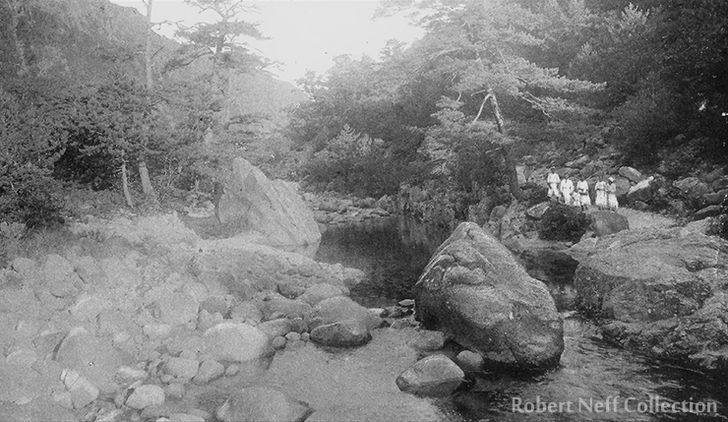
Hiking in the mountains, circa 1930s. Robert Neff Collection
By Robert Neff
Autumn in Korea is beautiful but notoriously short. It isn't uncommon to see large groups of people ― generally older ― hiking up and down the mountains that grace the Korean Peninsula.
For the most part, they are well prepared for their excursions, as evidenced by their colorful clothing, boots, walking sticks and canteens filled with water (or something stronger). But not everyone goes prepared.
In the fall of 1989, three male university students went hiking in the mountains. They were unfamiliar with the area and soon became disoriented and were unable to reach their intended campsite before nightfall.
Realizing that it would be foolhardy to continue in the darkness, they chose a relatively flat area beneath a huge tree and set up their tent next to a small pile of stones. Using some stones from the pile to make a fire pit, they built a small fire and then went to sleep ― exhausted by their hike.
It was just a couple of hours before dawn when the student sleeping nearest to the tent's opening screamed. He told his startled companions that a small hand had reached in through the tent and grabbed him by the leg.
His friends laughed at him and assured him it had been nothing more than a nightmare. He insisted that he had felt something and it was not his imagination. To placate him, they changed their sleeping positions and one of his companions slept near the opening.
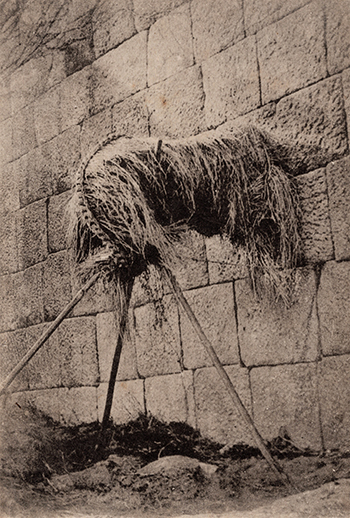
A body wrapped in straw, circa 1890-1900s. Courtesy of Diane Nars Collection
As they began to fall asleep, the student now sleeping near the opening felt something move against his leg. It touched him tentatively, as if it were uncertain, but gradually grew more persistent and, what felt like fingernails, lightly scratched his skin as it wandered down to his ankle.
At first he thought it was one of his companions trying to prank him, so he ignored it, thinking his friend would tire of his game. But it didn't stop.
Suddenly, the hand (which he now realized seemed unnaturally cold) clutched his ankle and began to pull his leg toward the opening. He screamed in terror and yanked his hand from the icy-cold grasp and scrambled away from the opening.
He told his startled friends what had happened and this time it could not be dismissed as a nightmare. Huddled together, they avoided the opening and uneasily awaited dawn.
All was quiet ― so quiet that they could hear their own heartbeats ― and the minutes slowly ticked by. After some time had passed, they heard rustling near the bottom of the tent. In the dim light they were horrified to see a shriveled child-like hand reach through the tent.
It suddenly grabbed one of the cowering young men's legs. Despite its victim being a powerful athlete, he was barely able to keep himself from being dragged from the tent. Fortunately, just then, a rooster crowed in the distance and the hand disappeared.
As the sun finally made its appearance, the students summoned up enough courage to leave the dubious sanctuary of their tent. Looking around, they could see a simmani (a wild ginseng hunter) in the near distance and they called out to him. But when he noticed the young men, he quickly ran away.
Alarmed and confused, they began packing their goods. So intent on their packing and getting away from the area, they did not notice the approach of an elderly woman until she demanded to know the reason for their presence. They anxiously told her about the circumstances leading to their camping and the subsequent strange encounter in the darkness.
Shaking her head, she said in a low, disapproving voice: “You should have never slept here.” She then pointed to the pile of stones next to their tent.
These stones, she explained, are part of an “Aegi jang” (a child burial site). In the past, people did not bury children in the ground but instead covered them with stones.
Those who had died from smallpox were often placed in trees or on straw platforms to dry; an effort to keep smallpox from seeping into the soil and being spread in the future. The crowing of the rooster had frightened away the spirit of the child.
As the scowling elderly woman gently placed the stones back onto the pile, the students quickly gathered their gear and left. They never returned to the site, convinced that it was haunted by the evils of the past.
Robert Neff has authored and co-authored several books including, Letters from Joseon, Korea Through Western Eyes and Brief Encounters.