To endure coming global recession
By Dr. Jeffrey I. Kim
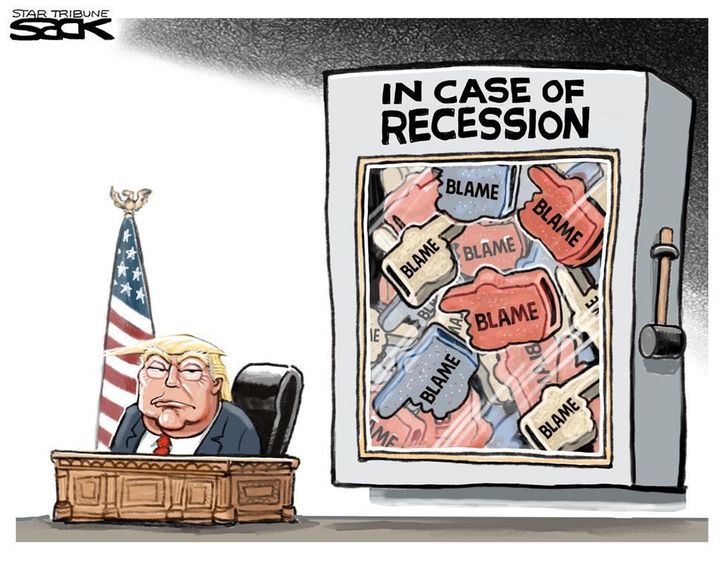
Many people in the world are worried that they are going to encounter another huge global recession soon. Economists often define a recession as when annual growth falls below 2.5 percent that lasts for at least two consecutive quarters.
Economic analysts predict that the escalation of the Sino-U.S. tariff war will form an economic “perfect storm” and lead to a very serious global recession. This time not only the U.S. and China but Europe and Latin America will also suffer from a deadly miserable economic disaster.
International news agencies are reporting that the trade war will damage the Chinese economy more than the U.S. because of China's enormous outstanding debt. Its state industries as well as consumers have borrowed heavily from banks. So there is world-wide speculation that China could face a local debt crisis before meeting the global recession.
Nouriel Roubini of New York University has recently predicted that three negative supply shocks could trigger a global recession by 2020. The first shock is the Sino-American trade and currency war.
The second shock, “the slow-brewing cold war” between the U.S. and China over technology, and the third one, potentially rising global oil prices due to the U.S. military confrontation with Iran.
Morgan Stanley has recently warned its clients that the risk of a global recession is high and rising as trade head-winds aggravate economic slowdowns. Its chief economist, Chetan Ahya said, “The downtrend in some global economies is becoming contagious and if trade tensions escalate further, we will enter into a global recession …”
South Korea could be one of the greatest victims of the global “perfect storm” simply because of its economic size. The Korean economy is the 4th-largest in Asia and the 11th largest in the world. Its GDP for 2018 was $1.62 trillion. But it relies heavily on international trade. In 2017 its exports were $577.4 billion and imports $457.5 billion.
South Korea's three major trade partners are China, Japan and the U.S. South Korea imports high-value intermediate goods from Japan. By using these, South Korea manufactures sophisticated final products and exports them to higher-income countries and to China.
Amid an increasing risk of global recession, residents of South Korea fear that the economy will soon face this “perfect storm” due to increasing diplomatic and political uncertainties. The country's diplomatic relations with Japan, China, and the U.S. seem to be getting worse.
Under these circumstances, long-term private investments in South Korea cannot be sustained. The number of foreign investors is decreasing. Confrontations between the ruling and opposition parties are becoming more intensified. Even the government's short-term fix for an economic recovery is not being timely implemented.
The Bank of Korea and the state-funded Korea Development Institute have revised downward a few times their early GDP forecasts for 2019. Now South Korea's annual GDP growth for 2019 is forecast to be as low as 1.4 percent. The GDP growth rates for the first and second quarter are 1.7 percent and 2.1 percent. The forecasts for third and fourth quarter growth are 0.6 percent and 1.1 percent. These statistics show that South Korea has already entered into the early stage of a recession.
The Korean people should be able to withstand the strongly blowing headwind of the perfect storm. To this end, political leaders and policymakers should undertake the following measures:
(1) Provide the people with vision and hope for the Korean economy so that they will shake off their fears. Recession fears tend to be self-fulfilling and can bring on a recession.
(2) Adopt both demand and supply policies to put the nation's economy on the right track. Income-led demand policy alone will not work. Consumer spending out of government subsidies cannot help boost production capacity. A supply-side policy that can increase longer-term investment must accompany it.
(3) Improve diplomatic relations with our major economic partners ― China, Japan and the U.S. Being antagonistic to our traditional trade partners will only pull our economy backward.
(4) Readjust the nation's internally inconsistent nuclear-power phase-out policy. With the current nuclear-power policy, we cannot continually sell our first-rate services, related to both construction and operation of nuclear power plants, abroad.
(5) Increase foreign currency reserves to prevent a foreign exchange crisis, which will surely bring on a serious recession.
Dr. Jeffrey I. Kim (ickim@skku.ac.kr), former foreign investment ombudsman, is a professor emeritus at Sungkyunkwan University. He earned a Ph.D. in economics at the University of Chicago and taught at the University of Colorado, Boulder, and the American University, Washington, D.C.