Doing our part for inter-Korean understanding
By Richard Pennington

Shortly after I moved to Seoul from Daegu in early 2009, I did some tutoring with young North Korean refugees. I wanted to help somehow to improve their lives. Secondarily, I was eager for a measure of contact with these people. In almost every case, coming south was dangerous and difficult; not everybody arrives safely.
That is the backdrop for a more recent contact I had with a North Korean woman named Kim Ok-in. My friend Audrey Lim and I attended the 2017 Amsa-dong Prehistory Cultural Festival, and among many features that sparkling day was a musical performance by a troupe of North Korean refugees. Ok-in was one of them.
Their costumes, their movements on stage and the way they spoke seemed “different” to me, and Audrey, a native of South Korea, confirmed that. After their 20-minute song-dance-and-drum show, they moved to an ad hoc dressing room and got ready to leave.
But this was too great an opportunity for me, so I pressed for an encounter. Audrey played a crucial role, of course. We met Ok-in, said nice words about the performance and exchanged cards. We tried not to overwhelm her or make her think we wanted anything from her. We offered and sought only friendship. Due to Audrey's charming manner, the lady's resistance faded quickly.
“Maybe we can have lunch sometime,” we said to Ok-in, and she seemed open to that. Three weeks later, we met her at a restaurant in the Jamsil district of Seoul. It lasted 90 minutes, and we had a fine time.
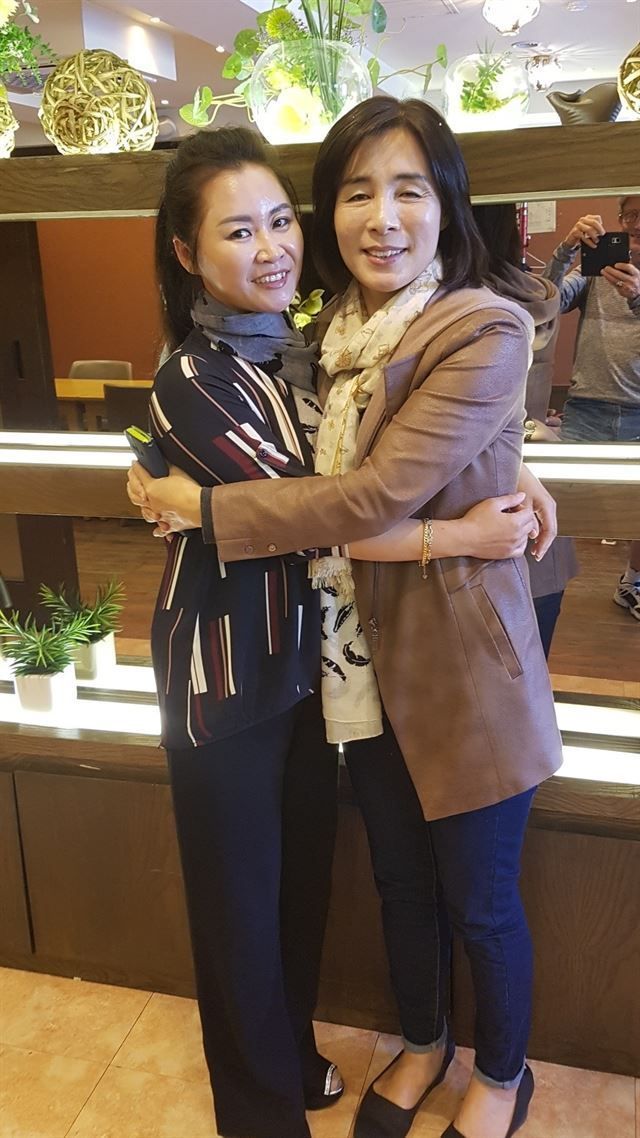
North Korean refugee Kim Ok-in, left, hugs Audrey Lim at a restaurant in Jamsil, Seoul. Courtsey of Richard Pennington
Naturally, my bilingual friend served as the fulcrum. I did not mind at all that the two of them sometimes carried on a lively conversation to which I was not privy. They got along well and clearly enjoyed each other's company.
Now and then, Audrey would turn to me with a smile and deliver a quick summary. She also conveyed some messages I had for Ok-in, such as “We are glad you are here” and “We respect you.” She knew it was sincere. With more than 30 years as a journalist ― Ok-in was informed of this ― I had a lot of questions.
Most were not too invasive; I realized that tact was called for above all. Nor did I expect her to volunteer candid opinions about the Kim regime, tell us of her awareness of the North Korean gulag and what she knew about the famine of the mid- and late 1990s that left more than 2 million people dead.
She said she was born and raised in Pyongyang, a fact that speaks volumes. Life is not too bad there, relatively speaking. Most people in the capital adhere to the company line ― the Kims are great, the DPRK is the most wonderful place on earth, and so forth ― and do not have a burning desire to escape as do those in the grim hinterland such as South Hamgyong, Yanggang and Chagang provinces.
Ok-in confirmed that she had participated in the famous “mass games” at May First Stadium in which as many as 100,000 people put on a highly politicized display of gymnastics, music, acrobatics and drama. I gently asked why she had left, and the answer was economics.
Ok-in and four other family members crossed the frozen Tumen River into China in the winter of 1998, toward the end of the famine. Four years later, they managed to reach Seoul. Her occupation consisted of giving performances like the one we saw at Amsa-dong, and by designing and crafting traditional Korean clothes.
Ok-in claimed to hold no regrets about having left, and yet she sometimes misses her native land. Her adjustment to life in South Korea, while smoother than for many other such refugees, has been challenging.
She had experienced a measure of hostility, suspicion and discrimination, and yet some people ― Audrey and me, for example ― have gone out of their way to befriend and welcome her. During our meal, she made one reference to unification of North and South Korea, but the when and the how were left unspoken.
We managed to get through this whole meeting without making any big mistakes, without doing anything to upset or frighten Ok-in. Audrey and I hoped to see her again, whether in performance or at another restaurant.
We would have welcomed some of her friends, giving them the opportunity to discuss their experiences on both sides of the border. It is entirely possible that Ok-in had reasons to fear that we could not even guess, but we never saw her again.
Audrey waited a suitable time before calling her. She said no, maybe later, not this time and so forth. After five or more calls, Audrey got the message. We had no choice but to accept Ok-in's decision not to meet with us again.
Richard Pennington (raput76@gmail.com), a native of Texas in the U.S., works as an editor at a law firm in southern Seoul. He has written 21 nonfiction books, including “Travels of an American-Korean, 2008-2013.” He is the director of an NGO, the Committee to Bring Jikji Back to Korea.