The real Sea Wolf: Captain Alexander MacLean (Part 1)

Sealing steamers in the early 1900s. Courtesy of Diane Nars Collection
By Robert Neff
Many people are aware that Jack London spent time in Korea as a war correspondent during the Russo-Japanese War (1904-05).
His photographs and newspaper articles give us a close-up look at Korea during this turbulent period.
But London has another connection (although tenuous) to Korea through one of his greatest fictional antagonists ― Wolf Larsen.
Larsen may have been fictional but he was based on one of London's acquaintances ― Captain Alexander MacLean.
In the 1890s, Nova Scotian-born Alexander MacLean was a well-known name in the regions surrounding the northern Pacific Ocean.
Standing 175 centimeters tall and weighing about 86 kilograms, he stood out among his peers, not so much because of his physical size or his blue eyes, or even his 45-centimeter-long moustache (he kept the tips tied together behind his head), but because of his personality and exploits.
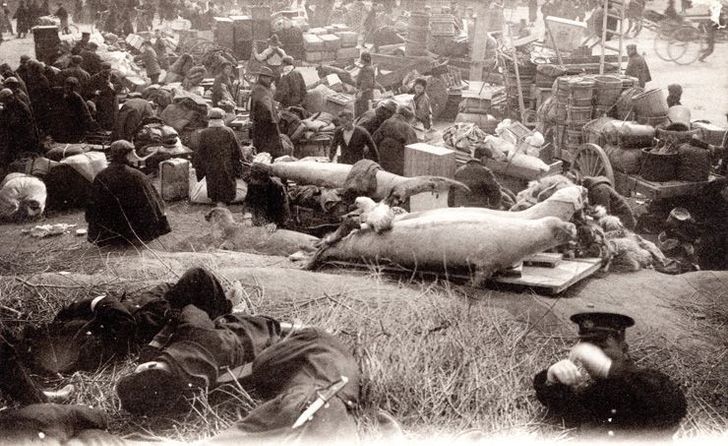
An unidentified Japanese port with seals in the foreground, circa 1900s. Courtesy of Diane Nars Collection
According to London, MacLean was “a rough character and was known as the worst man, so far as physical violence was concerned, among the seal hunters.” Perhaps London was being somewhat generous with his description because MacLean may have been a seal hunter but he was also an audacious seal poacher who was defiant against all authority except his own.
In 1891, Maclean commanded the seal schooner J. Hamilton Lewis and operated primarily out of the Puget Sound area of Washington State.
That summer, he sailed for Copper Island (now known as Medny Island) off the coast of Kamchatka, Russia.
This island was famed for its large populations of seals and in the previous year, 58,000 had been legally harvested. It was also a very popular spot for British and American poachers ― including MacLean.
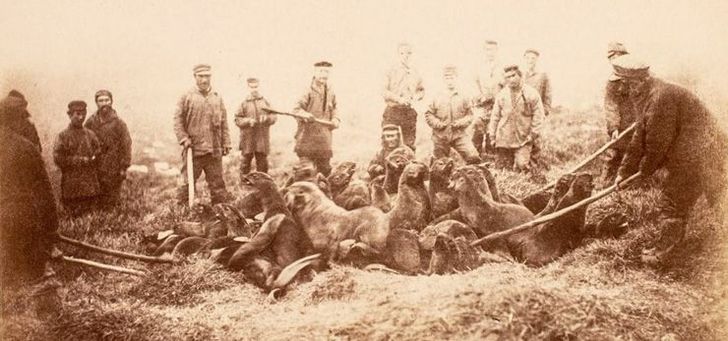
Hunting seals, photographed by Leonhard Stejneger, circa 1890s. Smithsonian Institution Archives
The J. Hamilton Lewis arrived at Copper Island at the beginning of August. It was not alone.
There were many other poaching schooners in the vicinity, some from the Puget Sound, others from Victoria, Canada, and still others from Nagasaki and Yokohama (Western ships). All were on the lookout for the Russian navy, which jealously guarded the region.
On August 2, under cover of a thick fog, some 25 whale boats (small wooden rowboats) landed on the island and dispersed a large number of poachers ― including MacLean ― who began slaughtering the seals.
Carcasses lay scattered about the beach, temporarily forgotten, as the men went about their butchery.
Suddenly, several Russian soldiers appeared and began shooting.
One poacher was shot dead before he could reach the safety of the whale boats ― his body was left behind.
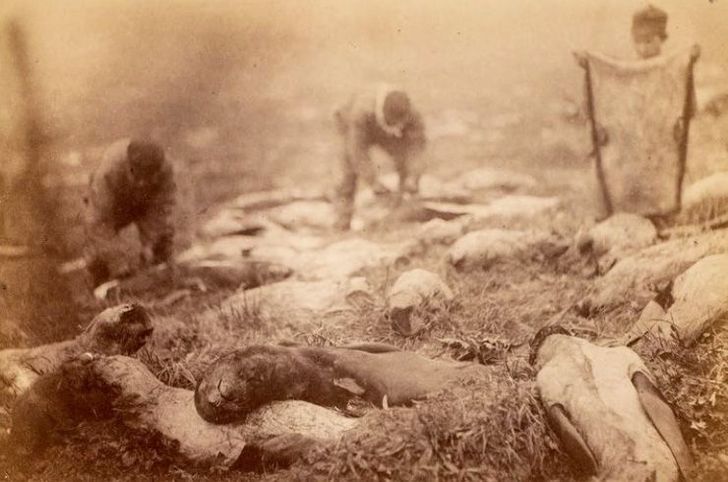
Dead seals, photographed by Leonhard Stejneger, circa 1890s. Smithsonian Institution Archives
As bullets began striking the boats, another man “jumped from the bow in fright and was drowned.” MacLean was also injured: “His knee cap was smashed and his left hand hit.”
Later that evening, the Alert (a 13-gun Russian warship) appeared and gave chase to the schooners.
Warning the schooners to stop, the Alert fired several blank cartridges. But when they failed to comply, the warship switched to live rounds.
One round struck the J. Hamilton Lewis and smashed its bowsprit. The schooner was forced to stop.
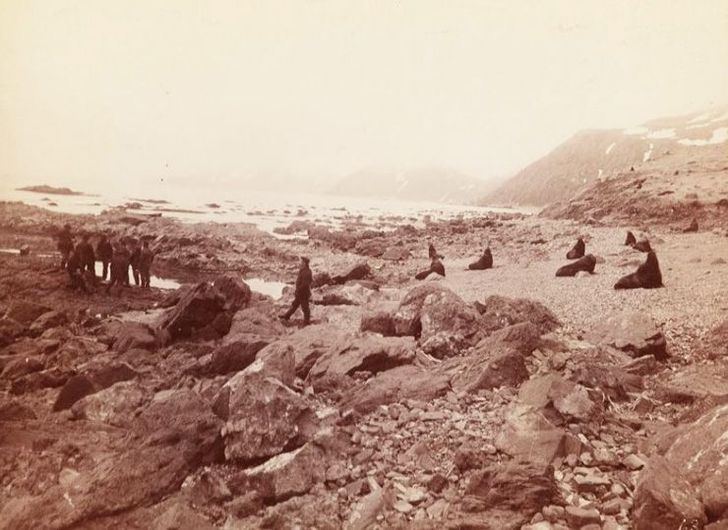
Among the seals, photographed by Leonhard Stejneger, circa 1890s. Smithsonian Institution Archives
This wasn't the first time MacLean had a violent encounter with Russian naval authorities. In June the previous year, while poaching along the island, he was chased down by the Russian gunboat Alexander.
Seeing the British red ensign flying from the mast of the J. Hamilton Lewis, the Russian officer demanded to see the schooner's papers. MacLean refused. He then hoisted the American flag and defied the Russian officer's attempt to board.
The officer, noting MacLean's well-armed crew, allowed the schooner to leave. There would be no warnings this time.
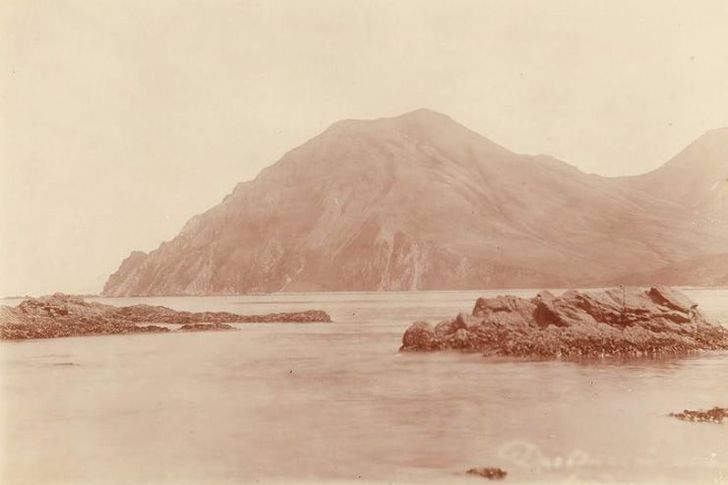
One of the islands where sealing was done, photographed by Leonhard Stejneger, circa 1890s. Smithsonian Institution Archives