Giuseppe Santori: An Italian castaway on Jeju (Part 1)

The port of Nagasaki, circa 1900.
By Robert Neff
On the morning of September 18, 1878, the 666-ton Italian barque Bianca Pertica, filled with coal, left Nagasaki bound for Hong Kong.
The weather seemed ideal for sailing ― a light breeze from the east filled the ship's sails and conveyed it through the calm waters at a lively pace. There was the promise in the air of a quick and easy voyage but lurking in the distance ― obscured by the ever-increasing number of dark clouds ― was, for many, their final destination.
Built in Genoa in 1867, the Bianca Pertica began as a steamer but was later, in 1872, converted into a two-masted sailing vessel. We know very little about the ship and its activities before her arrival in Hong Kong in January 1876. We know that shortly after its arrival, it was commissioned by a merchant to transport goods to Marseilles, France, via Thailand, and did not return to Hong Kong until June 1877. From that point on, she was engaged in Chinese and Japanese coastal trade.
Commanding the ship was Captain Tancredis, again ― we know almost nothing about him, and a crew of 14 men. Most of the men ― if not all ― were Italian. Conspicuously missing is the mention of any Japanese or Chinese crew members. Were any of the Europeans fluent in Japanese or Chinese thus negating the need for any Japanese or Chinese crew?
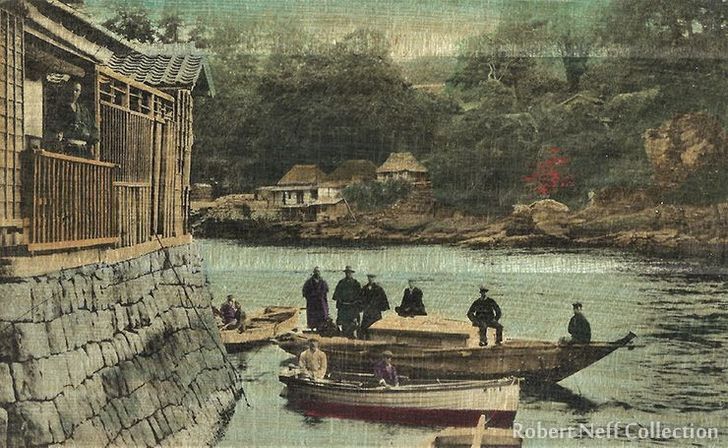
The Nagasaki area, circa 1900.
We have to assume that Captain Tancredis and his crew were competent. They had a history of sailing great distances without any mishaps and generally made good time. The last voyage from Hong Kong, the Bianca Pertica had departed on August 25 and arrived in Nagasaki on September 8 ― fairly good time. A local merchant named Tankosha was confident in the captain's skills and commissioned him to transport a large load of coal to Hong Kong.
Coal was one of Nagasaki's most important commodities. Many navies and shipping companies were switching from sailing vessels to steamships and Nagasaki was “the only place in the [Far] East where coal was mined in any quantity.” It seems almost ironic that that Bianca Pertica began as a steamship and was converted to a sailing vessel so that she could transport coal.
It isn't clear why the ship remained in Nagasaki for 10 days ― surely it did not take that long to load the ship with coal ― but, undoubtedly, the crew made good use of the down-time.
In his late teens or early 20s, Giuseppe Santori was possibly the youngest member of the crew. We know he was from Genoa but we do not know how long he had been with the ship. I like to think (somewhat romantically) that the older members of the crew took him under their wings and introduced him to the wild and dangerous debauchery of an open port in the 19th century.
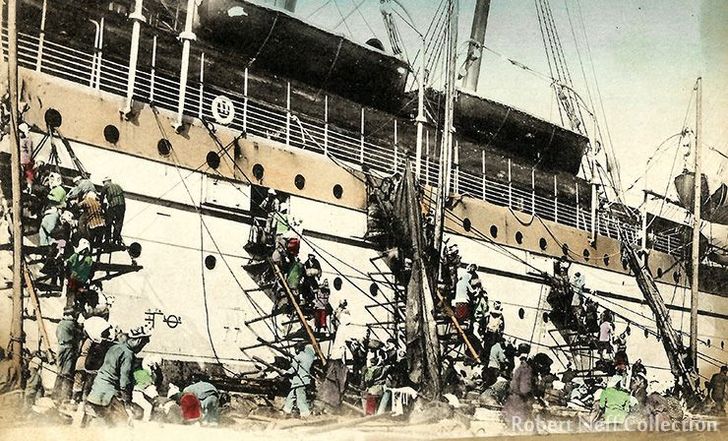
Loading coal aboard a large steamer, circa 1900s.
Nagasaki was the first Japanese port opened to the West and on several occasions served as a forward port for Western navies operating in the Far East. It was a rough port with a large transient population of sailors and merchants who supported an infamous thriving entertainment industry composed of drinking establishments and brothels, and thus is it not surprising that the local newspaper noted “naval officers regard Nagasaki as their favorite resort on the Eastern Station.” In fact, while the Bianca Pertica was in Nagasaki, the port was awash with sailors from two British warships (HMS Midge and HMS Lily) and the German gunboat Albatross.
The Italian community was very small, probably only six or seven people, but they seem to have been fairly affluent. Two of the most important hotels in the port were owned by Italians ― Hotel de Garibaldi and Belle Vue Hotel. Although there is no evidence to support it, it is likely that some of the crew visited these hotels. The Belle Vue Hotel would have a role in Santori's fate.
This brings us back to the day the Bianca Pertica sailed out of Nagasaki and into an extremely powerful typhoon. We could, perhaps, second guess Captain Tancredis and blame him for the events that followed. After all, August and September are prime months for typhoons in the region and experienced captains were more than aware of the risks they took when sailing during this period.
I don't think Tancredis knew a storm was approaching and he probably wasn't alone. Two British ships, Channel Queen (607 tons) and the City of Santiago (a 1,291-ton steamship) also left Nagasaki on the same day but, fortunately for them and their crew, they avoided the Bianca Pertica's fate.
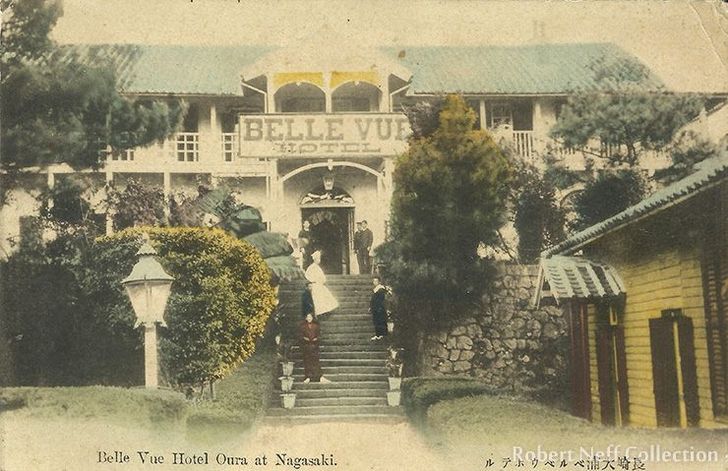
The Belle Vue Hotel in Nagasaki, circa 1900s.
Throughout the day, the Italian ship sailed without incident. Perhaps some of the crew were concerned as the clouds continued to amass and the breeze grew stronger, but they had faith in the captain. As evening approached, the sky darkened and the wind began to howl. The ship was cast about on towering waves and the wind threatened to topple the ship.
Concerned about the increasing strength of the wind, Tancredis ordered his crew to take in some of the sails. About 9:30 p.m., a particularly strong wind gust ripped away part of the main-sail from its riggings. The sail flapped wildly in the howling wind and threatened to cause more damage to the ship. As the men rushed to secure it, part of the fore top-sail was ripped away. At this point, most of the sails were lowered and the ship was turned to the west so it could flee the powerful storm rolling in from the east.
This maneuver was not without its danger. As the ship turned, huge waves crashed over the sides and water poured into the lower deck, further endangering the ship by slowing its response to the helm.
At midnight, the captain ordered part of the crew to man the pumps while the rest of the crew pulled down the remaining sails. One can only imagine the crew's fear as ropes and strands of sails whipped through the air, rain pounded them and the waves threatened to strip them from the deck. In daylight this would have been a frightening experience but in the darkness of night it must have been hell. Would morning bring relief?
[This is a revision of an earlier article that appeared in the RAS Transactions in 2007]
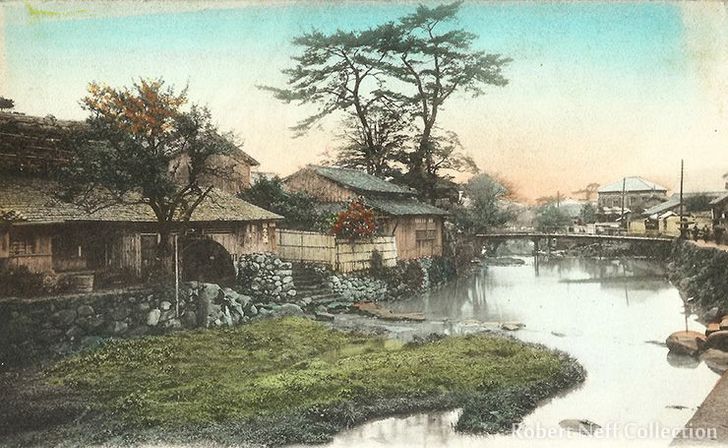
A watermill in the Nagasaki area, circa 1900s.
Robert Neff has authored and co-authored several books including, Letters from Joseon, Korea Through Western Eyes and Brief Encounters.