Memorial Day at national cemetery
By Richard Pennington
June 6 is a national holiday in South Korea, when people (are supposed to) pause and reflect about the sacrifices made during the Korean War. Of course, June 25 is the day in 1950 when Kim Il-sung's soldiers, with Soviet and Chinese blessing, crossed the 38th parallel and fomented a bloody three-year conflict.
He nearly succeeded, but the South Koreans had allies of their own ― the Americans, the Brits, the Canadians, the Turks, the Aussies, the Filipinos, the Kiwis, et al. ― and essentially restored the border. So it has remained for 6 1/2 decades.
I visit Seoul National Cemetery every June 6, and this year was no different. Please come with me as I recount that day's events. I got on the Seoul subway and took Line 2 west to Line 4, then north to Dongjak Station.
I came out at the entrance of the cemetery, established by presidential decree in 1955. About 1.4 million square meters, it is the resting place of 165,000 soldiers and others who died or fought in the war, along with some other notables.
In the shadow of Mount Gwanak, it overlooks the Han River and is a scene of considerable calm and majesty. I bought two bouquets of flowers and walked on in.
Soon my right-wing friend Yong Yoon arrived. After pausing at the main event where President Moon Jae-in spoke, we began a fairly long walk through the eastern and northern parts of the cemetery.
Yoon and I finally came to the grave of Park Chung-hee, the man who ruled South Korea from 1961 until his assassination in 1979. Park was admired by some (he engineered the country's economic development) and reviled by others (he took power at the point of a gun and subverted democracy), and quite a few people felt both ways about him.
Yoon, I tell you, is a Park devotee. He was the second of several speakers during a ceremony at the foot of the grave. While there, I posed with him and numerous others. I had brought a Taegeukgi (the Korean flag) with me, and the people took note.
Never before have I seen another foreigner at these gatherings, and I look. Each year it's just me, although I cannot claim to have seen every person there. This time, however, I saw a handful. Still, non-Koreans are so rare as to be oddities.
People appreciate foreigners, most especially Americans. They know what we did during the Korean War and continue to do to maintain the peace.
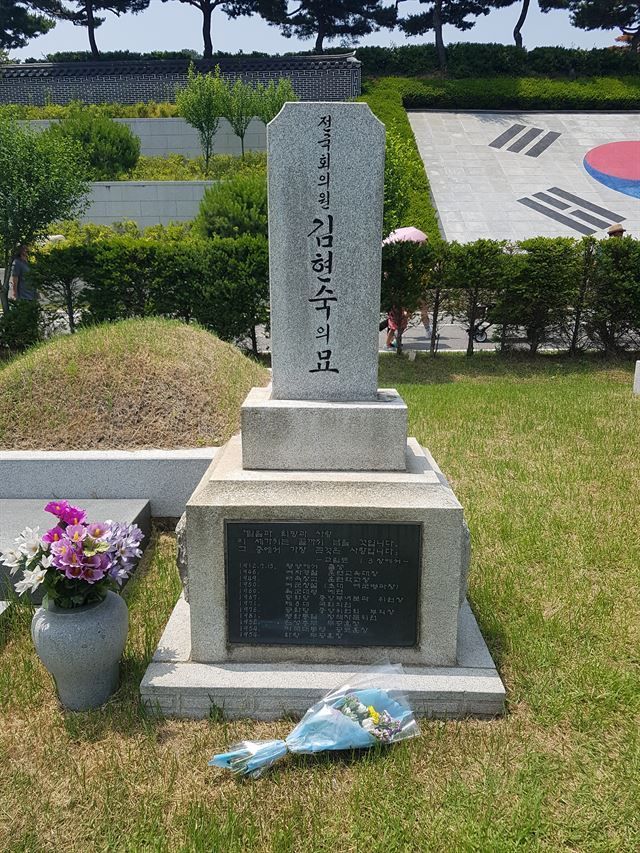
This is a grave of Kim Hyeon-suk at Seoul National Cemetery. She formed an all-female brigade during the Korean War. Kim, who rose to the rank of colonel, was awarded a Medal of Merit by U.S. President Dwight Eisenhower in 1954. She retired in 1960 and later served as a lawmaker. /Courtesy of Richard Pennington
With help from some young volunteers, Yoon and I made our way to a four-story charnel house called Chunghondang. I had a name (Kim Tae-seon) and serial number (324331) which had been provided by Kim's granddaughter, Paek Bo-min. She is my former student, now sailing toward a Ph.D. at the University of Northern Colorado.
Born in 1926 in what would later be called North Korea, Kim died in 1988. A patriotic man, he did his part in the war effort; I do not know the specifics other than that his service began in 1951 and ended in 1953.
We went up to the third floor of the building and located the glass-covered box that holds his ashes. I laid one of the bouquets there and quietly paid my respects.
We departed Chunghondang, tossed a handful of incense in a large burner and approached another set of young volunteers. How, we asked, do we find the grave of Kim Hyeon-suk (1912-81)? I only knew that it was in section 17.
Fortunately, that was close. One of the volunteers came with us and helped us locate her grave, where I laid the other bouquet. Kim was a fascinating person, in my view. As the war raged on, she sought to take a more active role than what was ordained for women at the time.
She formed an all-female brigade, with the grudging permission of President Syngman Rhee and most of the military brass. Although they marched, trained and learned to shoot guns, they did not actually engage in combat.
These hardy women conducted intelligence work around the hotbed that was Mount Jiri. After the war, Kim, who rose to the rank of colonel, was awarded a Medal of Merit by U.S. President Dwight Eisenhower in 1954. Her brigade lasted until 1960.
It had been a hot and muggy day at Seoul National Cemetery. Lots of walking up and down hills, so a measure of effort, trouble and discomfort was required. But how much? I think, I really think about what Koreans went through in the early 1950s.
Because of them, we have freedom in the southern half of the peninsula ― freedom to think, speak, criticize the government, travel abroad, live our lives and so on. Those up north can only dream of such freedom.
Richard Pennington (raput76@gmail.com), a native of Texas in the U.S., works as an editor at a law firm in southern Seoul. He has written 21 nonfiction books, including “Travels of an American-Korean, 2008-2013.” He is the director of an NGO, the Committee to Bring Jikji Back to Korea.