Big trouble in the camp: Seoul's foreign community in 1889 (part 2 - The American legation)
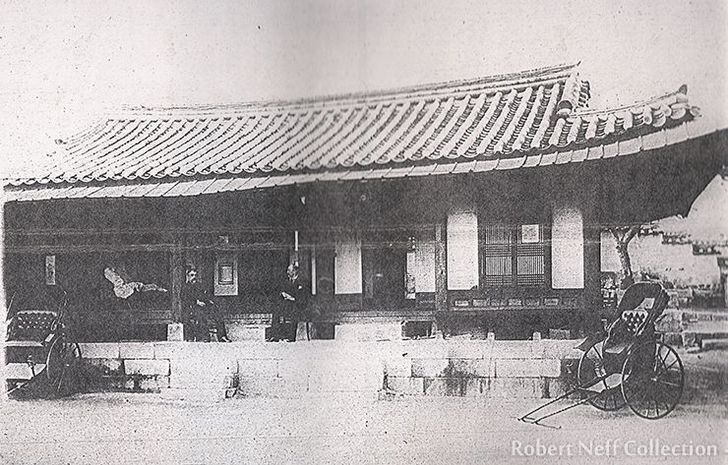
The American legation in Seoul, circa 1885.
By Robert Neff
In the summer of 1889, there was confusion in the American legation. Hugh Andrew Dinsmore, the American Minister and Consul-General to Korea, spent much of his time in Jemulpo (modern Incheon) away from his official post in Seoul. This wasn't really that unusual.
Many Westerners avoided staying in Seoul during the height of summer because of the intense heat and humidity.
Outbreaks of disease were common due to poor hygiene and the contamination of fresh water when the fetid open sewers overflowed during rainy season deluges.
Dinsmore, however, wasn't trying to avoid the heat or disease ― he was already in poor health.
We know little of his ailment, save that it was serious. In the middle of June, Dinsmore became deathly ill and, following the recommendation of his physician, went to Jemulpo where it was cooler and thought to be more conducive to his recovery.
According to Dinsmore, he spent about 10 days in the port city and afterward “returned to the legation improved in health but not well.”
Less than two weeks later, on July 5, he had a relapse and was once again forced to return to Jemulpo for secret ― albeit a relatively open secret ― treatment. He anticipated a relatively short stay and, before leaving, instructed Charles Chaille-Long, the legation secretary, to keep him appraised by regular mail (via the river steamboats) and, if there was something urgent, to do so by telegraph.
Dinsmore did not anticipate there being much work while he was gone. The President of the Korean Foreign Office had been removed due to the French servant incident [yesterday's article] and still had not been replaced.
And, although he personally did not like Chaille-Long (he thought him to be insubordinate and sneaky), he was sure the secretary would be able to handle the mundane business of the small American community ― fewer than 100 Americans resided in Korea.
But the short stay soon developed into a longer sojourn of, according to rumors, an indefinite stay. Dinsmore's messages to Long were, according to Chaille-Long, confused ― perhaps as a result of the medication he was taking for his severely swollen testicles.
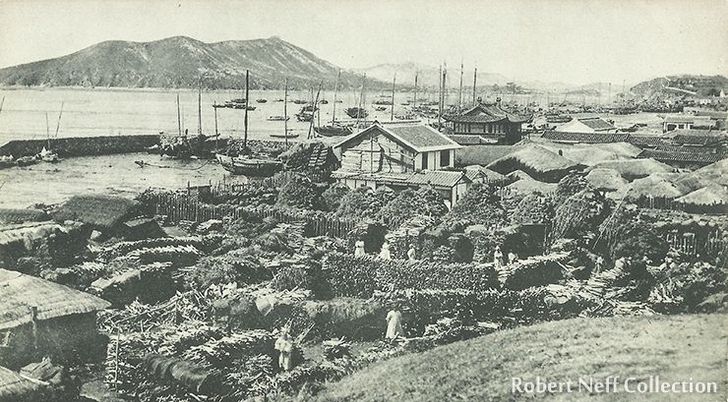
Jemulpo harbor, circa 1890s.
On July 25, Chaille-Long sent a message to Dinsmore in which he wrote: “Your prolonged absence from this post, which leaves me here absolutely without control or authority, has become painfully embarrassing to me by reason of the comments which are freely indulged in on all sides.”
He followed it with a letter two days later informing Dinsmore that he felt the minister was no longer physically and mentally able to fulfill his duties. He then quoted paragraph 36 of their personal instructions:
“A secretary of Legation will in case of the absence, death or disability of the diplomatic representative assume the duties and perform the functions of Charge d'Affaires ad interim without special instructions or credentials to that end.”
Chaille-Long then informed him: “I have this day addressed a note to the [Korean] foreign office and to our colleagues assuming charge during your temporary absence.” He closed his missive with a wish for Dinsmore's “steady convalescence.”
Dinsmore, furious at the act of “insubordination,” hastily sent a message (one lacking the normal civility of diplomats) to Chaille-Long. He declared that he had never ceased to be in charge of the legation and that Chaille-Long's actions were “wholly unauthorized and unwarrantable” and that he was forbidden to conduct any business as charge d'affaires. Dinsmore also stated that he would be returning to Seoul on the first river steamer.
Chaille-Long responded. He claimed he was firm in his belief that his actions were warranted and correct. Furthermore, he would be asking the State Department to pay him as charge d'affaires during Dinsmore's absence ― a period of 46 days. He added, “in order to avoid anything like a scandal, I defer the business of the office until your return.”
Dinsmore returned to Seoul on August 2. He promptly sent missives to the Korean Foreign Office and to his fellow diplomats explaining Chaille-Long's actions as being “under a misapprehension of his duty and authority.”
As for Chaille-Long, two days after Dinsmore's return, he went on two months' leave and returned to the United States. He kept his promise to petition the State Department for pay as charge d'affaires during Dinsmore's absence but his claim was denied. He subsequently tendered his resignation ― which was accepted with the “regret to be deprived of my valuable service.”
He then went on to Egypt and wrote several books ― self-glamorizing and exaggerated. He later returned to the United States and served as secretary for the United States commission to the Paris Exposition of 1900.
As for Dinsmore, he was replaced in May the following year and returned to his home state Arkansas, where he served as a U.S. representative for his state from 1893 until 1905. He did, however, have one more role ― a small one ― in Korea's history, but that is a story for another time.