Tough times: Russia lures 19th century Koreans
By Robert Neff
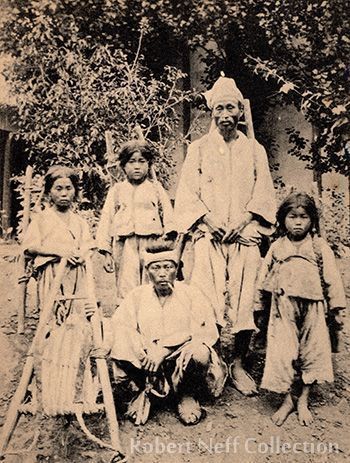
A Korean family ― Russian postcard, circa 1900. Courtesy of Diane Nars
In the 19th century, life in the northeastern part of the Korean Peninsula was filled with hardships.
The harsh environment, predations by wild animals and outlaws, heavy taxes and the perceived prejudice of the government in Seoul for the region caused many to wander elsewhere seeking better opportunities. For many, Russia was the land of opportunity.
According to Isabella Bird Bishop, a feisty elderly Englishwoman who traveled extensively throughout the Far East in the 1890s, Koreans arrived in Russia in 1863 when 13 families settled in the Russian province. Slowly that number grew. By 1866, there were about 100 families ― all “very poor” and provided cattle and seed by the Russian government.
It isn't clear when Koreans started emigrating but Korean documents indicate that in the winter of 1866-67 there were several incidents along the short Russian-Korean border.
“Bandits” ― believed to be Koreans ― crossed the Tuman River from Russia and carried away women, children, livestock and family possessions. A group of several hundred bandits ― trying to flee into Russia ― were forced to leave behind a large number of livestock, some 30 cooking stoves, grain and 20 carts.
The Joseon government tried to prevent a mass exodus to Russia by fortifying its border. A large number of guard posts were built ― each manned with three or five soldiers ― and a wooden barrier, with small alarm bells that would ring if someone tried to cross, was erected along the banks of the river. According to one of the reports, the defenses were so secure that “even little creatures like flying birds and leaping rabbits could not avoid them.”
Heungseon Daewongun, the Korean regent and father of the king, proclaimed that he felt alarmed and grieved that the people of the northern province would “abandon the home of their fathers and mothers and flee to a land where the customs and language are strange.” He ordered that some of the taxes be abolished or reduced and granted relief aid.

A Russian family in Vladivostok, circa 1900s.
It may have helped but not enough. According to Bishop:
“During 1869, a year of very great scarcity in Northern Korea, 4,500 Koreans migrated, hunger-driven, into Primorsk, some 3,800 of them being absolutely destitute. These had to be supported, no easy thing, as the territory, only ceded to Russia a few years before, was but a thinly peopled wilderness, and was also suffering from a bad harvest.”
Russia, at least in the beginning, welcomed the immigrants. The Koreans from the northern provinces were seen as “keen of character,” coarse and rough, but honest. They were hard workers and practical. They did not blindly follow orders but tended to question things they did not understand or agree with ― even to the point of becoming obstinate and argumentative. These qualities were appreciated in a frontier environment.
It is interesting to note that the Koreans of Seoul were not viewed in a similar manner. They were described as being soft, easily distracted, smooth-tongued and dull-witted.
The Koreans in Russia flourished. They quickly learned Russian. It is said that one of the first words they learned was khleb (bread) because of their great fondness for it.
When Bishop visited Russia in the mid-1890s, she claimed there were between 16,000 and 18,000 Koreans. Those who had arrived before 1884 could claim Russian citizenship. She was very impressed and noted that on the Russian side of the border:
“There are Korean villages, of which prosperity in greater or less degree is a characteristic. The houses are large and well built, and the farmlands are well stocked with domestic animals, the people and children are well clothed, and the village lands carefully cultivated.”
The people enjoyed more freedom than they had in Korea and, even though they were “alien settlers, practically enjoy[ed] autonomy.” They had their own police, judges and officials elected by the community.
Over the next decade, relations between Korea and Russia would continue to improve. Trade flourished and Russian influence in not only the markets but the politics of the Korean Peninsula became a cause of concern for Japan.