The Skeebo: terror in the dark

Fred Dustin and two Korean service members in the 1950s.
By Robert Neff
Like many young American men in the early 1950s, Fred Dustin was sent to Korea to fight in the Korean War. After completing his service in 1953, he returned home to Bellingham, Washington, and resumed his studies.
Despite the distance, he maintained an interest in the affairs of the peninsula and even convinced his parents to host a couple of young Korean soldiers for a short time.
Dustin was a natural storyteller and could weave experiences, exaggerations and occasional fabrications into fascinating tales. Often these stories had several versions ― depending on Dustin's mood and the identity of his listener.
As they explored the forested regions of the state in his old car, Dustin probably regaled the soldiers with the tales of his youth. More than likely, he also told them about the Skeebo.
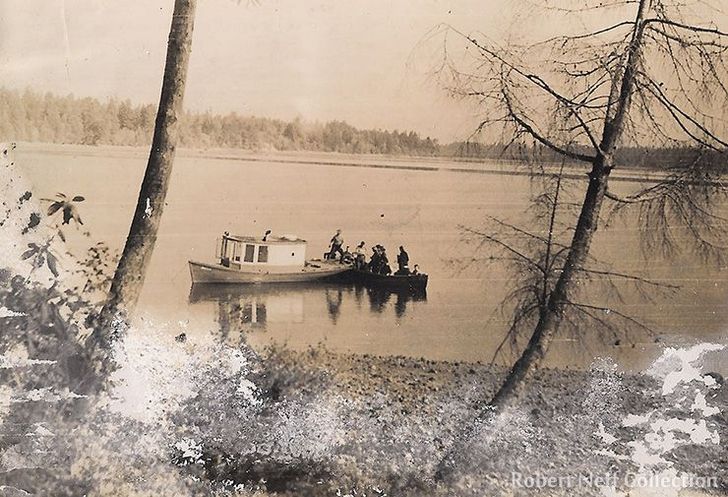
The expedition to Squaxin Island in March 1954.
Dustin became familiar with the Skeebo in the spring of 1954, when, as a student, he went on a field expedition to Squaxin Island with a small group of students led by Prof. Herbert Taylor ― a famed anthropologist.
Taylor was tasked with proving that the Squaxin Island Native Americans had resided on the island before the 1854 Treaty of Medicine Creek and was invited to the island by Chief Garrison. Dustin recalled there were, at that time, only eight members of the tribe: half of them lived on the island while the other half lived on the mainland.
Taylor's expedition left Boston Harbor (Olympia) and sailed for the heavily wooded island in a small boat owned by Chief Garrison. On arrival, the students set up their tents about a half a mile south from the Garrisons' home and settled in for the night.
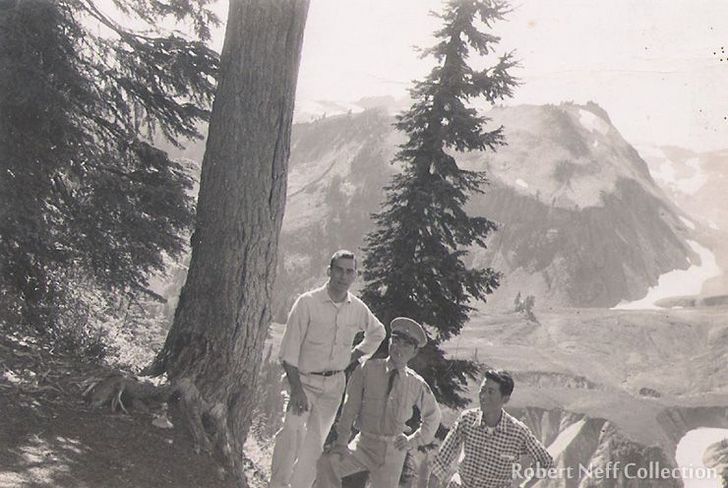
In the wilderness of Washington State.
They spent most of the following day looking about the island for possible sites that would prove when the islanders arrived. That evening, they gathered near Garrison's home and started the “ethnology or storytelling of myths and legends, the main one being the Skeebo or the Physical appearance/sign of imminent death of the beholder.”
Garrison began citing names of all those who had died on the island over the years and, for each name, he noted that just days before their deaths, and always at night, each of the deceased had seen the Skeebo.
Dustin explained: “The Skeebo had a long tail ― whether it was forked or not, I remember not the answer [and it] wore a top-hat, much in the style of a type worn by President Abe Lincoln! It was very short stature ― my mental apparition is like 3 feet in height! In other words, the identifying signs were shortness, a tail and a top-hat.”
Apparently Garrison, who was quite elderly at the time, believed and feared it. Dustin described the fear as “all consuming” and noted that “the windows [of Garrison's house] were blocked so that during the day some light came through but at night it was impossible to see outside; from the exit doors were built hall-like structures to the privy so there was no danger of seeing the Skeebo.”
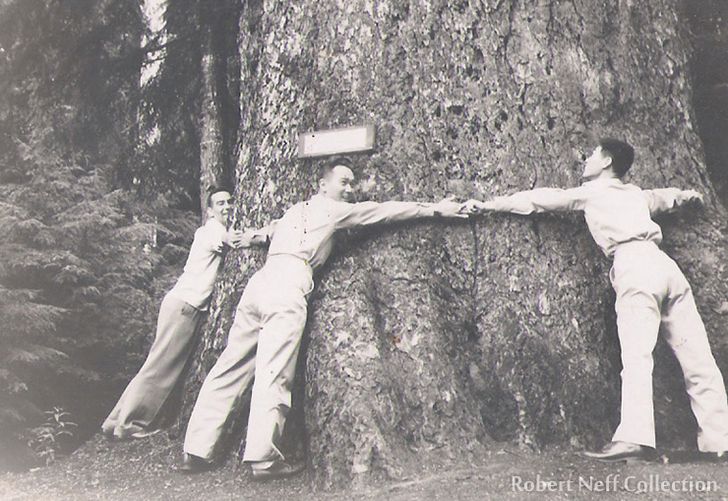
Measuring the girth of a tree.
It was about midnight when they decided to end the session and make their way back to camp. Dustin claimed that the walk back was absolutely the most horrifying experience of his life. The brightness of the moon allowed them to see off into the dark a great distance, which made it even more terrifying; if the Skeebo was lurking about, they would surely sight it.
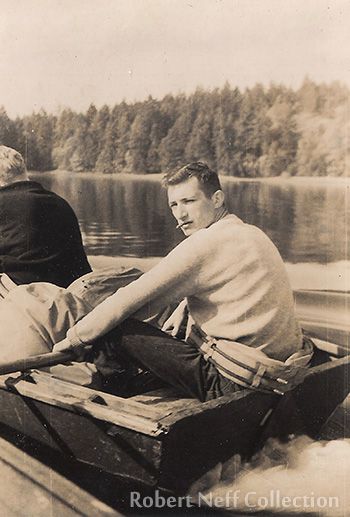
Mike O'Sammons, a participant in the March 1954 expedition.
“I frankly don't know what the other members of the team were doing because I actually covered my eyes with my hand only looking straight down for the pathway,” admitted Dustin. He then added: “I can remember to this very moment how dry my mouth was and how my whole body trembled as my heart pounded.”
Over the years, Dustin told me this story several times. The fear he experienced was real and when asked to explain it, he wrote:
“I really cannot explain the 'feeling' of that intense fear. I had been in fearful situations in my life; I had been in limited but certainly dangerous actions during the war even though I was a bandsman. When young, I was afraid of the dark. I can remember having to go out to the woodshed after dark to get wood for the cooking stove because I had not gotten it earlier and I can remember the feeling of 'some presence' which was rather terrifying. All the older people always suggested that at night, one should never look behind and always whistle when walking alone at night. There were old wives' tales such as if you can't hear the owls, watch out; in the woods, when the birds stop tweeting, be careful! and so on.”
He was not alone. None of the other members of the expedition really talked about what happened out there but, according to Dustin, “it had an effect on each and every one of us including Taylor: a traumatic effect of the type one simply wishes to forget about.”
And, yet, he never forgot.
There is a positive side to the story. Partially due to Taylor's efforts, the Squaxin Island Tribe received $18,000 as restitution from the American government.