Freedom, peace and friendship in Korea

Courtesy of David Tizzard
By David Tizzard
.jpg)
David Tizzard
One normally pictures British skies as being dreary, overcast, and rain-soaked. So it seemed rather fitting that the weather up near Dongduchon on Friday was exactly that, because a group of British veterans from the Korean War had come to participate in a memorial service.
The event was held to commemorate the 29th Brigade's Actions at the Imjin River ― otherwise known as the Battle of Solma-ri or the Battle of Gloster Hill. Three British and one Belgian infantry battalion held their position determinedly against all odds and despite the inevitably of the onrushing Chinese offensive.
The eventual and tragic yet noble fate of the 1st Battalion comprised of The Gloucestershire Regiment has become part of the broader British military history and created a bond with the people of South Korea with whom they fought so valiantly. That particular fidelity marked its 68th year anniversary this week.
From its early treaties to its current high trade levels and frequent cultural exchanges, Britain and the Korean people have established a commitment that has been nurtured and built over the years. The relationship remains a strong one, cemented in blood, and carried forward through bilateral agreements and a joint adherence to international norms and laws.
Historically, Britain's interest in Korea can be dated to the early 17th century. Through Portuguese sailors and explorers, news of a land known as “Corea” arrived. With it came promises of potential wealth and treasures to be obtained through trade and commerce ― particularly ginseng. Orders were thus given for Vice Admiral George Willis, commander-in-chief of the neighboring China station, to sign a treaty with Korea.
This year, it was British Ambassador to the Republic of Korea Simon Smith who honored the commitment between the two countries as he read a speech sent by Her Majesty Queen Elizabeth II: “For those veterans gathered here today at Solma-ri to commemorate the Battle of the Imjin, Her Majesty retains fond memories of her own meetings over the years with veterans of the Korean War and their family members. And she joins you all on this occasion in remembering all British servicemen who fell during the Korean War, whether at sea, on land, or in the air.”
Ambassador Smith was joined by Irish Ambassador Julian Claire, Belgian Deputy Ambassador Tine Jacobs, and representatives from the Korean and UN forces. They laid wreaths in front of the memorial and paid their respects to those that fought so valiantly for that which we are grateful today.
And to mark the gratitude and continued friendship between Britain and Korea ― as well as all those countries that served alongside them ― a more moving sight could not be imagined than seeing Korean high school children embracing and thanking the British veterans.
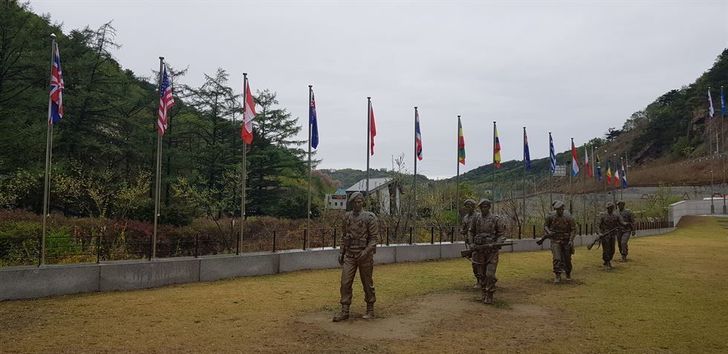
Courtesy of David Tizzard
Students from the Gyeonggi Semu High School and Yerim Design High School listened intently as Frederick Grundy spoke, reciting sections of Laurence Binyon's “For the Fallen.” Grundy and fellow veteran Keith Leese were joined by other soldiers and family members who had travelled to mark the occasion.
The exchanging of flowers, gifts, and memories between these groups also brought joy to a somber occasion and demonstrated the personal warmth that exists over an expanse of 8,000 kilometers and helped keep some of the rain at bay ― at least figuratively.
The students were awarded scholarships that help pay for their education and continued development as Korea goes from strength to strength, thanks in no small part to the excellence of its own academic achievements and support from the broader international community.
Freedom, peace, and friendship are values upon which any community could be successfully established. And that is very true of South Korea today.
The country stands proud among its neighbors as having embraced democracy and freedom of speech. Moreover, its modernization is not only limited to its marvelous technological developments, it now embraces a plurality of social thought and seeks true equality for all, even its minorities.
Its cultural achievements, often embodied in global superstars such as BTS and Son Heung-min, reach far and wide and this wave brings a message of understanding and acceptance rather than division and conflict.
The ceremony on Friday, arranged by the United Kingdom Defence Attache and The U.N. Korean War Allies Association, quite rightly remembered the sacrifices and gallantry of a time that recedes further but remains unforgotten.
With it, the veterans march on. And as they do, so does the freedom, peace, and friendship between the Republic of Korea and the United Kingdom. And long may it continue.
David Tizzard (datizzard@swu.ac.kr) is an assistant professor at Seoul Women's University.