The unwelcomed Guest of 1886
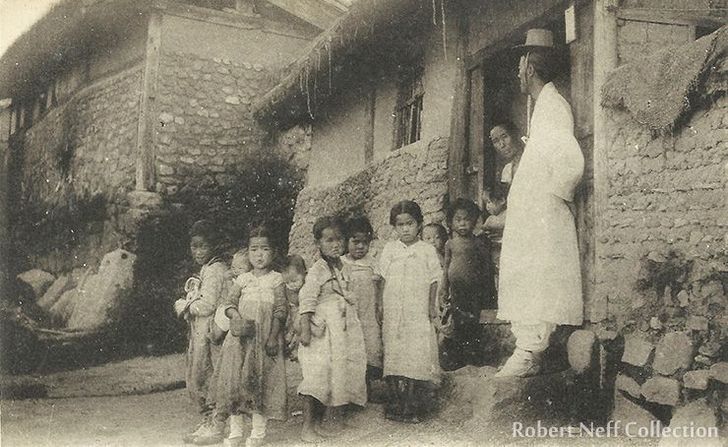
Curious children in the streets of Seoul circa 1900-1920s.
By Robert Neff
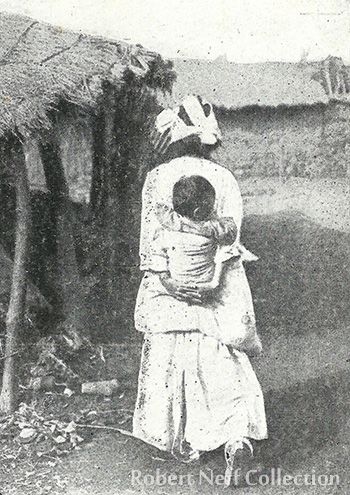
A woman carrying a young child on her back circa 1900-1920s.
In February 1886 the Guest arrived. It wasn't his first arrival ― in fact, he was a frequent visitor ― nor was it his last visit. In an effort to discourage his visits, people tied thorny bushes and twigs to their roofs and the entrances of their homes, but the Guest, if he desired to visit, would not be stopped by these mortal precautions.
When he did enter a house and into his host (usually small children), there was little to do but wait. Mothers and grandmothers often took to the streets, young whimpering children strapped to their backs, speaking in low but honorific voices to the Guest asking him to cut short his visit and spare his host from excessive suffering.
But the Guest would not leave until he desired to do so. It was said that his visit usually lasted for 13 days, but some people tried to appease him and encourage him to leave early with feasts of breads and other delicacies spread out on a table next to a small wooden horse. It was hoped that once the Guest was full that he would mount the horse and ride away, but it was rare for the Guest to do so.
A bowl of fresh water was placed in the host's room and would not be removed until the Guest had departed. Visitors were kept to a minimum, not out of fear that the Guest would lash out at them, but because the host was susceptible to the pains and hardships of his visitors ― their pain became his pain.
When the Guest's visit was a particularly harsh one, the mudang (shamans) took to the streets, banging on drums and chanting ― a small wooden horse was always part of their ritual and, of course, it was expensive and added further to the misery of the hosts' families. There was nothing else to do but plead for the Guest to leave.
Whether it was the placating voices of the mothers and grandmothers, the drumming and chanting of the mudangs, or the feasts of bread of delicacies, the Guest eventually did depart, leaving behind a mixture of relief and misery.
For the lucky ones, his visit pocked their faces with scars; for the less lucky ones, he left them scarred and robbed them of their vision; and, for the others, he robbed them of their lives. The Guest was known in the West as smallpox.
According to Horace N. Allen, an American missionary doctor in the 1880s, about 50 percent of Korean children died before the age of five from smallpox. The disease was so prevalent that people did not even bother to name their children until after they had hosted the Guest.
Relieved mothers sometimes scraped the smallpox scabs from their surviving children and took them to temples or shrines and burned them ― thanking the Guest for sparing them. But for those who were not spared the suffering did not end with death.
Often the body of a child was taken out of the city and laid out near the gates ― a visual reminder to the Guest that he had already claimed victims. Others were wrapped in straw mats and placed on platforms or suspended from trees ― exposed to the elements so that they would dry out and decompose so as not to contaminate the soil. Reportedly, people sometimes encountered these straw bundles still moving, the child not quite dead. Some were rescued by compassionate souls, but many were beyond saving.
The Guest did not discriminate. Noble families ― even royalty ― and common people were all subject to visits by the Guest. Sometimes, much to their detriment, even foreigners found themselves the host as we shall see in tomorrow's article.