The dust storm - how the blame game costs lives

People's lives must take priority over industrial power. From Unsplash
By Amanda Price
Parts of South Korea have been blanketed in fine dust particles again. On March 13, pollution in Sangdaewon-dong in Gyeonggi Province was at emergency level. No-one there should have been outdoors.
More recently, the National Assembly declared the fine dust pollution would now be classified as “a social disaster”.
Amid these alerts for citizens and government announcements, accusations seem to surface. Subtly, and then sometimes blatantly, we are informed that someone else is largely responsible for this mess.
While the bull's eye has been painted firmly on China, the Minister for the Environment, Cho Myung-rae, recently announced that North Korea was also to blame. Of course, air is not restricted by national borders, but North Korea?
Scientists are beginning to wonder what they should do with the mounting evidence that Korea's fine dust pollution is more the result of domestic causes, than pollution drifting in from China … or North Korea.
But then again, what do environmental scientists know? The circumstantial evidence suggests we should lay the greatest portion of blame on others, so let's do that.
This seems to be the attitude held by many Korean politicians, and, according to the Korean Economic Institute, it is an attitude that has delayed and complicated policies that should have been implemented years ago. It is also an attitude that costs lives.
In 2016, the same Korean Government teamed with NASA in a joint venture to investigate and track the behavior and flow of fine dust particles, in particular PM2.5. NASA planes followed the fine dust for months and collected samples at various altitudes. Together with South Korea's National Institute of Environmental Research (NIER), they developed a model that answered the questions that everyone was asking.
In 2018, the findings were announced to the Korean Government. NASA scientist and Program Manager, Barry Lefer, reported, “Our conclusion was that the local emissions are a strong source of ozone and small particles. The model said that over half of the air pollution is coming from local sources and the rest is coming from other countries.” (emphasis mine)
The findings of this lengthy and expensive experiment confirmed the fine dust particle pollution was a problem in which South Korea had an equal, if not greater share. These expert findings, by Korean and NASA authorities, have been largely ignored or replaced with circumstantial speculation. Consequently, most Koreans have been given reason to believe that China is largely responsible for Korea's pollution.
This is a 2018 interview with Professor Chang Limseok, Director of NIER's Air Quality Forecasting Centre. Chang was also part of the Korea-US Air Quality Study (KORUS-AQ Campaign). His expert analysis is very insightful. The professor's interview begins 7:13 minutes into the
.
Korean citizens should not be held accountable for believing misinformation; it is simply what happens when science is filtered through politicians and the media. Scientifically empirical evidence is tossed aside in favor of speculation, and speculation is turned into headlines. Headlines sell. Science, particularly pure science, does not.
Meanwhile, as people are encouraged to point fingers at China, the Korean Government is only beginning to change what it should have changed years ago.
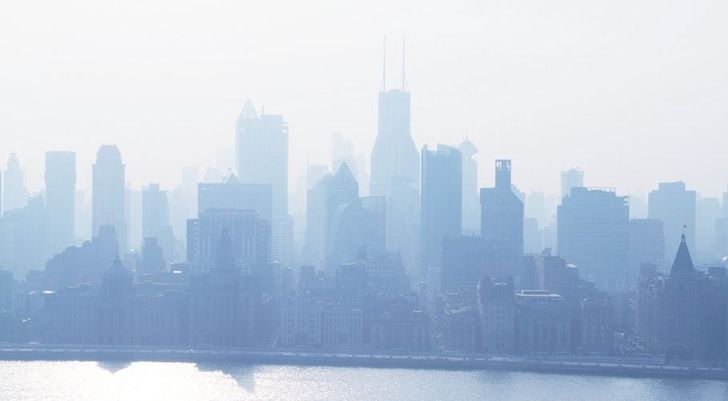
Shanghai, China, on an average day. Once an agricultural society, then an industrialized society, China now aims to become an ecological society. From Unsplash
China, by contrast, has responded to its air quality dilemma with reforms and radical government restructuring. While on first impression this may “seem too little too late,” independent experts have confirmed there is significant change. According to University of Chicago research, China has already reduced its pollution in some areas by 42 percent.
While China still has a long way to go and much to answer for, it is still moving in a forward direction. Having churned out an appalling amount of pollution into the atmosphere, China is now committed to building an “ecological society”. What is more astounding is that previously cynical experts say that it looks to be working.
The news that China denies all responsibility is far from accurate. China has simply refused to accept 80 percent of the blame. None of this is to suggest that China is blameless, only that China has chosen the things it can change and made them a priority.
According to Chang, the methodology of air quality control is to change what is in your power to change.
The fine dust particles created by natural causes, and the approximately 40 percent that comes from other countries, are not directly within Korea's power to change. What Korea can change is its own man-made causes, as well as the value it places on pure unbiased science.
The solutions to Korea's poor air quality are not to stop frying mackerel, nor hope for a change in the weather. The solutions will require extensive research (by experts), but solutions are within reach. There is no need for hand wringing or “Oh, what shall we do?” ― other countries are already demonstrating what must be done.
The imperative is not only the country's future, but the present state of people's health. For far too many families, delay has resulted in the death of their loved ones ― a situation that defies understanding.

Researchers have discovered that fine dust particles may cause dementia and even Alzheimer's disease. From Unsplash
It is well known that it often takes many years for the effects of pollution on the human body to manifest. Originally, the toxins in the fine dust particles were thought to cause respiratory problems, but scientists have since discovered that fine dust particles can make their way to the heart, and even the brain. University of Arizona scientists have even discovered links between fine dust particles and dementia.
Tragically, the time for action has well since passed for far too many.
Radical reforms must begin with industries, and where cities have exceeded the environment's capacity to sustain them, the next step must be there.
In an ideal world, environmentally reformed businesses and communities could relocate to more rural areas. In that setting, more companies could allow employees to work remotely from home. Korea's thousands of villages could be repopulated. Children could walk to school. Cars would not be emitting toxins as they crawl through the endless congestion. Food waste would be fed to animals.
It would not be an immediate cure, but it would help.
Sadly, we do not live in an ideal world, but we do live in a world of possibilities.
Korea has a significant but achievable task on its hands. The price of an industrialized society has come at the cost of human health, and in some cases, human lives. Medical as well as environmental research must therefore be priorities.
The hope for Korea lies not with government policies, although these are necessary, but with a mindset that everyone is responsible to change what must be changed.
There are often surprises to be found in reform. In the process of fixing one problem, a solution is often found for another. A less industrialized Korea, a less hectic pace of life and a greater concern for each other's well-being, may well result in unexpected outcomes.
Korea is capable of turning this “social disaster” into a new beginning.
I look forward to a Korea with startling blue skies, and people who have no need for masks.
“Never doubt that a small group of thoughtful, committed citizens can change the world; indeed, it is the only thing that ever has.”
― Margaret Mead
Amanda Price is the former Director of Hillcrest College's International Student Department. She has a background in Science, History and Literature and has been consulting on Asian Affairs for more than 10 years. Her special interest is world history and she is the founder of Griffith University's History Readers. She writes full time and can be reached at amanda-price@bigpond.com