Flying in the New Year: Kites of Joseon
By Robert Neff
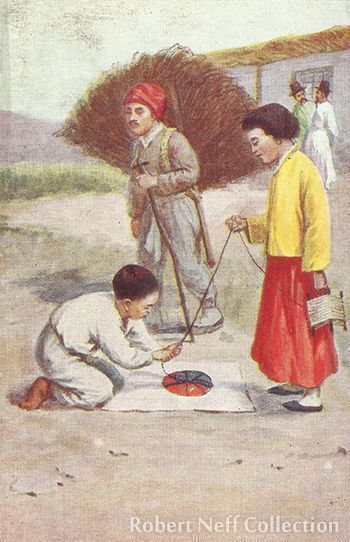
Korean kite, circa 1900-1920
In the past, kites were an integral part of the Lunar New Year celebration as both entertainment and a vehicle to dispel the previous year's bad luck. For two weeks following the New Year, the sky was filled with them.
The kites were generally square-shaped, tailless, and made from bamboo and strong paper with a round hole in the center. Some were very colorful and graced the sky with their beauty but these were not the kites that attracted the most attention. It was the plain kites ― the fighting kites.
Fighting kites were agile weapons mastered not only by boys but also men who used them to take down the kites of their opponents through the elaborate dance of aerial combat. The kites would soar and dive, twist and turn as they attempted to severe the strings of the kites around them. While the kites may have been relatively inexpensive, the strings could cost a pretty penny depending on the quality. Some duelists even glued powdered glass to their strings, making them more likely to severe the string of their enemy while protecting their own.
Crowds would gather in the streets to watch the combat “in breathless excitement and with [the] keenest interest, which they [showed] by their ejaculations and cries of encouragement or dismay” as the winner would cut the string of his opponent, allowing it to fall to the ground in disgrace. Even shopkeepers would close up or ignore their potential customers in an attempt to witness the prowess of a favored flier.
The vanquished kite, on reaching the ground, was fair game for anyone who wished to claim it. Young boys would race to claim them but they were not alone, “even old men caught the contagion and hobbled off in search of the unlucky kite ― finders being keepers.”
A trio of early American teachers in the late 1880s thought they would try their hand at flying kites. They were confident of their skills ― after all, as boys, they had flown more than their fair share of kites ― but that confidence ended quickly. They had flown kites with tails and the Korean kites lacked them. Their attempt to impress their students was thwarted by “the loss of several kites, which by their plunging were cast down into neighboring grounds and became the prey of the ubiquitous small boy.” Their clumsy efforts had only served to convince their students that Koreans were truly the superior kite fliers.
But on the 15th day of the Lunar New Year, kite flying took on a new meaning. People wrote their names, birthdays and misfortunes on slips of paper and tied or glued them to their kites. They then flew their kites to as high as they could go and then released them ― the thought being that the kite would take away all of the misfortune and evil that had plagued them the previous year. Some people added small coins to their kites as incentive for someone to pick it up. It would be like opening Pandora's Box for the unlucky finder who, out of ignorance or desperation, took it home.
Sometimes the unlucky finder was a foreigner. Foster Beck, the young son of an American missionary in Korea, claimed that it was acceptable to keep the Korean kites that fell into his yard. But if he attempted to fly the kites after the last day of kite season, the former owner “would be very much afraid that the kite had not taken away the evil spirit from him, and that his house would be destroyed, and that his parents would die.”
This year, go out and celebrate the Lunar New Year with a kite ― but before you pick up an abandoned kite, make sure it is before the 20th.