Kim Yuna's greatest performance

Olympic figure skating gold medalist Kim Yuna speaks during the United Nations General Assembly at the U.N. headquarters in New York City on Nov. 13, 2017, before the assembly adopted the Olympic truce for the PyeongChang 2018 Olympic and Paralympic Winter Games. /Korea Times file
By Richard Pennington

She was the six-time (2003, 2004, 2005, 2006, 2013 and 2014) South Korean national champion, three-time (2007, 2008 and 2010) Grand Prix champion, two-time (2009 and 2013) world champion, Olympic gold medal winner (2010) and silver medal winner (2014). These are just the high points in the long and glorious figure skating career of Kim Yuna.
Has there ever been a better combination of artistry and athleticism on the ice than this woman? I am tempted to say no, but names like Michelle Kwan, Kristi Yamaguchi, Katarina Witt, Dorothy Hamill, Peggy Fleming and Sonja Henie come to mind.
Before going any further, I should say I know next to nothing about figure skating or how it is judged. I am familiar with the terms “lutz,” “salchow,” “double axel” and “triple toe loop” only because the TV announcers use them during the Olympics.
At Vancouver in 2010, Kim gave a breathtaking performance that epitomized beauty, charisma and splendor. She won the gold medal by skating to a James Bond theme and George Gershwin's “Concerto in F,” captivating judges, spectators and millions of ordinary people like me.
Kim had a big margin of victory over her two closest rivals, Mao Asada of Japan and Joanie Rochette of Canada. This, by the way, was Korea's first Winter Olympic medal outside of speed skating, making Kim's success all the more remarkable.
Kim retired, nursed some injuries, came back, found a new coach and was ready to defend her title in Sochi, Russia, in February 2014. In addition to the enormous pressure on her to win, she would be skating early due to her relative inactivity. That put her at a disadvantage.
And there had been some changes in judges' scoring; points would now be given for certain facets of a skater's program ― X points for this jump, Y points for that spin and so on. The purpose was to obviate judging bias, but the risk was that a skater could do those things mechanically and receive a high score despite putting on a mediocre performance.
And so we come to Adelina Sotnikova. She did what she was supposed to do and got high scores ― so high that they nearly eclipsed those of Kim in Vancouver four years earlier.
Sotnikova's showing in 2014, which included a jump that she clumsily landed with both feet, did not come close to matching that transcendent display. Kim, aware of the new scoring rules, had nevertheless dared to put on a fluid, moving and error-free performance. Her program in Sochi surely was enough to merit another gold medal.
But Sotnikova, a native of Moscow, had played to the Russian crowd and benefited from “home cooking.” She was given the gold medal, Yuna got silver, and I am not even going to bother to look up the identity of the bronze medalist (OK, it was Carolina Kostner of Italy).
The point is that Kim Yuna did not win a second Olympic gold. Most observers ― at least those not of Russian descent ― thought an injustice had been done, that Kim's program was clearly superior to that of Sotnikova.
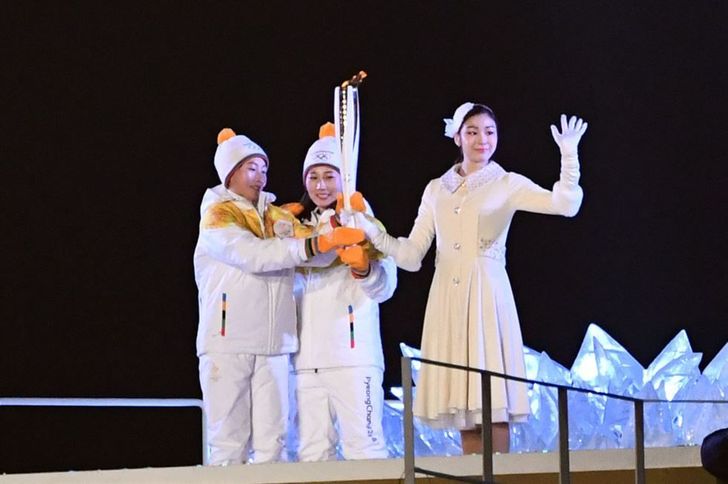
Olympic figure skating gold medalist Kim Yuna holds the Olympic torch together with two other torchbearers at the opening ceremony for the 2018 PyeongChang Winter Olympics at the Olympic Stadium in PyeongChang, Gangwon Province, Feb. 9, 2018. /Korea Times file
In the days and even weeks that followed, there was an outcry in Korea. Editorials were written in virtually every newspaper, an online petition got huge numbers, and all the trending topics on Twitter in Korea pertained to this issue.
But let us look at the behavior of Kim. In the kiss-and-cry booth of the Iceberg Skating Palace, she beamed and waved when the final results were announced. On the podium, she received her silver medal with good grace and congratulated Sotnikova for winning.
She refused to be drawn into the controversy, insisting she had done her best and was relieved her athletic career was over. Kim, who had every right to wail, moan and insist she had been robbed, just would not do it. I have been watching sports for more than 50 years, and I have never seen such maturity after a second-place result.
Some smug and spoiled American jocks could learn a lot from her, and I can think of no better example than quarterback Vince Young of the University of Texas ― my alma mater. Young pouted and sulked after he did not win the 2005 Heisman Trophy. There was no such childish response from Kim in Sochi.
She has earned more than $20 million as a skater and for endorsements of everything from bagels to smartphones, she has graced the cover of Harper's Bazaar, she has sung in concert with Big Bang, she has given $100,000 for earthquake relief in the Philippines, she knows how to work a red carpet, she has managed to maintain a modest public demeanor, and she has no shortage of marriage proposals.
This young woman ― born on Sept. 5, 1990 ― did a brief skating routine before lighting the Olympic torch at PyeongChang in February 2018.
Hail Queen Yuna!
Richard Pennington (raput76@gmail.com), a native of Texas in the U.S., works as an editor at a law firm in southern Seoul. He has written 20 nonfiction books, including “Travels of an American-Korean, 2008-2013.” He is the director of an NGO, the Committee to Bring Jikji Back to Korea.