Walking in the footsteps of the past: Naju in 1884 (Part One)

Palanquins in the late 1890s early 1900s. Photos from Robert Neff Collection
In the fall of 1884, George C. Foulk, an American naval officer, traveled throughout the southern part of the Korean peninsula in a palanquin. He was accompanied by a small number of Koreans who acted as his servants, guards and chair bearers. His diaries provide us with some of the earliest and most fascinating first-hand descriptions of the Joseon countryside as witnessed by a Westerner.
Foulk arrived in Naju, the “Little Seoul”, late in the afternoon on November 14, 1884, and in his diary wrote:
“Passing over a low hill, the wall of Naju comes in sight. The north wall is about a half mile long, 20 feet high, crenellated, broken down in places and altogether very ancient looking. It runs along a hill […] near the gate I expected to find a large city, but lo! From the arch beheld quiet fields. Only a few houses were to be seen. The walled area is about a half to three-quarters of a mile square, but only a small section in the west and southwest is built up.”
As he entered the city he seemed somewhat disappointed.
“The streets are narrow and the houses poor, battered a little by bamboo and iron” ― there was little in color or decoration. Upon seeing him, crowds of people gathered about, but they were relatively unobtrusive and Foulk seemed unbothered by their curiosity.
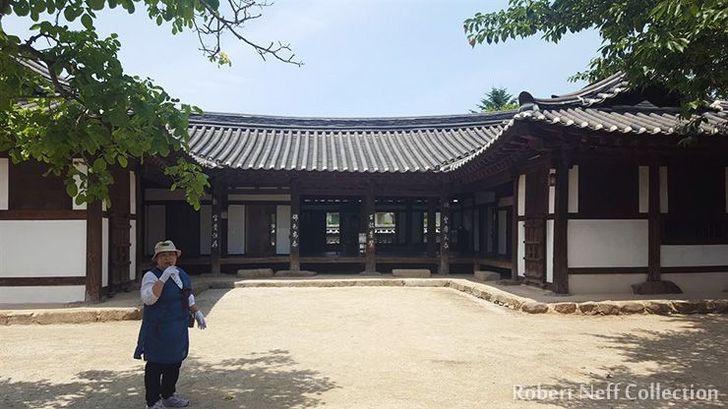
The Governor's residence in Naju.
He was, however, bothered by the indifference shown by local minor officials. Apparently no preparations had been made for his visit (despite notice being sent) as evidenced by a few mats “hastily pitched on the floors” of his quarters and the food offered “was very poor and shabby.” He was determined not to let these slights go unanswered and intended to inform the governor (who was due to return to Naju that evening) about them “and some other things, too.”
He seemed to have been under the impression that he was the first Westerner to visit the city, but he was not. In late May or early June 1654, the surviving 35 crew of the Dutch sailing vessel Sperwer, which was wrecked off the coast of Jeju in 1653, passed through the city on their way to Seoul. Unfortunately, they merely noted the city's name of and gave none of their impressions.
Before Foulk's arrival, a Japanese man had traveled through the city and “raised a great deal of trouble” among the people, which may have accounted for the less-than-welcoming attitude toward Foulk.
The following morning, Foulk rose early and was surprised that his servant had brought a tub of hot water to bathe in. “I actually had a fair bath,” he wrote in his diary, “a marvelous thing in a land where baths are unknown.”
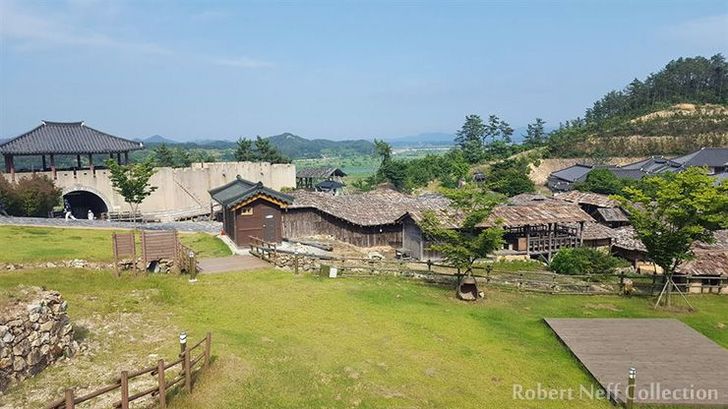
Buildings from the Naju Image Theme Park.
Freshly bathed and in his uniform, Foulk called upon the governor, Pak Kyu-dong. Foulk described him as “about fifty, tall, strong, grey and dark […] rather solemnly agreeable and kind [and] dressed in green duds, and had the usual seal strap fast to him.” Park would have probably been pleased with Foulk's description. Unlike now, it was a good thing in those days to look older than one's true age ― Park was only 34.
The governor told Foulk that he had contemplated having the officials beat for the poor quality of food served the American visitor but on reflection thought it might displease his honored guest if he had done so. Foulk heartily agreed and added that he would “feel very bad if any Korean suffered on account of my visit.”
But, the governor's apparent willingness to have someone beaten for not being attentive to Foulk's needs is contradicted by another of Foulk's observations: “[The governor's] servants struck me as particularly careless of etiquette &c to him, in spite of his savage look.”
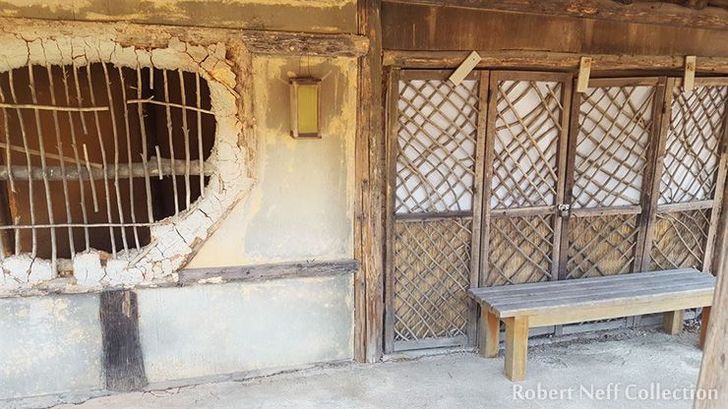
Buildings from the Naju Image Theme Park.
In fact, the more time Foulk spent with the governor, the less favorable his impression became. At one point Foulk judged him to be “rather a low-born man” suited for a low-level government position as he was untidy in dress and “evidently a man of little savoir faire.”
According to the governor, before meeting Foulk, he had met only one foreigner ― a Japanese man ― and so he knew little about the ways of other cultures. Foulk wrote:
“He [the governor] seemed to think it remarkable I should have my hat off while he kept his on. I explained this away, but somehow it seemed to me the old chap wanted me to be a Korean rather than a foreigner in the matter.”
When Foulk told the governor that he planned on sightseeing in the city he was mildly surprised when the governor asked if he could accompany him. Having recently been appointed ― three months earlier ― he “had not yet been sightseeing” in his own city. Foulk naturally agreed.