Troubled waters: Chinese fishing fleets in Joseon Korea

Gunsan port circa 1910-1920.
By Robert Neff
In the 1880s, they congregated in large numbers off the coast of Gunsan. Their nets were incessant, their crews were often violent and they were outsiders ― they were the Chinese fishing fleets.
In early March 1885, Captain Ferdinand H. Morsel, a German in the employ of the Korean Customs Service, set sail aboard the government schooner Wong Ko Huan to inspect major ports on the west coast of the Korean Peninsula.
As they approached Gunsan, he noted that there were several fleets of fishing vessels and while most were Korean, a large number were Chinese. These Chinese vessels ranged in size “from one-masted boats of 5-10 tons, two, three and four-masted junks up to large five-masted junks.” He noted about a dozen of the five-masted junks anchored nearby.
According to Morsel, the Chinese fishing fleet plied its trade for three or four months a year ― especially during the herring season ― and he wondered what impact this foreign fishing fleet had on the Korean fishing industry and how much revenue was lost through this poaching.
But poaching was not the only damage done to local fishermen and their families. The crew of a Chefoo junk went ashore and committed “violence of all sorts.”
A Korean woman and two men made their way to the schooner and pleaded for help. According to the woman, “the Chinese had taken her husband and another villager prisoner [and] unmercifully beaten both and other natives as well; nearly smashed the whole house to pieces” and been involved in several other “unpleasant” acts.
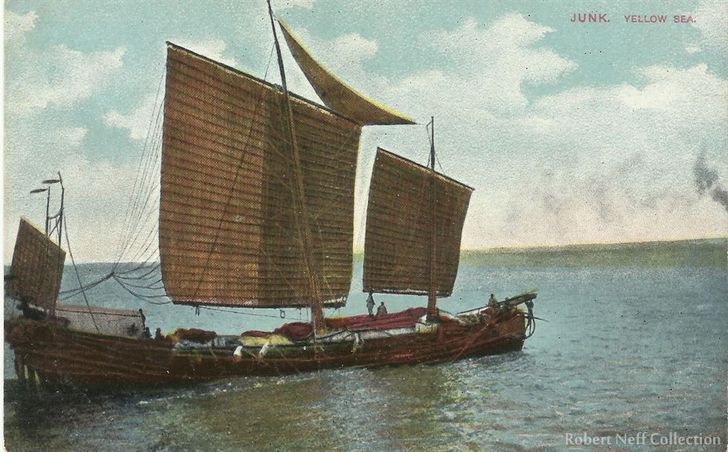
A Chinese junk circa 1920.
The villagers were terrified. The Chinese junk was armed with an old iron cannon and the crew was a hard lot of men. But even more fearsome was a Korean in their employ, whom the villagers “charged with all sorts of extortions and rascalities [sic] in the dealings between the two nationalities.”
Despite their pleas for help, Morsel advised the villagers to seek assistance from their local authorities.
The Chinese were not the only foreign fishing fleets operating in Korean waters. The Japanese fleet was active along the east and south coasts of the peninsula and Jeju Island was plagued with both fleets. Naturally enough, their intrusions were resented by the Korean fishermen, as evidenced by accounts of violent encounters at sea that pepper the contemporary newspapers and government records.
Korea continues to be plagued by fleets of Chinese poachers and over the past couple of years there have been several instances where violence has occurred, resulting in the loss of lives on both sides. As the fish population continues to dwindle, these violent encounters will only increase ― the products of greed.