Rolling tobacco in Joseon
.jpg?w=728)
Korean women smoking pipes and cigarettes circa 1900s
By Robert Neff
Men were not the only ones to smoke in Joseon Korea. Women, of all classes, enjoyed their pipes as much as their male counterparts and some, including the queen, were quick to take up the newest smoking craze ― cigarettes.
When the American journalist, Frank Carpenter, visited Seoul in 1888, he wrote:
“The queen dresses, of course, in Corean costume. She wears fine silks and she has beautiful diamonds. She carries a chatelaine watch which is diamond studded and she smokes American cigarettes by the thousand.
“All Corean women smoke and the majority of them smoke pipes.”
Ten years later, the New York Times noted that American cigarettes were used exclusively at the palace, where large quantities were consumed making them very popular with not only the women but also the upper classes.
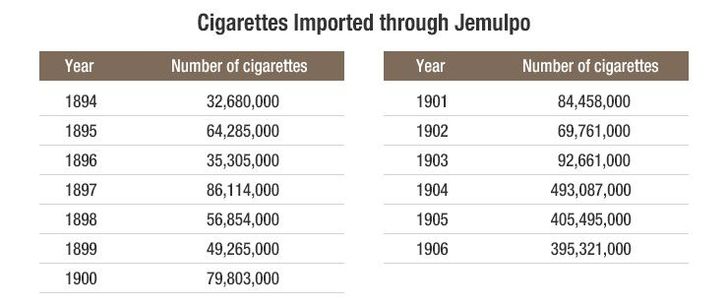
These cigarettes were mainly imported by Townsend & Co. at Jemulpo (modern Incheon), but, by no means did this company hold a monopoly ― the German firm, E. Meyer & Co., also began to import American cigarettes.
These imported American cigarettes were then sold to Chinese merchants in Seoul who resold ― a package of 20 cigarettes cost about 40 cents.
There were other cigarettes for sale. Russian and Egyptian brands were sold to the European residents in Seoul and Jemulpo and were a little cheaper.
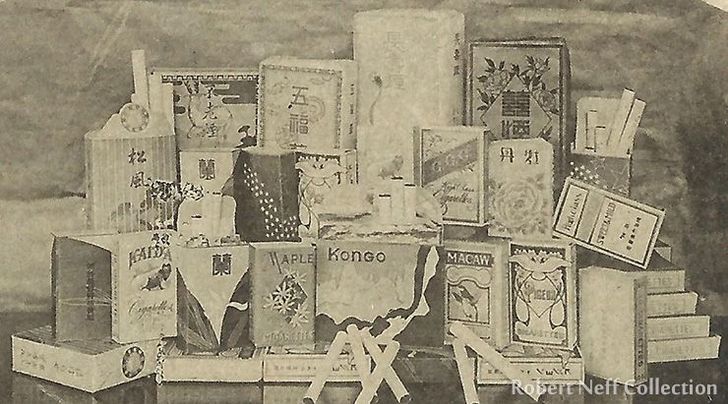
Cigarettes in Korea during the Japanese occupation. Circa 1920-40s
In 1896, Gaillard Jeune, a French merchant in Jemulpo, advertised 100 Bastos cigarettes for 60 American cents; 100 Egyptian cigarettes for $1.75 and 500 Blue Star cigarettes for $1.95.
A cigarette made in Shanghai, using American tobacco, called Little Sweetheart was fairly successful in Korea at the end of the 19th century. A package of ten cigarettes sold for about 4 cents.
The most popular cigarettes in Korea at the time were those made in Japan. Asahi was extremely popular and claimed to use only American tobacco but was probably mixed with Japanese tobacco. A package of ten cigarettes ― with mouthpiece ― sold for only 3 cents.
By far, the cheapest and poorest cigarettes were Korean. A package of 20 cigarettes sold for 2 cents.
Some unscrupulous merchants tried to take advantage of their unwary customers by repackaging inferior cigarettes in American and other European tobacco companies' boxes and selling them as genuine products.
Horace Allen, the American Minister to Korea, urged the Korean government to take action, which it did by declaring any Korean found guilty would be executed.
Allen was surprised but noted the Korean government's actions were ineffective against “the Japanese merchants who were the chief offenders.”
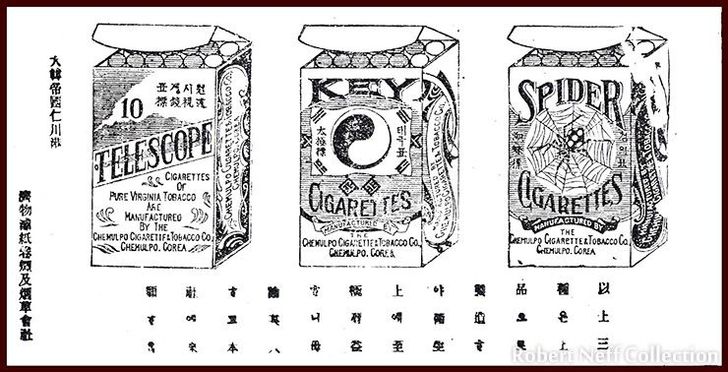
Brands of Chemulpo Cigarette & Tobacco Company from a newspaper in the early 1900s.

Cherry ― a Japanese brand of cigarettes sold in Korea in the early 1900s.

Honey Bee ― a Japanese brand of cigarettes sold in Korea in the early 1900s.

Star ― a Japanese brand of cigarettes sold in Korea in the early 1900s.
In 1901, a Greek resident, known only as Bandlus, established the Dongyang Tobacco Company and built at large cigarette-making factory in the eastern part of Jemulpo. Unfortunately, he could not compete with the cheap imports and soon failed. His failure led others to try.
In 1903, the British-owned Oriental Cigarette & Tobacco Company was established at Jemulpo under the management of A. S Hamilton. The factory had 6 machines that rolled 1 million cigarettes made from American and Korean tobacco. In 1903, it employed 797 men and 60 women.
Its competitor was the Chemulpo Cigarette & Tobacco Co. ― which appears to have been one of Townsend's businesses. In 1905 it manufactured a couple of brands including Telescope (표경시원) ― said to be manufactured with “pure Virginia tobacco” ― Key (태국표) and Spider (검이표).
Working in the cigarette factories was hazardous work and occasionally claimed lives. In 1904, the Korea Daily News reported:
“An unfortunate fatally occurred on Wednesday evening in the factory of the Chemulpo Cigarette and Tobacco Co. A Chinaman named Chang Fook-il experimenting with a tobacco drying machine, opened one of the doors of the machine, unknown to anyone and thrust his head inside.
The stopping of the machine caused the foreman to investigate matters, when the unfortunate man was discovered with his head tightly jammed among the pipes.
The machine was reversed and the Chinaman released, but his skull was so badly fractured that he died one hour after admission to St. Luke's hospital. The deceased was a native of Chefoo and had asked for leave of absence to return there, in order to get married.”
Despite the dangers, working in a cigarette factory paid fairly well and even provided its employees with benefits as demonstrated by this article that appeared in The Seoul Press in July 1910:
“It is reported that the cigarette manufacturers in Seoul have planned to establish a night school in each of the five wards for the young employees of all the tobacco manufacturing companies here and most of the young hands will be admitted at a moderate fee.”
In the years following the annexation of Korea, Japan monopolized the tobacco industry and the foreign firms were forced to close and sell out. The only reminders of these American and British tobacco companies' presence in early 20th century Korea are the occasional cigarette covers found in museums or auctions.