Pearls and politics

Koreans visiting a British warship at Geomun-do, circa 1886
By Robert Neff
Shortly after Lucius Foote, the first American Minister to Korea, arrived in Seoul on May 12, 1883, he declared that his sole purpose in coming was to extend the influence of the United States and to open new fields for commerce. What he didn't mention was the role he would play behind the scenes for his own benefit.
Foote was fascinated with pearls and was delighted to discover that Korea had a small pearl industry. During his short tenure, he bought $400-$500 worth of pearls and was quite pleased with them ― showing them off to the handful of guests who visited him. When Foote resigned his post in January 1885, he returned to San Francisco with his pearls and sought out potential partners or investors.
But he wasn't the only one in the American legation in Seoul that found the pearls alluring and as a possible source of riches. Ensign George C. Foulk, a naval officer who replaced Foote as the American representative, also speculated on Korean pearls.
He bought one for $10 (convinced that it was worth between $400 and $1,000) and sent it to his parents but cautioned them that they should keep the matter private so as to “avoid anything which might furnish food for talk that [he] was speculating in pearls, while an officer of the Navy. There is no harm in doing so actually, but the talk would be disastrous.”
Meanwhile, back in San Francisco, Foote managed to sell his pearls for nearly $3,000 dollars and approached a friend, H.A. Newell, with a business proposition. If Newell could provide a ship and crew, Foote could arrange an exclusive pearl concession. Newell agreed and Foote went to work to arrange the concession through Foulk.
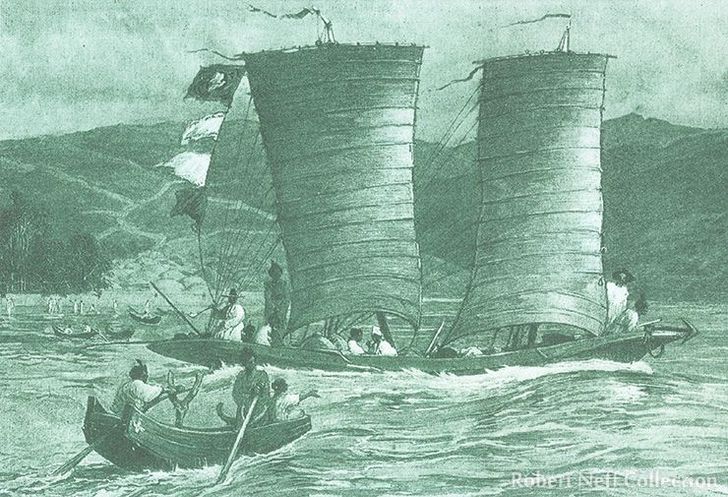
Korean tax collectors at Geomun-do, circa 1886
On November 14, 1885, Newell was granted an exclusive right to fish for pearl oysters along the entire coastline of Korea (with the exception of Jeju Island) for 20 years. It was also stipulated that pearl fishing operations had to begin within a year or the contract would be regarded as void and annulled. For this privilege the Korean government received 10 percent of the net profits.
In the early summer of 1886, a small schooner, aptly named The Pearl, and commanded by Captain C. H. Anderson and a small crew, sailed from San Francisco for Korea. The Pearl arrived in Fusan (Busan) in mid-July and took on supplies while Anderson plotted where he should begin pearl fishing.
Undoubtedly, Anderson was aware of the political situation in Korea regarding the British occupation of Geomun-do (see last week's articles) but he seems to have been rather naive in the manner in which a Korean official used him as a political weapon.
The Korean official suggested that the captain begin hunting pearls in Geomun-do ― a place that was famous for pearls. Maybe, to support his claim, he showed Anderson an article from The North China Herald that stated pearls were readily accessible in the island group. Anderson needed little persuading and within days set sail for the British garrison ― Port Hamilton.
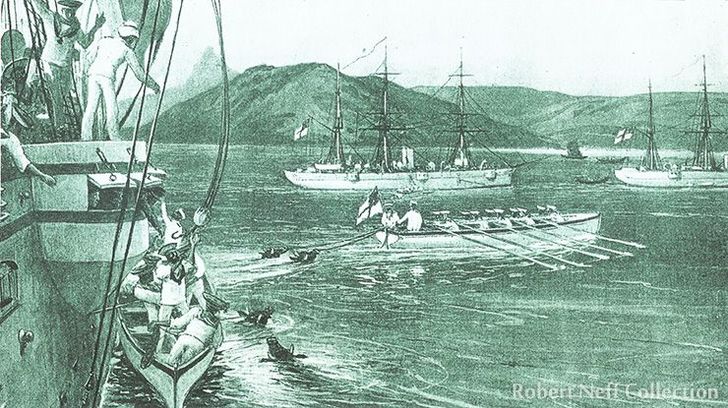
The British navy landing cattle on Geomun-do, circa 1886
On July 18, The Pearl arrived and found itself confronted by the British navy. The Pearl was allowed to anchor, with the instructions that Anderson was to report to the British flagship Audacious in the morning and present his credentials to Vice-Admiral Vesey Hamilton.
Anderson did as he was told and was somewhat shocked when he was instructed by the admiral that he would not be allowed to fish for pearls near Geomun-do. Anderson protested and showed the admiral his contract with the Korean government but the admiral replied:
“Port Hamilton belonged to England and not to Corea, and acting under instructions, [he] was obliged to refuse permission to fish in the harbor of Port Hamilton, or within the territorial limits, three miles around the place.”
Anderson responded that he did not believe Korea or the United States recognized the British occupation of the islands and demanded to lodge a formal complaint ― which was done. Afterward, Anderson returned to The Pearl fuming.
Eventually, a compromise was reached and the admiral agreed to allow the American to ascertain whether there were enough pearls in the vicinity to justify setting up operations or not. Apparently there weren't and Anderson sailed on to seek other fertile fishing grounds.
It soon became clear that the political instability of the country and the insufficient number of pearls made it unlikely the company could make a profit. The Pearl departed Fusan in early October for San Francisco ― it had been a costly failure for Newell but, as we shall see tomorrow, not a complete loss for Captain Anderson.