REVIEW 2018 Seoul Defense Dialogue: overall discourse about the Korean peninsula

Seoul Defense Dialogue (SDD 2018)
By Hwang Jae-ho
The seventh Seoul Defense Dialogue (SDD 2018) was held for three days from September 12-14. This year's SDD resulted in strong debate inside and outside the country, because since it took place right before the Pyongyang Inter-Korean Summit between president Moon Jae-in and Kim Jong-un on Sept. 18.
At the very first SDD, in 2012, there were only 167 participants from 15 countries and two international organizations; but it has steadily grown ― this year there were 800 participants from 52 countries and three international organizations.
Participating countries also have expanded from the Asia-Pacific region to Europe, the Middle East, and Africa. Compared to SDD 2012, the number of sessions has risen from three to eight.
At SDD 2018's “Sustainable Peace: From Conflict to Cooperation”, there were four plenary sessions: Ⅰ. Denuclearization of the Korean Peninsula and Establishment of a Peace Regime, Ⅱ. Strategic Balance in Northeast Asia: Cooperation and Confidence Building, Ⅲ. Maritime Security Cooperation: Challenges and Tasks, Ⅳ. Cyber Security: Strengthening Mutual Cooperation and four special sessions: Ⅰ. Defense Cooperation for Energy security, Ⅱ. Defense Cooperation for International Peacekeeping Activities, Ⅲ. Defense Cooperation for Prevention of Violent Extremism, Ⅳ. Defense Cooperation for Humanitarian Assistance and Disaster Relief.
Opening ceremony
Korean Minister of National Defense Song Young-moo delivered said in his opening remarks, “We are now standing oat the historical transitioning point where the world's last frontier of the Cold War, the Korean Peninsula, is ending the confrontation and moving toward to peaceful cooperation. Korea is not going to let this opportunity pass by us.”
In the keynote address, Korean Director of National Security Chung Eui-yong emphasized that peace was the President Moon government's goal. Therefore, it aimed to eliminate the threat of war from the Korean peninsula by accomplishing complete denuclearization and building a permanent peace regime.
He also said the Inter-Korean Summit (on Sep. 18) would be a big step following the DPRK-U.S. Summit, with both sides striving to reach consensus on building mutual military trust and ending the armed conflict.
Plenary Sessions
In plenary session 1, Seoul National University Professor Emeritus Yoon Young-kwan moderated the topic of denuclearization of the Korean peninsula and building a peace regime.
Korean Vice Minister of Unification Chun Hae-sung said that after the successful DPRK-U.S. Summit, the Korea peninsula was finally ready for denuclearization and a peace regime. Although the DPRK and the U.S. still had different views regarding the sequence of denuclearization and guaranteeing DPRK's political system, the development of inter-Korean relations would contribute on DPRK-U.S. relations as well.
The other presenter, RAND Corporation senior political scientist Andrew Scobell suggested Korea needed to establish its own model for denuclearization because of the difficulties of defining the denuclearization and because of different characteristics to previous cases.
Vice Minister of National Defense Suh Choo-suk pointed that both Koreas' leaders agreed on a steady decrease in military activity leading to military detente, and that trust building would be the core of bringing about permanent peace on the Korean peninsula.
He added that once Korea started its peace and prosperity era, not only Northeast Asia, but the world will soon reap the rewards.
Tsinghua University Vice Director of Institute of Contemporary International Relations Liu Jiangyong said the U.N. Security Council should reduce the sanctions on the DPRK because only engagement and communication would bring the DPRK to the denuclearization table.
On the other hand, Chancellor of Takushoku University Satoshi Morimoto argued that the sanctions and current defense preparedness must continue until the DPRK's military threats actually decreased.
Feodor Voytolovskiy, Director of the Primakov Institute of World Economy and International Relations (IMEMO) of the Russian Academy of Sciences, noted that international organizations and international society's political, financial, and technological aid would be significant in bringing about ultimate peace on the Korean peninsula.
And finally, Marcel Pesko, Director of the OSCE Conflict Prevention Centre, suggested that the Helsinki Process must be considered as a long-term project that could be applied to bring about Korean denuclearization.
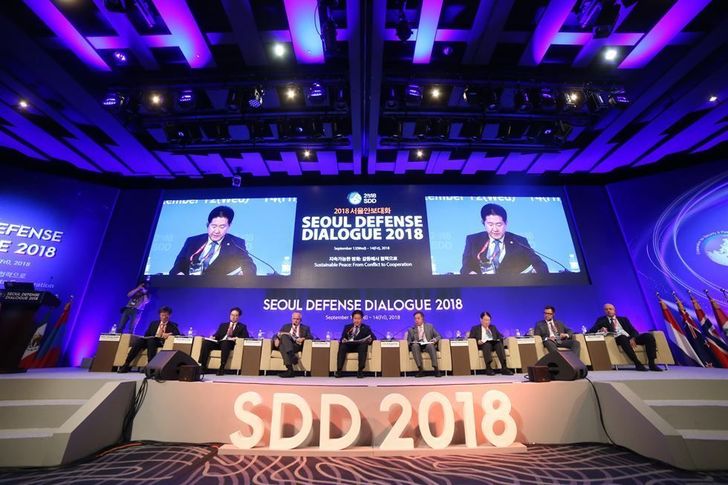
Seoul Defense Dialogue (SDD 2018)
Plenary session two was moderated by Canadian Global Affairs Institute Vice President Colin Robertson.
Kim Joon-hyung, a professor at Handong Global University said the international order was faltering and the China-U.S confrontation was getting serious; citing the tension on the Korean peninsula and in the Taiwan straits.
Abraham Denmark, Director of Asia Program at the Woodrow Wilson International Center for Scholars, said the China-U.S. confrontation would be a dilemma for Korea because Korea preferred positive relations with both. However, Korea must keep in mind that the ROK-U.S. alliance was far more important than anything else.
Zhang Tuosheng, Chairman of the Academic Committee of the China Foundation for International Strategic Studies, said ongoing conversation was needed to stabilize relations among the major powers, build international cooperation for Korean denuclearization and peace building, and to resolve maritime and territorial disputes to improve Northeast Asia's strategic balance.
Alexander Nikitin, Director of the Centre for Euro-Atlantic Security at the Moscow State Institute of International Relations, noted that even though Northeast Asia had to deal with multiple security challenges, unlike Europe, it did not have a representative regional institution or treaty for stabilization.
Professor Noboru Yamaguchi from the Japanese International University said China had to keep thinking about how to structure not only regional order but also at international level. It needed to consider how to lead the DPRK into international society as well as providing economic aid.
Randall Schriver, U.S. Assistant Secretary of Defense for Asian and Pacific Security Affairs of, stressed that there was no change in U.S. general policy on Asia and that the U.S. still focused on its traditional alliances.
He also said that trust building with China was one issue; however, managing the situation before it expanded into military conflict was more significant.
William Alberque, Director of NATO's WMD Arms Control, Disarmament, and Non-Proliferation Center, stressed that the bilateral effort was effective only when it came with a multilateral effort. He suggested there should be a practical working group for trust building at next year's SDD.
Plenary session three was moderated by Korea Institute for Maritime Strategy President Lee Seo-hang.
Yeo Suk-joo, Deputy Minister of Defense Policy at the Ministry of National Defense of Korea, highlighted the necessity of cooperation to make the most of the New-Southern Policy and also to bring about peace and prosperity in Asia. He also proposed an 'umbrella' system to manage maritime security.
Euan Graham, Director of the Lowy Institute's International Security Program, specifically analyzed several countries' situations as well as Korea's status as a strategic maritime location.
Pang Zhongying, Dean of the Institute of Marine Development Studies at China's Ocean University, explained China's One Belt One Road, China's maritime policies, and how maritime security based on science and technology would contribute to peace and prosperity.
Dang Quang Minh, Acting Director of Vietnam's Institute of Defense Strategic Studies, said universal cooperation and compliance with international law were necessary.
Canada's Deputy Minister of National Defense Jody Thomas said maritime security needed to be extended in various aspects; for instance, preserving marine life and resources.
Nicolas Regaud, France's Special Representative to the Indo-Pacific of the Directorate General for International Relations and Strategy, also mentioned the environmental perspective as well the importance of nations sharing humanitarian efforts and information.
The Cyber Security session, which Daniel Stauffacher, President of the ICT4 Peace Foundation, moderated, was a new and interesting area at the SDD.
Kwon Hyuk-jin, Director General of the Information Planning Bureau at Korea's Ministry of Defense, said now was the time where cyber military action was demanded, with both advanced detection and information sharing to prevent cyber attacks required.
Ewan Lawson, Senior Research Fellow from the Royal United Services Institute, strongly stressed that building a digital frame was urgent because the world was finding it difficult to understand each other's norms.
Moreover, Professor My Thai from Florida University introduced diverse examples of cyber security issues and pointed out that the higher technology dependency goes, the higher the risk. Lastly, Jun Osawa, Senior Research Fellow from the Nakasone Yasuhiro Peace Institute, focused on the need to develop a cyber security strategy to prevent surprise attacks from state and non-state belligerents.
Special Sessions
Continued, defense cooperation in various sectors was discussed at special sessions.
Kelly Magsamen, Vice President of National Security and International Policy at the Center for American Progress, moderated special session 1, which focused on energy security.
Pak Yong-duk, Managing Director of the Korea Energy Economy Institute, said international cooperation was needed to prevent terror attacks that endangered energy security.
Neil Melvin, Director of the Armed Conflict and Conflict Management Program at the Stockholm International Peace Research Institute said China's increased energy meant the Indian Ocean would be the main transport route. Therefore, the region needed to be secured through multilateral cooperation.
Huan Yunsong, Associate Dean of the School of International Studies at Sichuan University, said China considered energy security a public necessity, so it therefore would cooperate in ensuring energy security.
Prashanth Parameswaran, Senior Editor from The Diplomat, said energy security must be approached from all economic, diplomatic, and security aspects.
Special session 2, about PKO, was moderated by Professor Hong Kyu Dok from Sookmyung Women's University.
Professor Im Yoon-gab from Korea National Defense University, shared his overseas experience over the past 25 years and also explained the need for secured public opinions.
Markus Kaim, Senior Fellow from the German Institute for International and Security Affairs at Stiftung Wissenschaft und Politik of Germany, focused on how simple monitoring of PKO had transformed into a complex and multi-leveled operation, depending on international security circumstances.
Park Sung-ho from the PKO center, stressed the importance of quick reaction capability while Martin Sebastian, Head of Centre for Maritime Security and Diplomacy at the Maritime Institute of Malaysia, concentrated on Northeast and Southeast Asian countries' regional cooperation on PKO.
Yevgeny Ilyin, First Deputy Chief from the Russian Main Directorate for International Military Cooperation, asked for global understanding on how interests could conflict.
Suay Alpay, Turkey's Deputy Secretary of Defense, also emphasized the need to prevent disputes.
Next, Pascal Boniface, Director of the Institute Relations International Strategic, was moderator of special session 3.
Jang Ji-hyang, Director of the Middle East and North Africa Center at the Asan Institute for Policy Studies, and Charithie Joaquin, from the Research and Special Studies Division at the National Defense College of the Philippines, both emphasized the significance of prevention and response to violent extremism and pointed how governments were facing difficulties in dealing with extremists' rapidly changing tactics.
Muhammad Rifqi Muna, Senior Researcher at the Indonesian Institute of Science Center for Political Studies, was concerned about violent extremist groups' being able to breach cyber security, and their use of SNS to recruit members.
EU Ambassador to Korea Michael Reiterer said that understanding what motivated extremists was the key to understanding and countering terrorism.
Rakesh Bhadauria, Distinguished Fellow at the United Service Institution, moderated special session four, which Associate Research Fellow Liu Shu from China's Academy of Military Science presented.
David Capie, Director of the Center for Strategic Studies at Victoria University of Wellington particularly mentioned military's HADR within the climate change.
Alexander Neill, Senior Fellow at the International Institute for Strategic Studies, Swedish Ambassador Jakob Hallgren, and Sarmiento Beltran, Deputy Secretary of Mexico Navy all strongly supported the need for international strategic cooperation for HADR, and the appropriate response to recipient countries and regional demands.
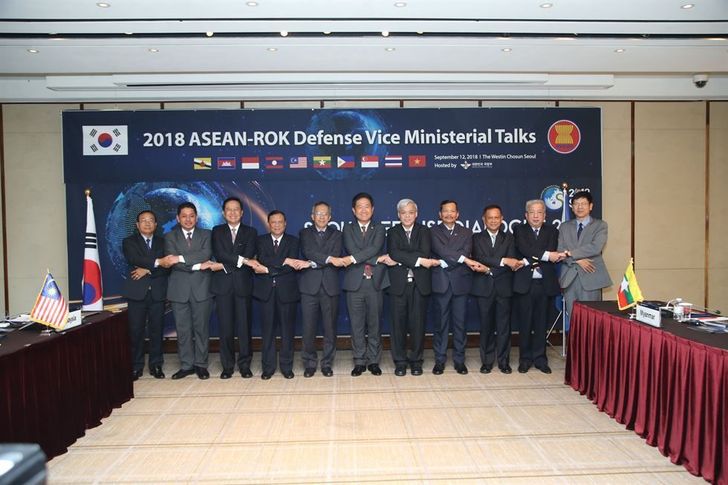
Seoul Defense Dialogue (SDD 2018)
Concluding Remarks
Seoul Defense Dialogue 2018 enabled us to think deeply about Korea's geopolitical destiny resulting from its division and conflict for the last 70 years. Korea persistently tries to find domestic and international connections to build a peace regime and accomplish denuclearization. The great journey toward peace on the Korean peninsula ― a step toward global peace and security ― is on the move, and the Seoul Defense Dialogue is part of this.
Hwang Jae-ho is director of the Global Security Cooperation Center, Hankuk University of Foreign Studies, Seoul. Ko Sung-hwah, a researcher at the center, assisted Professor Hwang with the article.